- Product Details
Continuous High-Speed Laser Marking for Automated Production Lines
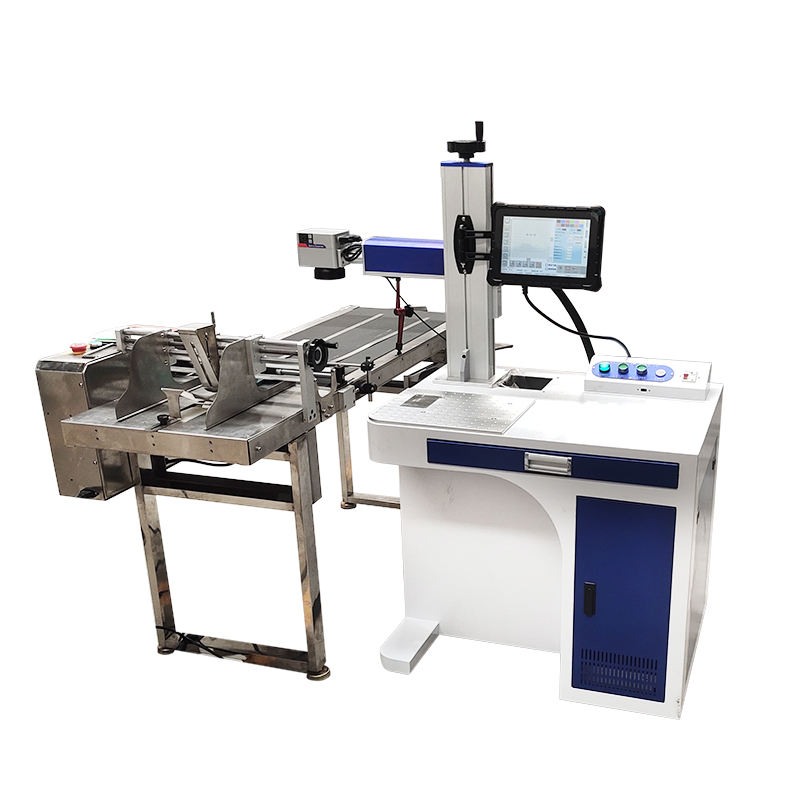
The flying fiber laser marking machine is designed for continuous, high-speed marking in automated production environments where stopping the conveyor is not acceptable.
In traditional marking systems, each product must stop for positioning and marking, which creates a bottleneck in high-speed production lines. As production speed increases, this stop-and-go process becomes inefficient and limits overall throughput.
The flying marking system eliminates this limitation by performing marking while the product is moving. It synchronizes the laser output with the conveyor motion in real time, allowing uninterrupted production flow.
This makes it particularly suitable for industries such as packaging, labeling, and standardized component manufacturing, where large volumes of products must be processed continuously.
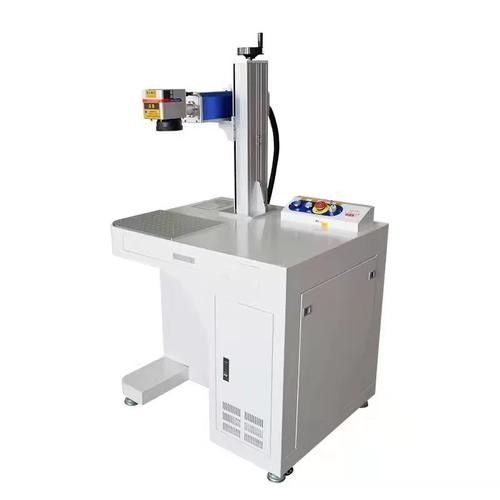
Flying Fiber Laser Marking Machine
Core Working Principle
The flying marking system operates based on real-time motion synchronization rather than static positioning.
The conveyor is driven by a variable frequency motor, allowing speed adjustment according to production requirements. The typical working range can be adjusted from low speed up to high-speed operation, depending on the application.
An encoder is installed on the conveyor system to continuously measure the actual movement speed and displacement. This data is transmitted to the control system in real time.
At the same time, a photoelectric sensor detects when a product enters the marking zone. Once the product reaches the trigger position, the sensor sends a signal to initiate marking.
The control system combines encoder feedback and sensor input to calculate the exact position of the moving product. The galvanometer then adjusts the laser trajectory dynamically so that the marking is “written” onto the product while it is still in motion.
This requires precise coordination between motion speed, laser timing, and scanning path. Any mismatch would result in distortion or misalignment, which is why system stability and calibration are critical.
Conveyor Speed and Production Matching
One of the key parameters of a flying marking system is conveyor speed.
The system typically supports adjustable speeds through a frequency converter, allowing operators to match the marking system with the production line speed.
As the conveyor speed increases, the marking process must also accelerate accordingly. This means higher laser power and optimized parameters are required to maintain marking clarity at higher speeds.
The encoder ensures that even when the speed changes, the marking position remains synchronized. Without encoder feedback, it would be impossible to maintain accuracy in a moving system.
In practical applications, there is always a balance between speed and marking quality. Extremely high speeds may reduce marking depth or contrast if not properly configured.
Product Positioning Requirements
Unlike vision-based systems, flying marking relies on consistent product positioning.
Products must follow a fixed path on the conveyor, typically guided by a side plate or mechanical alignment structure. This ensures that each product passes through the marking zone in a predictable position.
The system does not correct for rotation or random placement. If a product is tilted or misaligned, the marking result will also be offset.
For this reason, flying marking is best suited for products with regular shapes such as square, rectangular, or cylindrical items that can be guided consistently.
Sensor Triggering and Timing Control
The sensor plays a critical role in determining when marking begins.
When a product reaches the detection point, the sensor triggers the marking signal. The system then calculates the delay time and marking position based on conveyor speed and distance between the sensor and marking field.
This timing must be precisely calibrated. If the delay is incorrect, the marking may appear too early or too late on the product.
In high-speed production, even small timing errors can accumulate, so proper system setup and testing are essential.
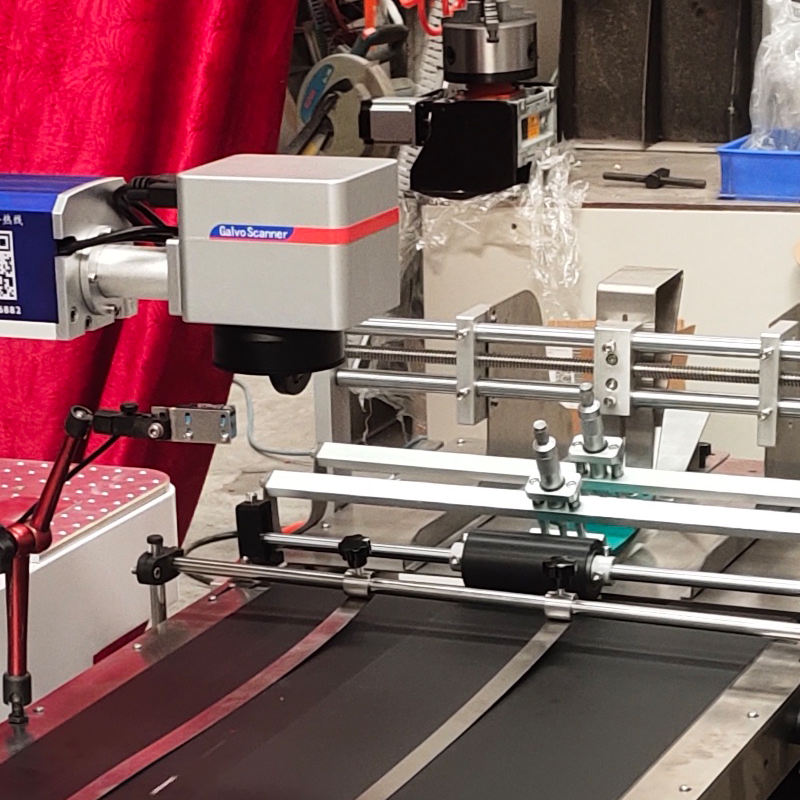
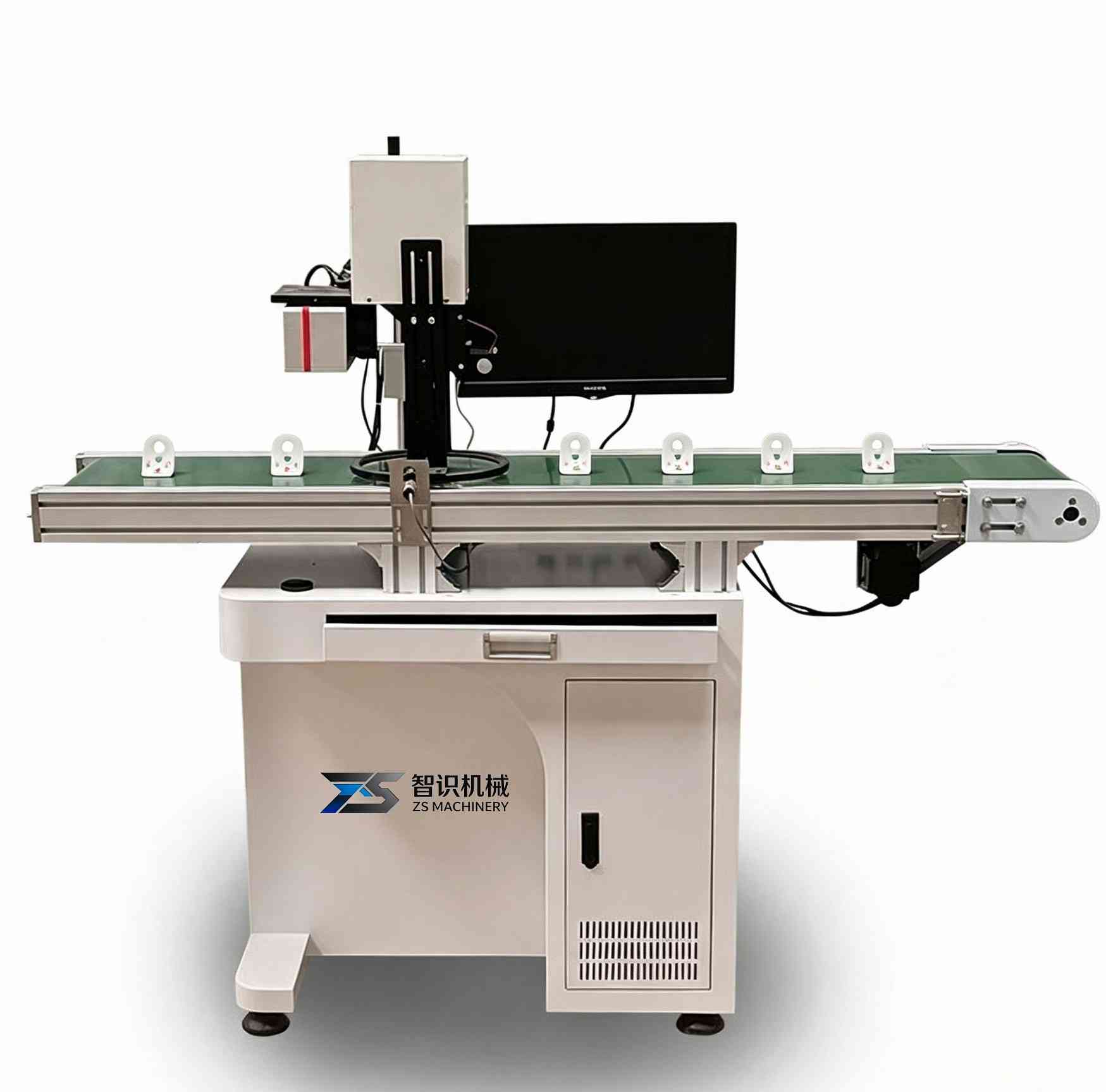
Flying Marking Machine Conveyor Belt
Key Advantages in Production
Continuous Operation Without Interruption
The most significant advantage is that the conveyor does not need to stop. This eliminates idle time between products and allows maximum utilization of the production line.
High Throughput Capability
Because marking is performed during movement, the system can handle large volumes of products efficiently, making it suitable for mass production.
Integration with Existing Production Lines
The system can be directly integrated into packaging or assembly lines without major structural changes, making it easy to upgrade existing production processes.
Stable Operation for Standardized Products
For products with consistent size and shape, the system provides stable and repeatable marking performance.
Power Selection and Performance
The system is available in 30W, 50W, and 100W configurations.
30W is suitable for low-speed lines and basic surface marking.
50W is commonly used for medium-speed production, offering a balance between marking speed and quality.
100W is recommended for high-speed lines where short marking time is required, or when deeper engraving is needed on moving products.
In flying marking applications, higher power is often preferred because it allows sufficient marking energy within a shorter interaction time.
Typical Application Scenarios
Flying laser marking is widely used in industries where products move continuously along a conveyor.
In the packaging industry, it is used for marking dates, batch numbers, and product codes on boxes, labels, or metal packaging components.
In standardized manufacturing environments, such as fasteners or small metal parts, the system enables high-speed identification marking without interrupting production.
It is also suitable for applications where the production line speed is fixed and cannot be slowed down for marking operations.
Limitations and Considerations
While flying marking offers high speed, it comes with certain limitations.
The system requires consistent product positioning and is not suitable for randomly placed or irregularly shaped items.
Marking accuracy depends on synchronization quality, so installation and calibration must be handled carefully.
At very high speeds, marking depth and contrast may decrease if parameters are not properly optimized.
Compared to vision systems, flexibility is lower, but efficiency is significantly higher.
Hybrid Solution: Combining Vision Positioning with Flying Marking
In practical production environments, some applications require both flexibility and high-speed processing. In such cases, vision positioning and flying marking can be integrated into a single system.
This hybrid approach combines the strengths of both technologies. The vision system is used to detect product position and orientation, while the flying marking system performs marking without stopping the conveyor.
In this configuration, the camera first captures the product’s position and calculates its offset. Instead of stopping the conveyor, the system dynamically adjusts the laser path in real time based on both the vision data and encoder feedback.
This allows the machine to mark products that are not perfectly aligned while still maintaining continuous movement.
Advantages of the Combined System
The integration of vision and flying technologies provides several important benefits in complex production environments.
It allows a certain degree of positional deviation or angular variation in product placement, reducing the strict requirements for mechanical alignment.
At the same time, it maintains high production speed because the conveyor does not need to stop for marking.
This is particularly useful in production lines where products are not perfectly positioned but high throughput is still required.
Solution-Oriented Approach
For customers with complex production conditions, we recommend evaluating whether a hybrid solution is necessary based on actual product placement and line speed.
We can analyze your production workflow and provide a tailored configuration that balances accuracy, speed, and system complexity.
Sample testing is available to verify the feasibility of combined vision and flying marking under real operating conditions.
Get a Quote and Production Optimization
If your production line requires continuous marking without stopping, selecting a properly configured flying laser marking system is essential for maintaining both speed and quality.
We can analyze your conveyor speed, product spacing, and marking requirements to recommend a suitable configuration, including laser power and synchronization setup.
Sample testing is available to verify marking clarity under real production conditions.
Contact us to optimize your marking process and improve overall production efficiency.