How to Achieve Black Laser Marking on Anodized Aluminum? Process Principles and Parameter Guide
In consumer electronics, 3C products, automotive components, and high-end industrial manufacturing, anodized aluminum has become one of the most commonly used metal materials. Whether it is laptop housings, mobile phone frames, industrial nameplates, or decorative parts, anodizing processes are widely used.

On these products, we often see a very premium black laser marking effect, which usually features:

  • Deep and delicate black logos
  • Sharp and clear text
  • Almost no visible surface indentation
  • No fading or wear
  • A strong high-end appearance

The process used to achieve these effects is commonly called:Black Marking on Anodized Aluminum

Many customers are confused when they first encounter this process:

Why can ordinary fiber lasers only produce “white” marks, while some machines can create extremely deep black marks on anodized aluminum?

In fact, black marking on anodized aluminum is not simply achieved by increasing laser power. It is a typical “laser parameter control process.”

Today, we will explain in detail how to achieve stable and high-quality black marking on anodized aluminum from three aspects: material characteristics, laser principles, and practical parameters.

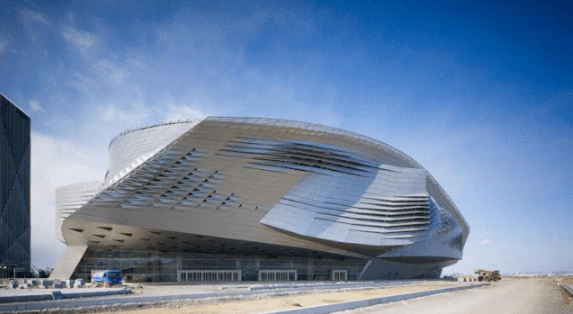
Applications of anodized aluminum in the construction industry

Applications of anodized aluminum in the construction industry

What Is Anodized Aluminum?

Anodized aluminum refers to aluminum that has formed an oxide layer on its surface through an electrochemical oxidation process. This oxide layer not only improves the material’s corrosion resistance, wear resistance, insulation, and weather resistance, but also gives the material:

  • A matte metallic texture
  • Rich color appearance
  • A more premium visual effect

Therefore, anodized aluminum is widely used in:

  • Mobile phone housings
  • Laptop computers
  • Tablet devices
  • High-end electronic products
  • Architectural decorative materials
  • Industrial nameplates

Why Is Anodized Aluminum Suitable for Black Laser Marking?

Ordinary metal laser marking usually creates marks through:

  • Material ablation
  • Oxidation discoloration
  • Melting and evaporation

However, anodized aluminum is different.

Its surface naturally contains a special porous oxide layer that is highly sensitive to laser energy. Under suitable parameters, the laser does not significantly damage the oxide layer. Instead, it changes the microscopic structure of the surface, increasing the material’s light absorption ability and creating a “visual black” effect.

Simply put:

Black marking on anodized aluminum is not created by “burning it black,” but by changing the nanostructure of the surface to make it absorb more light.

Therefore:

High-quality black marking on anodized aluminum is essentially a physical processing method rather than aggressive material ablation.

Factors Affecting Black Marking on Anodized Aluminum

1. Effect of Q Frequency on Black Marking

Q frequency (KHz) refers to the number of laser pulses emitted per second. For example, 20KHz means the laser outputs 20,000 pulses per second.

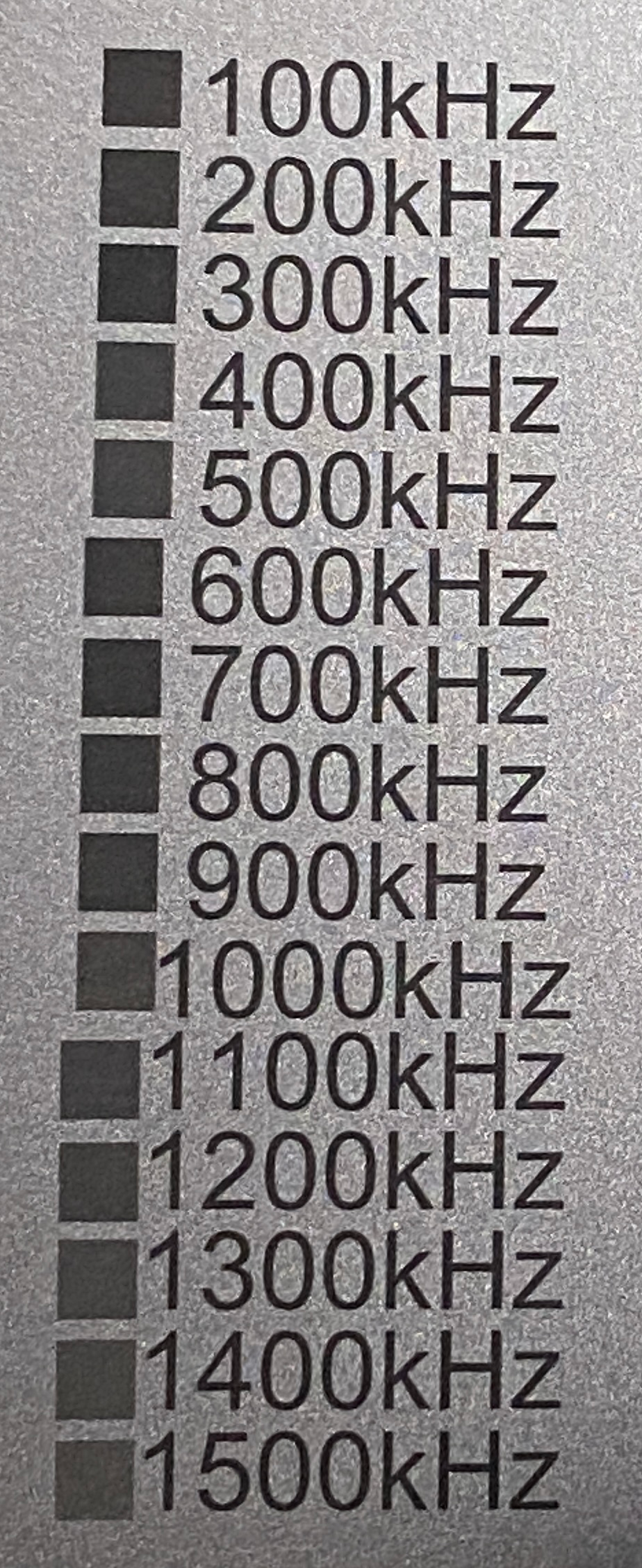
Different Q frequencies were tested to achieve the darkest possible effect (therefore other parameters were slightly adjusted), as shown in the figure below:

Blackening effect of anode aluminum at different Q frequencies

Blackening effect of anode aluminum at different Q frequencies

From the results, it can be seen that frequencies between 100 and 900KHz produced better effects.

In practical applications, a Q frequency range of 200–800KHz is generally recommended to achieve better marking results.

2. Effect of Pulse Width on Black Marking

Pulse width is one of the most critical parameters for black marking on anodized aluminum.

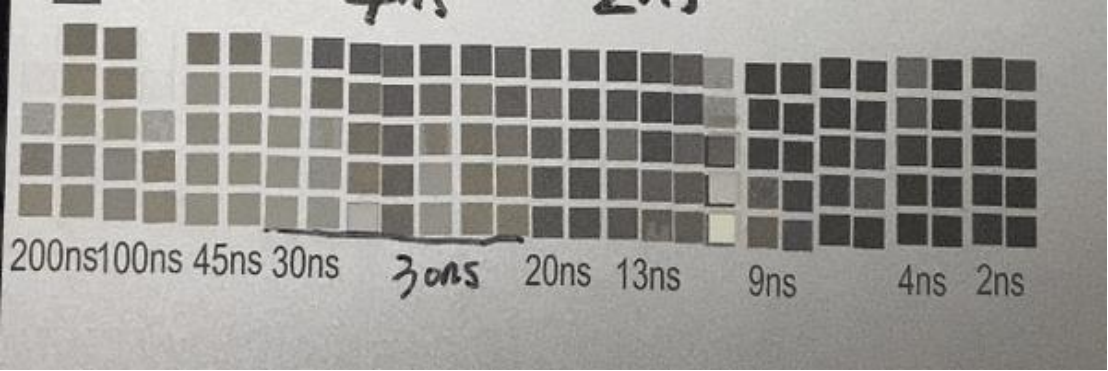
Different pulse widths were used for multiple black marking tests on anodized aluminum, as shown below:

Effects of different pulse widths on blackening of anode aluminum

Effects of different pulse widths on blackening of anode aluminum

From the results, it can be seen that the effect improves as the pulse width becomes narrower.

Wide pulse widths, especially 200ns and 100ns, can easily damage the surface oxide layer, causing the marking to appear white when viewed from different angles.

In contrast, narrow pulse widths, especially 4ns and 2ns, produce black and delicate results, achieving the ideal marking effect.

3. How Does Marking Speed Affect Black Marking?

Marking speed refers to the movement speed of the galvanometer during marking.

When the marking speed is slower:

  • The engraved lines become finer
  • The marking becomes denser
  • The engraving gains more depth

When the marking speed is faster:

  • The engraved lines become less refined
  • The marking appears sparse
  • The depth decreases

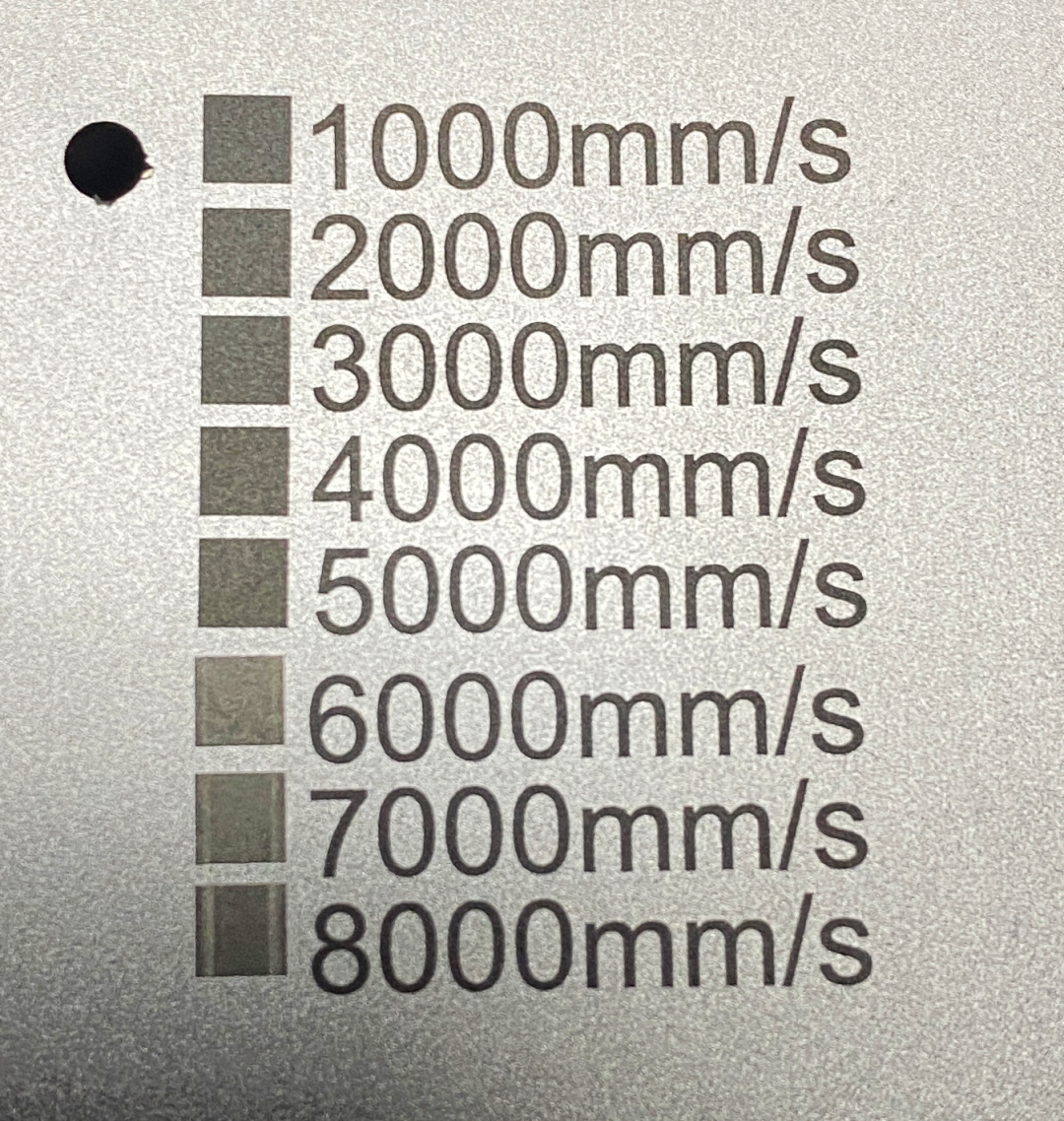
The effects produced by different marking speeds are shown below:

The effect of different speeds on blackening of anode aluminum

The effect of different speeds on blackening of anode aluminum

It can be seen that speeds between 1000 and 5000 produce black, uniform, and delicate results.

At speeds between 6000 and 8000, the marking tends to become gray and uneven.

4. Effect of Fill Density

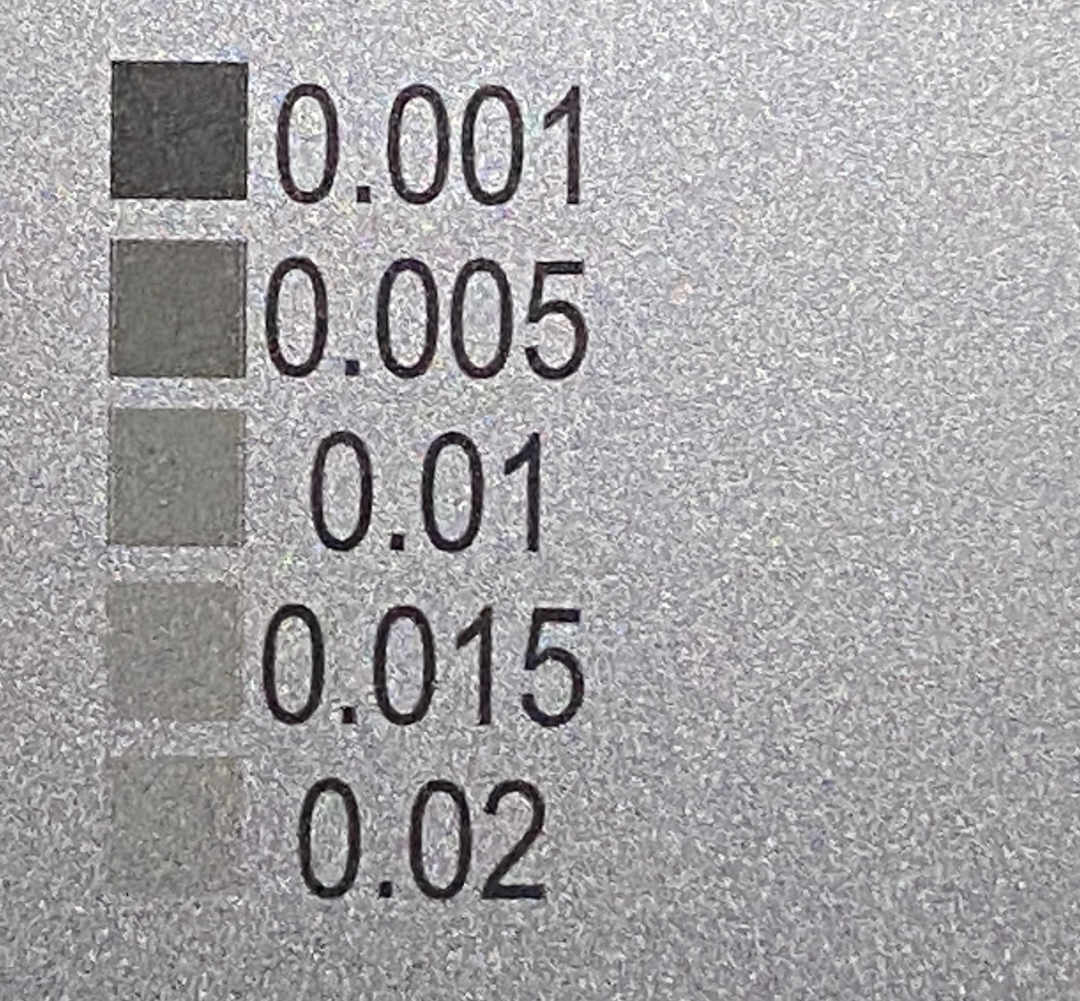
Many customers overlook the importance of fill density (Hatch Spacing).In reality, it has a very significant influence on the darkness of the marking.The effects produced using different fill densities for black marking on anodized aluminum are shown below:

Marking effect of different filler densities

Marking effect of different filler densities

From the results, it can be seen that denser filling provides:

  • More uniform laser coverage
  • More complete nanostructure formation
  • Stronger light absorption effects

Therefore:

Higher fill density usually means a deeper black color.

However:

  • Processing time increases
  • Heat accumulation becomes stronger

So it is necessary to find a balance between:

  • Blackness
  • Efficiency
  • Thermal effects

Recommended Parameters for Black Marking on Anodized Aluminum (Reference)

Different materials, colors, and oxide layer thicknesses will affect the final result.

However, based on extensive testing experience, the following parameters can generally be used as a reference:

Parameter Recommended Range
Marking Speed (mm/s) 1000–5000
Fill Density (mm) 0.0005–0.01
Q Frequency 200–800KHz
Power Percentage 40%–90%
Pulse Width 2–4ns
Laser Type MOPA Fiber Laser
Lens F160 / F245
Processing Efficiency 0.1–0.4s/mm²

Contact ZS Machinery for Anodized Aluminum Black Marking Today

Achieving high-quality black marking on anodized aluminum requires more than just a laser machine. It depends on the right laser source, stable parameter control, practical process experience, and application understanding.

At ZS Machinery, we specialize in MOPA fiber laser marking solutions for anodized aluminum, stainless steel color marking, titanium color engraving, and other precision metal marking applications. Based on different anodized colors, oxide layer thicknesses, and production requirements, we can help customers optimize laser parameters to achieve darker, finer, and more consistent marking results.

Our laser marking systems are widely used in:

  • Consumer electronics
  • Aluminum product manufacturing
  • Automotive parts
  • Industrial nameplates
  • High-end decorative products

Whether you need deep black marking, high-speed production, or customized laser solutions, ZS Machinery can provide professional technical support and suitable machine configurations for your application.

Contact ZS Machinery today to get:

  • Free marking samples
  • Technical consultation
  • Parameter recommendations
  • Customized laser marking solutions for anodized aluminum applications.

Related Posts