UV LED Curing Explained: Technology, Systems, and Industrial Applications
What is UV Curing?
UV curing is a photochemical process in which liquid materials—such as inks, coatings, or adhesives—are instantly transformed into a solid state using ultraviolet (UV) light as the energy source. In simple terms:
UV material + UV energy = instant solidification
When exposed to UV radiation, photoinitiators inside the formulation absorb energy and trigger polymerization (cross-linking reactions), converting liquid resins into durable solid films within seconds. This is fundamentally different from traditional drying, which relies on heat and evaporation.
Because of its speed, precision, and environmental advantages, UV LED curing has become a core technology in modern printing, electronics, packaging, and coating industries.
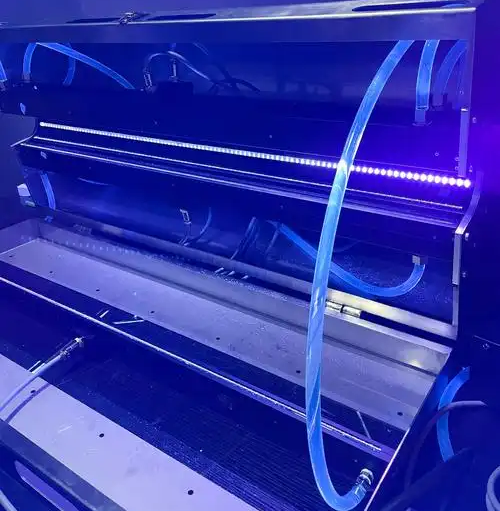
UV LED curing
UV Spectrum and Wavelength Fundamentals
Ultraviolet light is part of the electromagnetic spectrum with wavelengths ranging from 10 nm to 400 nm, shorter than visible light. Different UV bands determine curing depth and performance:
UVA (320–400 nm): Deep penetration, commonly used for inks, coatings, adhesives
UVB (280–320 nm): Medium penetration, improves mechanical strength
UVC (100–280 nm): Strong surface curing, limited penetration, often used for sterilization
UVV (395–455 nm): Near-visible UV, used in LED curing for deeper layers and pigmented systems
In industrial curing, UVA and near-UV (365–405 nm) are the most widely used ranges—especially in UV LED curing systems.
UV LED vs Traditional UV Curing (Mercury Lamps)
Traditional Mercury UV Lamps
Conventional UV curing systems use mercury vapor lamps that emit broad-spectrum UV light (including infrared and visible wavelengths).
Advantages:
Wide spectral output compatible with many photoinitiators
Mature and relatively low-cost technology
Limitations:
High heat generation (can damage heat-sensitive materials)
Requires warm-up time
Shorter lifespan
Produces ozone and requires ventilation
Higher energy consumption
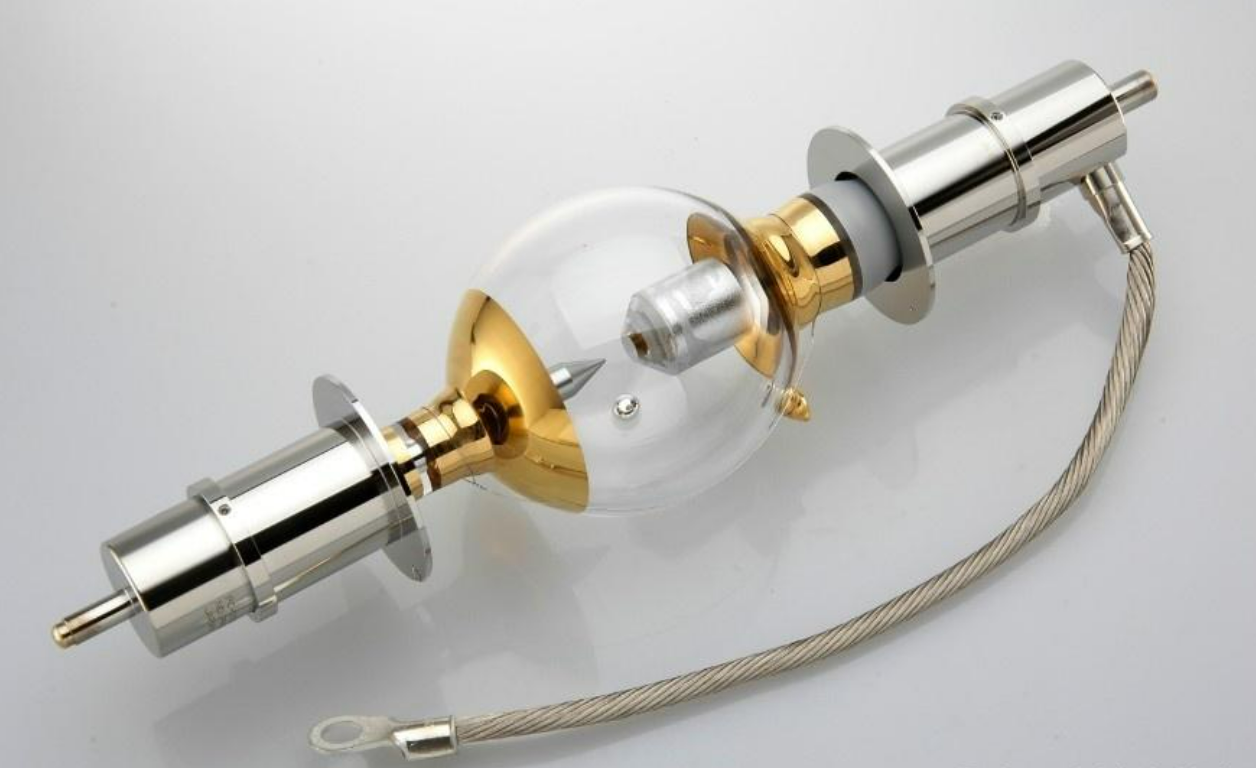
Traditional mercury lamp
UV LED Curing Technology (Modern Standard)
UV LED curing uses semiconductor-based light sources that emit narrow-spectrum UV light, typically at 365 nm, 385 nm, 395 nm, or 405 nm.
Key Advantages:
Instant on/off (no warm-up time)
Much lower energy consumption (typically 10–20% of traditional systems)
Long lifespan (20,000–30,000 hours)
Minimal heat output (“cold curing”)
No ozone emission, environmentally friendly
Compact system design
Consideration:
Requires wavelength-matched photoinitiator formulations
Higher initial equipment cost
In today’s industrial environment, UV LED curing is rapidly replacing mercury lamps, especially in applications involving plastics, electronics, and digital printing.
How UV Curing Works (Chemical Mechanism)
The curing process is driven by photoinitiators, which absorb UV energy and generate reactive species:
Free radicals (radical curing systems)
Cations (cationic curing systems)
These reactive species initiate:
Polymerization
Cross-linking
Grafting reactions
This chain reaction transforms liquid monomers and oligomers into a solid, high-performance polymer network within seconds.
UV Curing System Components
A complete UV curing system is not just a lamp—it is an integrated engineering solution combining optics, thermal management, and control systems.Core Components:
1.UV Light Source
Mercury lamp or UV LED module
Determines wavelength and curing efficiency
2.Reflector System
High-reflectivity aluminum surfaces
Focuses and evenly distributes UV energy onto the substrate
3.Power Supply / Driver
Mercury: high-voltage ballast
LED: constant-current driver for stable output
4.Cooling System
Air cooling (standard)
Water cooling (high-power LED systems)
Critical for maintaining performance and lifespan
5.Shielding & Safety System
Prevents UV leakage
Includes interlocks and protective housing
6.Conveyor / Motion System
Controls exposure time via speed
Directly affects curing energy (dose = intensity × time)
UV Curing vs Thermal Drying
Although both methods convert liquid materials into solids, their mechanisms and performance differ significantly.
UV Curing:
Curing time: 0.1–10 seconds
Energy consumption: low (10–20% of heat drying)
Process: photochemical reaction
Production: compact, high-speed
Thermal Drying:
Curing time: minutes to hours
Energy consumption: high
Process: heat evaporation and chemical curing
Requires long drying tunnels
By comparison, we can draw the following conclusions,UV curing is ideal for high-speed, high-efficiency manufacturing, while thermal drying remains useful for thick coatings or special materials.
Key Advantages of UV LED Curing
UV LED curing is widely adopted because it delivers both performance and sustainability:
Ultra-fast curing → ideal for automated production lines
Energy efficiency → significantly reduced operating costs
Superior coating performance → high hardness, chemical resistance
Low thermal impact → safe for plastics, films, electronics
Eco-friendly → no VOCs, no ozone
Compact integration → suitable for modern digital equipment
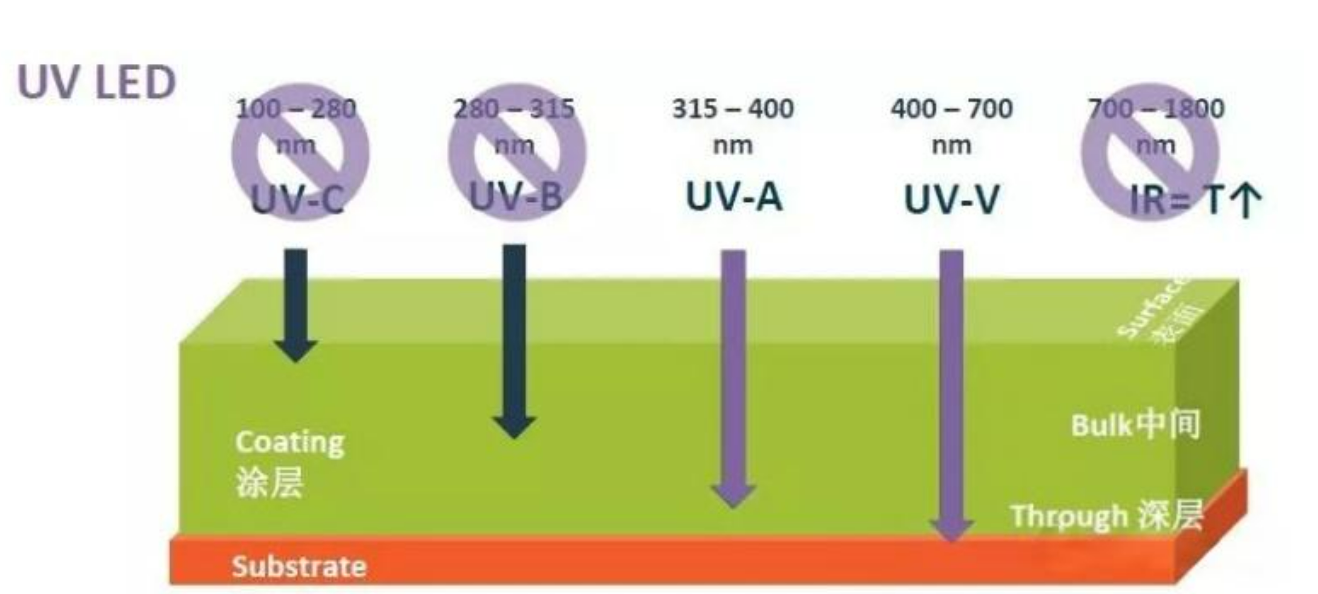
UV LED wavelength
Limitations of UV Curing
Despite its advantages, UV curing has some constraints:
Limited penetration depth for thick coatings
Requires specialized UV-compatible formulations
Higher upfront equipment investment
These limitations are typically addressed through system design and material optimization.
Industrial Applications of UV LED Curing
Printing Industry
UV curing is widely used in:
Packaging printing (boxes, labels, flexible films)
Commercial printing (magazines, brochures)
Plastic card printing (ID cards, bank cards)
It enables instant drying, vibrant colors, and high-speed production.
Coating & Surface Finishing
Applications include:
Wood coatings (furniture, flooring)
Automotive parts (interior plastics, wheels)
3D printed parts post-processing
UV curing delivers hard, scratch-resistant, and durable surfaces.
Electronics Manufacturing
Used for:
PCB solder mask curing
Display panel bonding (LCD/OLED)
Component encapsulation
It ensures precision, insulation performance, and reliability.
Adhesives & Bonding
UV adhesives are used in:
Flexible packaging lamination
Optical bonding (touch screens)
Structural bonding in electronics
They provide fast curing, strong adhesion, and clean processing.
Medical Industry
Applications include:
Medical device assembly
Dental resin curing
Sterile packaging
UV curing supports high hygiene standards and precision manufacturing.
Construction & Decorative Materials
Used in:
Glass decoration and coatings
Flooring adhesives
Decorative panels
It improves durability, appearance, and production efficiency.
Why UV LED Curing Matters for Modern Manufacturing
As industries shift toward automation, customization, and sustainability, UV LED curing has become a key enabling technology.
Compared to traditional processes, it offers:
Faster production cycles
Lower energy consumption
Cleaner environmental footprint
Higher product quality
For manufacturers, adopting UV curing systems—especially UV LED curing technology—is no longer just an upgrade, but a strategic move toward efficient and future-ready production.
UV curing, particularly UV LED curing, represents a major advancement in industrial processing technology. By combining photochemistry, precision engineering, and energy efficiency, it enables instant solidification, superior material performance, and scalable production.
Whether in printing, electronics, coatings, or packaging, UV curing continues to expand its role as a core technology in modern manufacturing systems.
If you are exploring UV printing, coating, or marking solutions, understanding UV curing is the first step toward building a high-performance and competitive production line.
Is UV Laser Marking Really “Universal”? A Deeper Look at UV Laser Marking Technology