Aluminum and Plastic Laser Etching: Processing Challenges and Equipment Selection Guide
As industrial manufacturing continues to demand higher standards for product identification, precision processing, and surface finishing.Laser etching has become a very important technology in both metal and plastic processing industries. Its basic principle is to focus a small-power laser with high beam quality (usually UV laser or fiber laser) onto an extremely small spot, generating high power density at the focal point to instantly vaporize the material and create holes, grooves, channels, and other micro-scale structures. It is widely used in laser micro/nano cutting, engraving, etching, drilling, and other precision processes.
Today, ZS Machinery will systematically explain from a practical processing perspective:
Processing challenges of aluminum and plastic
What type of laser should be selected for each material
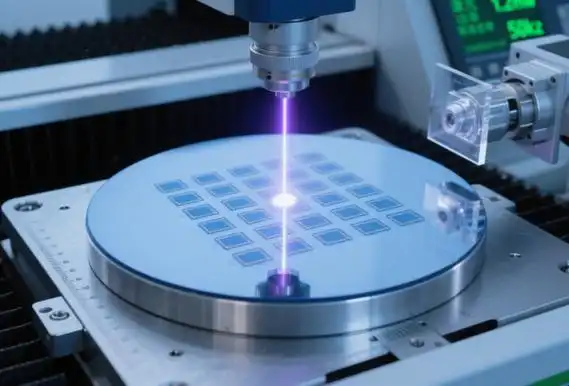
Laser etching process
Processing Challenges of Aluminum and Plastic
Laser etching can be applied to a wide range of materials, including both metals and non-metals. Aluminum and plastic are discussed separately because they are among the most difficult materials to process and also the most likely to encounter processing problems. Let’s take a closer look at the reasons behind this.
Processing Challenges of Laser Etching Aluminum
Aluminum is currently one of the most widely used metals in industry and is extensively applied in consumer electronics, automotive parts, industrial equipment, nameplates, and structural components. However, aluminum itself has one very typical characteristic: high reflectivity.
Materials such as aluminum and aluminum alloys strongly reflect laser energy. Unlike stainless steel, which absorbs laser energy efficiently, aluminum processing can easily encounter the following problems if the parameters are incorrect or if the laser power is insufficient:
Insufficient energy absorption
Light marking color
Uneven engraving depth
Rough edges
Low efficiency
Poor processing stability
Especially with ordinary continuous fiber lasers, highly reflective aluminum may sometimes produce a situation where “the marking appears visible during processing, but becomes unclear after wiping.”
In addition, aluminum conducts heat extremely quickly. As soon as the laser concentrates heat in one area, the heat rapidly diffuses away. Therefore, achieving deep engraving, deep etching, or high-contrast black marking is actually not easy.
Processing Challenges of Laser Etching Plastic
Compared with aluminum, the biggest challenge with plastics is not that they are difficult to process, but that they are too easily damaged by heat. Since there are many types of plastics, different materials have huge differences in laser absorption and heat resistance. For example:
Hard engineering plastics such as ABS, PC, and PA have relatively good heat resistance
Soft plastics such as TPU, TPE, and silicone are highly heat-sensitive
Acrylic (PMMA) has extremely strong absorption for CO2 lasers
This leads to a very practical issue: the same laser machine may produce completely different results on different plastics.
For this reason, laser etching plastic may appear simple, but in reality it relies more heavily on processing experience and parameter control than many metal applications.If you want to know more about UV Laser,you can refer to UV Laser Engraver vs UV Laser Marking vs UV Laser Etching
After understanding the processing challenges of these two materials, let’s now look at:what laser to choose for these two material.
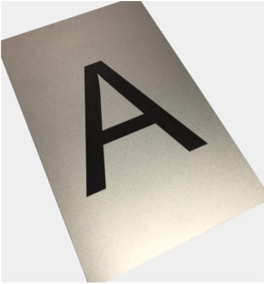
MOPA Laser Marking On Aluminium
What Laser Should Be Chosen for Laser Etching Aluminum and Plastic?
What Laser Is Suitable for Aluminum?
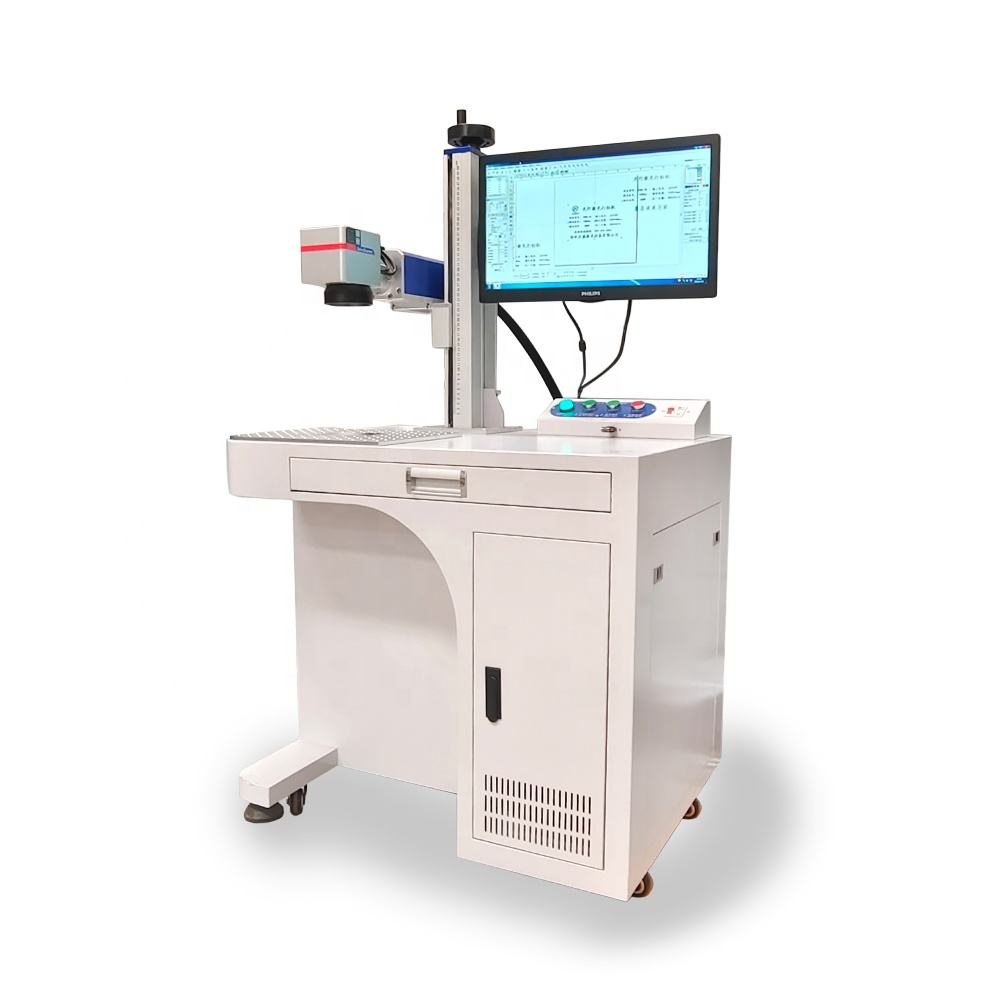
For laser etching aluminum, the most mainstream solution in the industry is still the fiber laser. Since aluminum is a metal material, it has relatively good absorption at the 1064nm wavelength, especially after surface oxidation, where the laser absorption rate increases further. In particular, the widely used MOPA fiber laser has very obvious advantages in aluminum processing.
Although ordinary fiber lasers can also process aluminum, their parameter adjustment range is limited, and in many cases they can only achieve “white marking” or shallow engraving. MOPA lasers, however, can adjust pulse width and frequency, allowing much more precise control of heat input. Therefore, they deliver significantly better results in applications such as black marking on anodized aluminum, color marking on stainless steel, and precision etching on aluminum.
If you would like to learn more about aluminum etching, you can click:How to Achieve Black Laser Marking on Anodized Aluminum? Process Principles and Parameter Guide
What Laser Is Suitable for Plastic?
The situation with plastics is much more complicated than aluminum because “plastic” itself is only a general term. Different plastics vary greatly from one another. Some plastics have excellent heat resistance, while others are extremely heat-sensitive. Therefore, when performing plastic laser etching, the following factors must be carefully considered:
Heat affected zone
Yellowing
Burning
Melting
Rough edges
Odor generation
For hard engineering plastics such as ABS, PC, PA, and PP, their relatively good heat resistance means that fiber lasers can often be used directly for processing.
However, for soft plastics such as TPU, TPE, silicone, PVC tubing, and flexible packaging materials, the situation is completely different.These materials are highly heat-sensitive. If ordinary fiber lasers are used, problems such as the following can easily occur:
Burned edges
Material curling
Yellowing
Melting
Strong odor
Therefore, for soft plastics, UV lasers are usually recommended in the industry. UV lasers belong to the “cold processing” category. They have shorter wavelengths, smaller focused spots, and extremely low thermal impact on materials.
Acrylic (PMMA) is a very typical special case.
Although it is also a plastic, it has extremely high absorption for CO2 lasers (10.6μm wavelength). Therefore, the most common acrylic processing equipment in the industry is actually the CO2 laser.
How to Choose Laser Power
ZS Machinery has extensive experience in laser etching for both aluminum and plastic materials. Based on our practical experience supplying machines to customers, we recommend the following solutions:
For aluminum laser etching, especially applications such as black marking on anodized aluminum, deep logo engraving, and fine texture processing, we usually recommend starting with at least a 50W MOPA fiber laser. This is because aluminum itself has high reflectivity, while many high-end applications also require more stable energy control and finer heat input. Compared with ordinary low-power equipment, 50W MOPA not only offers faster processing speed, but also provides more stable black marking results and stronger deep engraving capability, making it more suitable for long-term industrial use.
For common hard plastics such as ABS, PC, PA, and PP, a 30W fiber laser is usually already a very cost-effective choice. Since plastic processing itself does not require extremely high power, a 30W entry-level machine is already sufficient for most applications. You can click here to learn why 30W is more recommended than other power options.
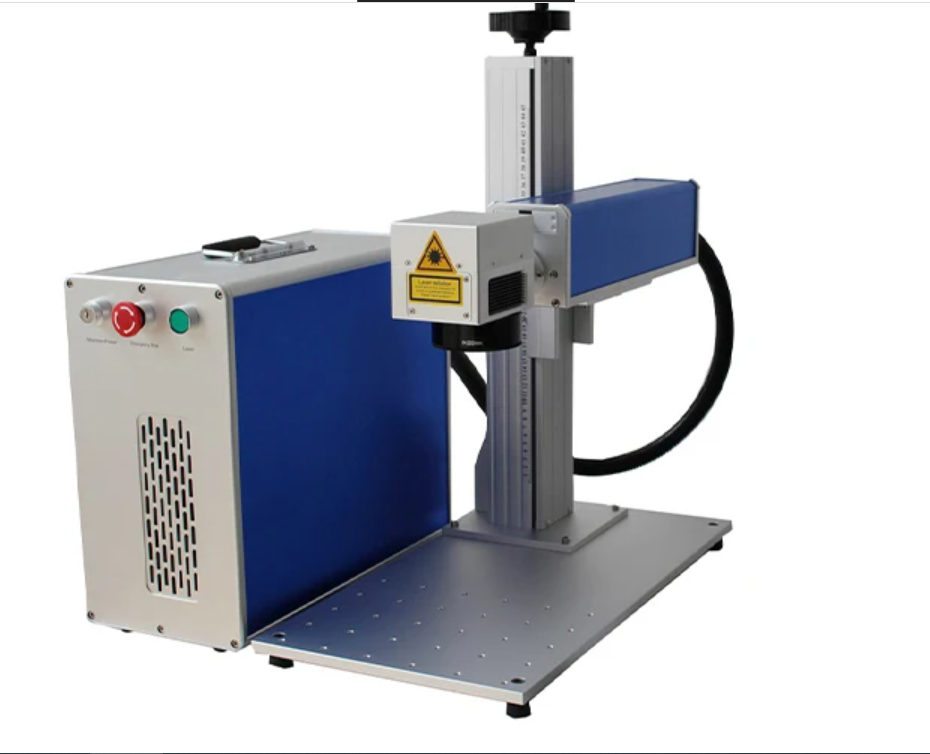
30W Fiber Laser Marking Machine
For heat-sensitive plastics such as TPU, silicone, and PVC tubing, a 5W UV laser is more strongly recommended. UV lasers belong to cold processing technology, with an extremely small heat affected zone, effectively preventing yellowing, burning, and deformation of plastics. In fact, in the UV laser field, 5W is already sufficient for the vast majority of plastic marking applications. Compared with 10W UV lasers, the equipment cost is much lower, which is why 5W UV has become the most widely used and most accepted configuration on the market today.
For acrylic materials, we recommend a 30W CO2 laser etching machine. Equipment at this power level provides a good balance between performance and cost, making it highly suitable for acrylic laser etching applications.
Contact Us Now
At ZS Machinery, we believe that efficient and stable laser etching comes from the combination of proper equipment selection and real-world processing experience. With the right configuration, manufacturers can significantly improve product quality, reduce defect rates, and achieve consistent, high-precision results across different materials.
If you are planning to upgrade your laser processing capability or are unsure which solution is most suitable for your application, contact us today and we will give you a specilized marking solution for your own use.
Four Types Metal Marking Machine Guide:Classification, Principles, and Industrial Applications