Glass Laser Marking: Methods, Challenges, and Practical Solutions
Glass is widely used across industries such as construction, consumer products, electronics, medical packaging, and laboratory equipment. From everyday glassware to high-precision optical components, its applications continue to expand. However, one fundamental challenge remains the same: glass is inherently brittle and sensitive to thermal stress.
Because of this, marking or engraving on glass is not as straightforward as it is on metals or plastics. Traditional mechanical methods can easily cause chipping or breakage, while chemical processes lack precision and consistency. This is where glass laser marking becomes an increasingly important solution.
As a non-contact process, laser marking avoids mechanical stress while offering high precision and flexibility. But unlike metal marking, glass laser processing relies heavily on controlled thermal effects, which means the process must be carefully managed to avoid cracks or damage.
In practical applications, glass laser marking is not a single technique but a combination of different methods, each based on how the laser energy interacts with the material.

Glass bottle laser marking samples
Understanding How Laser Marking Works on Glass
Unlike metals, glass does not melt and re-solidify in a clean, controlled way under laser exposure. Instead, most laser marking on glass works by creating localized thermal stress, which leads to microstructural changes such as tiny cracks, density variations, or surface frosting.
These changes scatter light differently, making the marked area visible. The challenge is not simply to “mark” the glass, but to control how energy is distributed, so the result is clear, consistent, and does not compromise the integrity of the material.
Depending on the laser type and processing parameters, this interaction can produce very different visual and structural effects.
Multi-Pass Laser Marking: A Controlled Approach
One of the most practical methods in glass laser marking is the use of multiple low-energy passes instead of a single high-energy exposure.
Rather than applying excessive energy at once—which can easily lead to uncontrolled cracking—this approach gradually modifies the glass surface layer by layer. Each pass introduces a small amount of thermal effect, allowing stress to distribute more evenly across the marking area.
This method is particularly effective for common materials such as soda-lime glass and borosilicate glass, which are widely used in bottles, laboratory containers, and daily-use products.
In real production environments, this approach helps achieve a balance between marking visibility and structural safety, making it suitable for applications like pharmaceutical bottles, cosmetic containers, and household glassware.
Micro-Crack Formation: The Basis of Visible Marking
Another widely used principle in glass laser marking involves the formation of controlled micro-crack structures.
When the laser heats a very small area of the glass surface, it expands locally. As the material rapidly cools, internal stress builds up, leading to the formation of tiny cracks. When these micro-cracks are evenly distributed, they create a visible contrast that forms text, codes, or patterns.
This method is commonly associated with CO2 laser marking on glass, where the wavelength is well absorbed by the material surface. By carefully adjusting parameters such as power, speed, and frequency, it is possible to create relatively uniform markings such as barcodes, QR codes, and simple graphics.
However, the key here is control. If the energy input is too high or uneven, cracks can propagate beyond the intended area, affecting both appearance and strength. That is why process optimization plays a critical role in achieving stable results.
Frosted and Crackle Effects: Decorative Applications
In some cases, the goal of glass laser marking is not just identification, but aesthetic enhancement. By carefully managing heating and cooling cycles, the laser can create a frosted or “crackle” texture on the glass surface.
This effect is achieved by generating a network of fine surface micro-cracks that scatter light, resulting in a matte or textured appearance. Unlike polished glass, these areas appear non-transparent, giving a distinctive visual contrast.
Such effects are widely used in interior design and decorative applications, including glass partitions, background panels, and customized glass furniture. In these scenarios, the laser becomes not just a marking tool, but a surface design technology.
High-Precision Laser Marking on Glass
With advancements in laser technology, especially with UV laser systems, it is now possible to achieve much finer and more controlled marking on glass.Unlike CO2 lasers, UV lasers operate through a “cold processing” mechanism, where the material is modified with minimal thermal impact. This significantly reduces the risk of cracking and allows for:
Finer details
Cleaner edges
More uniform marking contrast
As a result, UV laser marking is often used in applications that require high precision and high reliability, such as electronic glass components, display panels, and medical devices.
In these cases, the marking is not only about visibility, but also about maintaining the functional integrity of the material.
Choosing the Right Laser for Glass Marking
One of the most important factors in glass laser marking is selecting the appropriate laser source. Different lasers interact with glass in very different ways.
CO2 lasers are commonly used for general-purpose marking and decorative effects due to their strong surface absorption. However, they rely heavily on thermal cracking, which may limit precision.
UV lasers, on the other hand, offer much higher control and are better suited for fine marking and applications where cracks must be minimized.
Fiber lasers, which are widely used for metal engraving, are generally not ideal for glass marking because glass does not effectively absorb their wavelength.
Understanding these differences is essential when choosing the right solution for a specific application.
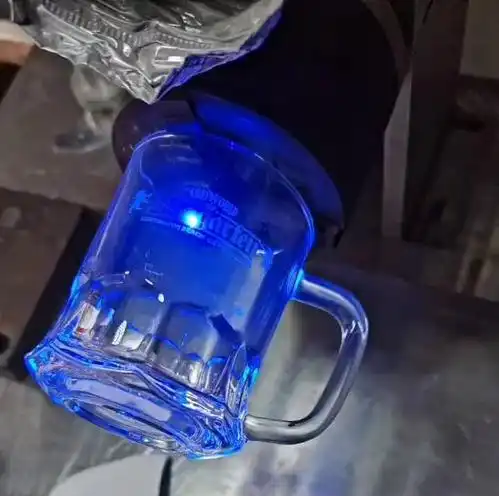
UV Laser Marking On Glass Cup
Final Thoughts
Glass laser marking is not simply a matter of applying a laser to the surface. It is a process of controlled energy interaction, where precision, parameter tuning, and material behavior all play critical roles.
When done correctly, laser marking offers a reliable way to create permanent, high-quality markings on glass without mechanical contact. From industrial identification to decorative design, it provides a level of flexibility and consistency that traditional methods cannot match.
If you are considering glass laser marking for your application, it is important to evaluate not only the marking requirements, but also the material type, desired effect, and production conditions. Choosing the right process and equipment can make a significant difference in both quality and efficiency.
ZS Machinery has been in the field of marking solution for more than 10 years,we specialized in marking on different materilas and applications.If you are not sure which solution to use,you can contact us at any time,our technical team will give you a suitable marking solution for your own use.
How to Choose the Right Laser Engraver for Plastic Materials