MOPA Fiber Laser Guide: Principles, Advantages, Applications, and Development Bottlenecks Analysis
The Chinese laser market is dominated by fiber lasers, accounting for over 60%. Fiber lasers are classified into continuous, quasi-continuous, and pulsed fiber lasers according to their operating mode. Pulsed fiber lasers mainly include Q-switched pulsed fiber lasers and MOPA (Master Oscillator Amplifier) pulsed fiber lasers.
MOPA pulsed fiber lasers, due to their advantages of high beam quality, high single-pulse energy, and high average power, have a very broad prospect in laser processing, medical and health fields, weapons manufacturing, and space optical communication.
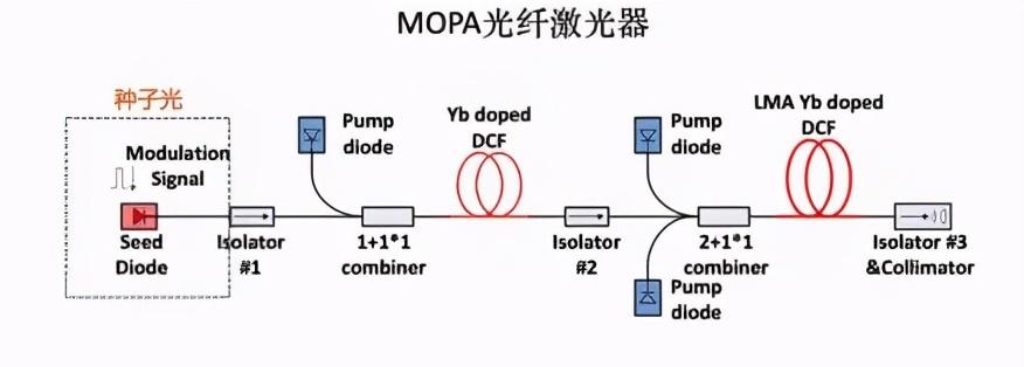
MOPA fiber laser principle schematic diagram
What is a MOPA Fiber Laser?
MOPA is a laser structure consisting of a “master oscillator + power amplifier.” Its core principle is: first, a low-power seed source generates a laser signal, and then the laser is amplified through one or more stages of fiber amplifiers, ultimately obtaining a high-power, high-beam-quality laser output.
Compared to traditional Q-switched fiber lasers, the biggest advantages of MOPA are:
Independently adjustable pulse width
Width adjustment range of repetition frequency
More flexible laser waveform control
Ability to balance high peak power and high processing precision.
Traditional Q-switched lasers primarily generate pulses by changing the resonant cavity loss, thus the pulse width is typically fixed between 80ns and 140ns, with a limited adjustable range. In contrast, the pulse width of MOPA lasers can be flexibly adjusted between 2ns and 500ns, with some models even supporting a wider range of control. This is a key reason why MOPA is called an “intelligent pulsed fiber laser.”
To learn more about the differences between the two, you can refer to MOPA Fiber Laser VS Q-switched Fiber Laser.
Advantages of MOPA Lasers
Compared to ordinary fiber lasers and Q-switched fiber lasers, the core advantages of MOPA fiber lasers can be summarized in the following three points:
1. Adjustable Pulse Width
This is one of the most crucial advantages of MOPA fiber lasers, directly determining its upper limit capability in precision machining. A narrower pulse width results in a shorter pulse duration, limiting heat diffusion within the material. This significantly reduces the heat-affected zone, sharpens edges, and reduces surface ablation and yellowing.
This characteristic makes MOPA particularly advantageous in applications requiring high contrast or high precision, such as stainless steel color marking, anodized aluminum surface marking, and high-precision electronic component marking. These processes rely on precise pulse width control to achieve stable and consistent results.
2. High Repetition Rate
MOPA fiber lasers offer a significant advantage in repetition rate, typically reaching the MHz level. This means more laser pulses can be output per unit time, significantly improving processing speed and production efficiency.
In practical industrial applications, a high repetition rate not only represents faster speed but, more importantly, maintains continuous and stable energy output during high-speed scanning. This results in more uniform marking, cleaning, or micromachining processes, reducing missed areas or uneven energy distribution. The advantages of high repetition rate are further amplified in automated production lines or in-line flying marking scenarios, making MOPA ideal for high-volume, high-speed industrial production environments.
3. Enhanced Thermal Control Capabilities
Another key advantage of MOPA lasers lies in their precise control over heat input. Since pulse width, frequency, and peak power can all be independently adjusted, operators can flexibly match processing parameters according to the absorption and thermal diffusion characteristics of different materials, thereby effectively controlling overall heat accumulation.
This capability is particularly important in practical applications. For example:
(1)In precision electronics machining, it is necessary to avoid heat damage to sensitive components
(2)In thin-plate welding, it is necessary to reduce deformation and burn-through
(3)In stainless steel color marking, it is necessary to precisely control the thickness and color change of the oxide layer
(4)In anodized aluminum stripping processes, it is necessary to achieve the effect of “removing the coating without damaging the substrate
(5)In dissimilar metal welding, it is necessary to minimize the risk of intermetallic compound formation. In many high-end processing scenarios, the key challenge is not whether processing is possible, but how to minimize the thermal impact while ensuring the desired effect. MOPA excels in this aspect.
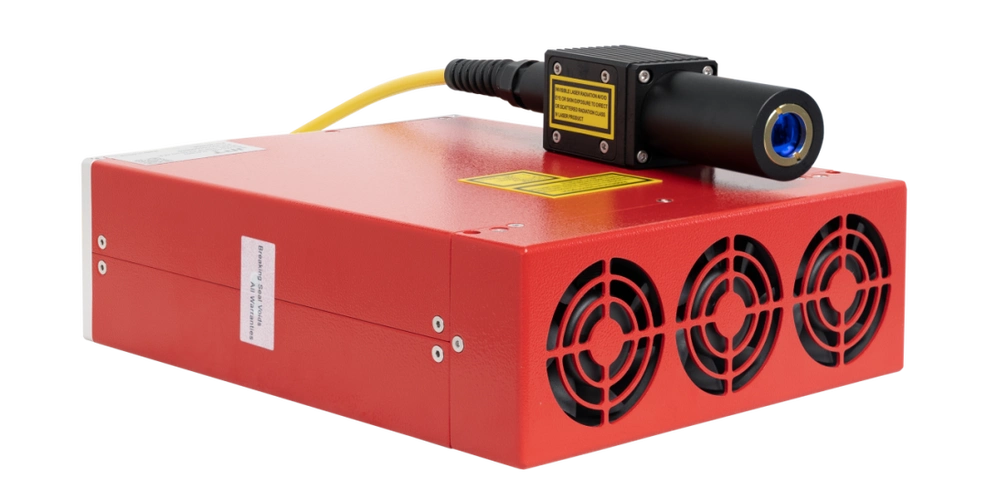
JPT 60W MOPA Laser Source
Key Applications of MOPA Fiber Lasers:
1. Color Marking on Stainless Steel
Color marking on stainless steel is one of the most representative and mature applications of MOPA fiber lasers. Its core principle is not simply “burning” or “etching,” but rather inducing the formation of oxide films of varying thicknesses and structures on the stainless steel surface through precise control of laser parameters.
When the laser acts on the stainless steel surface, the material undergoes an oxidation reaction at localized high temperatures, forming an extremely thin and uniform oxide layer. This oxide film, varying in thickness, produces optical interference effects, resulting in different colors.
Because it requires no consumables and the markings are wear-resistant, corrosion-resistant, and fade-resistant, this process is widely used in high-end products. For example, MOPA color marking has become an important means of enhancing product added value in areas such as high-end brand logos, precision craft decorations, medical device markings, stainless steel cup and kettle surface patterns, and electronic product casing decorations.
2. Anodized Aluminum Black Marking
In the 3C electronics manufacturing industry, anodized aluminum is widely used in structural components such as mobile phone casings, laptop casings, and tablet bezels. These materials typically have a dense protective aluminum oxide film on their surface, providing both corrosion resistance and a high-end metallic texture. However, the marking process requires very high precision: it must ensure high-contrast marking effects without compromising appearance consistency.
Traditional laser processing of these materials is prone to problems such as localized yellowing, edge burning, or surface roughness due to excessive heat input, affecting the overall appearance quality. MOPA lasers, with their narrow pulse width and high repetition rate, can complete energy application in an extremely short time while significantly reducing the heat diffusion range. This causes the material surface to undergo primarily microstructural changes rather than macroscopic ablation, resulting in a clear, high-contrast black marking effect.
This combination of “low thermal impact + high-precision control” makes MOPA a crucial component in the manufacturing of high-end consumer electronics products, especially for products with extremely high requirements for appearance consistency, where it has become one of the mainstream marking solutions.
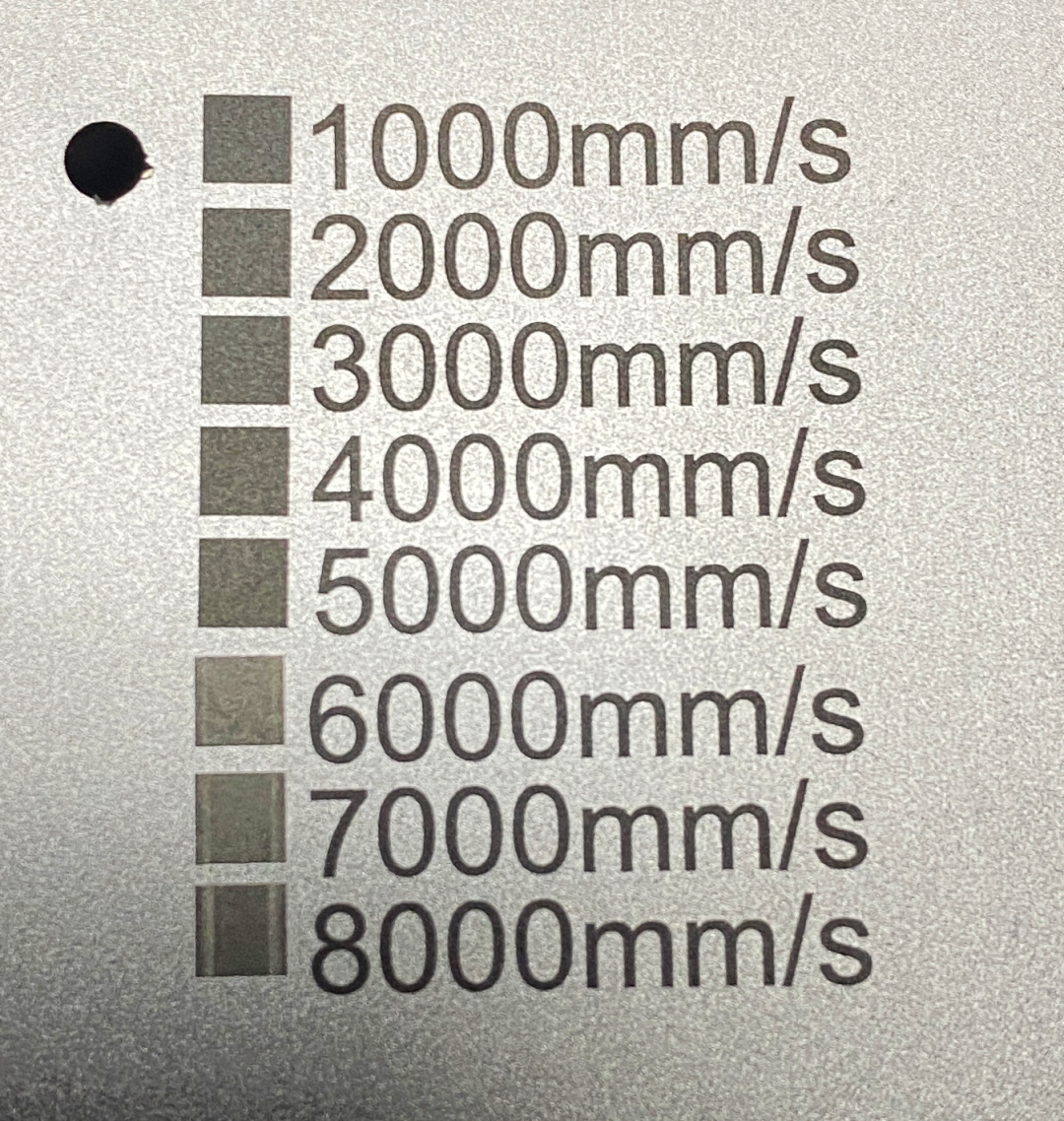
The effect of different speeds on blackening of anode aluminum
3. Precision Welding and Dissimilar Metal Welding
Dissimilar metal welding has always been one of the technical challenges in laser processing. Different metals often have significant differences in melting points, thermal conductivity, and thermal expansion coefficients. These factors can easily lead to stress concentration during welding, resulting in cracks or brittle intermetallic compounds, severely affecting the joint strength and reliability.
The advantage of MOPA fiber lasers in this field lies primarily in their high controllability of energy input. By adjusting the pulse width, frequency, and peak power, sufficient penetration depth can be ensured while keeping the heat input at a low level, thereby reducing excessive molten pool expansion and unnecessary heat-affected zones. Furthermore, high peak power enables localized melting of materials in a short time, while lower average power helps reduce overall heat accumulation. This “high peak, low heat” characteristic is particularly crucial for dissimilar metal welding.
Therefore, in practical industrial applications, MOPA lasers have been widely used in copper-aluminum welding, battery tab welding, and precision electronic connections. In new energy battery manufacturing and high-end electronic assembly, such welding requires not only high connection strength but also stability and consistency, and MOPA achieves a good balance between these key indicators.
Development Challenges of MOPA Fiber Lasers
The main challenges in the development of traditional fiber lasers are nonlinear effects, spontaneous emission amplification effects, and thermal effects. In addition to these, the most intractable obstacle to the development of MOPA fiber lasers is a novel nonlinear limiting factor: transverse mode instability (TMI).
While effectively suppressing the stimulated Brillouin emission (SBS) effect significantly increases laser output power, further power increases are limited by the TMI effect. The TMI effect limits the average power output of the laser system, rather than the peak intensity. Therefore, methods used to suppress nonlinear effects, such as SBS, do not significantly affect the TMI effect. When the average output power exceeds the threshold, beam quality degrades.
The solution—bending the master amplifier fiber—is the simplest and most direct method.
TMI suppression methods are divided into active and passive suppression. Active suppression involves dynamic control of the system, using an acousto-optic deflector and a control loop at the signal input end to change the spatial offset of the input light at the fiber injection end face, thereby dynamically controlling the fiber excitation mode. This can also be achieved through modulated pumping or phase shift control through dynamic system control. However, active suppression requires the introduction of external mechanisms, which increases system complexity to some extent.
Passive suppression reduces the thermal load caused by quantum defects and photon darkening by optimizing the core doping composition and laser system parameters, thereby increasing the TMI threshold. In MOPA fiber amplification systems, bending the master amplifying fiber is the simplest and most direct way to improve the TMI threshold. However, this bending introduces mode distortion within the fiber, thus affecting the TMI effect. Currently, no work has provided a detailed analysis of the changes in the TMI threshold caused by this mode distortion.
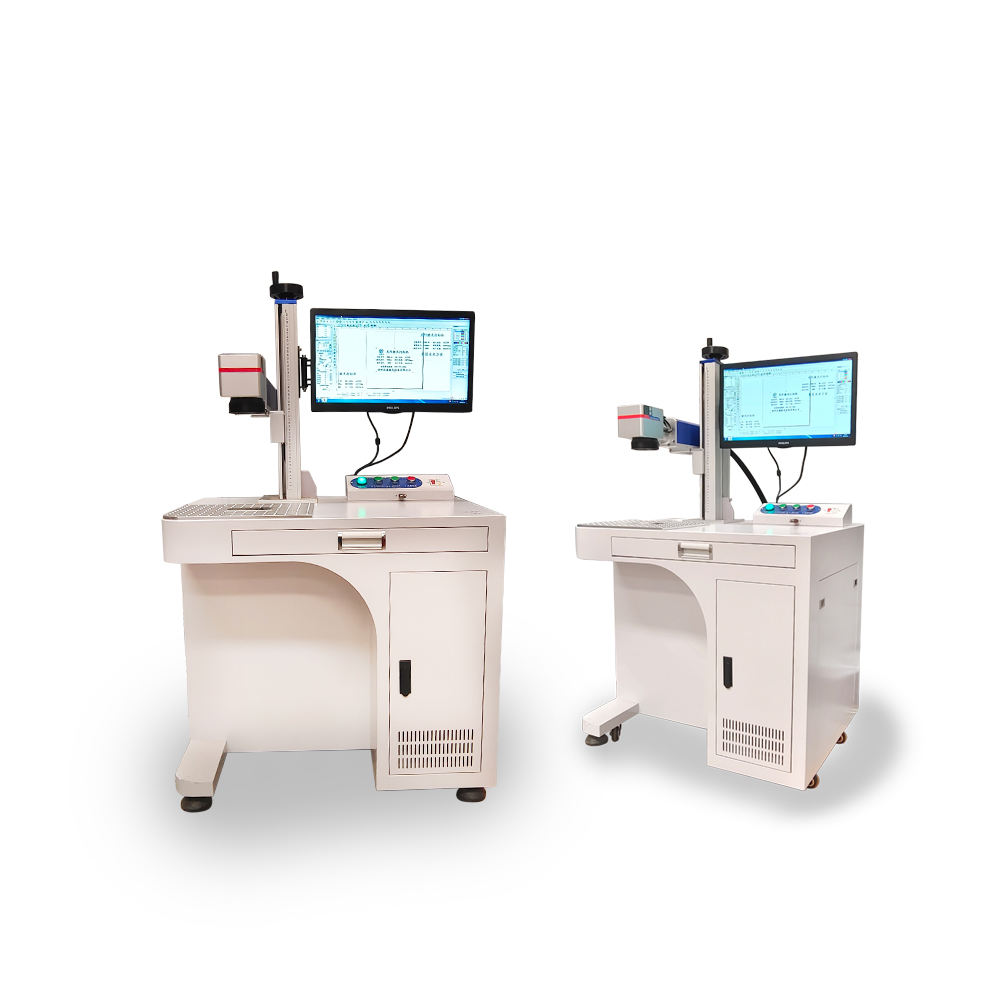
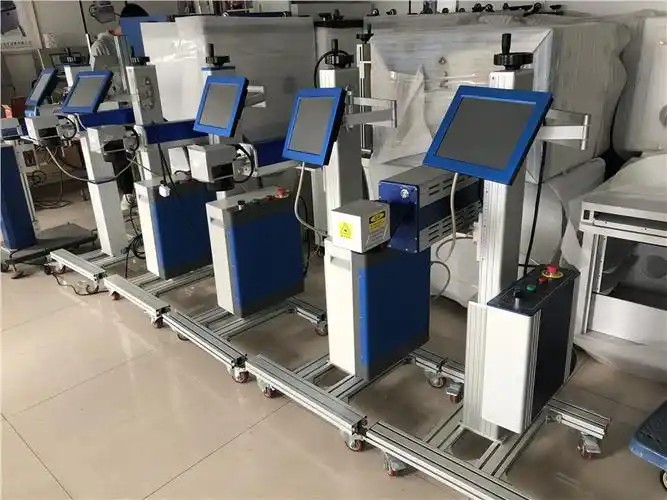
MOPA Laer Marking Machine
In summary, MOPA fiber lasers are becoming an important technological route in the field of precision laser processing.It demonstrate irreplaceable value in applications such as stainless steel color marking, anodizing aluminum processing, and high-end welding.
At the same time, they still face key technical challenges such as TMI in high-power applications, which provides continuous development space for further technological optimization and structural innovation.
As fiber laser technology continues to mature, MOPA will achieve further replacement and upgrading in a wider range of industrial scenarios.
For information on MOPA laser selection, prototyping testing, or specific process solutions, please contact ZS Machinery for technical support and application advice.
Differences between MOPA Fiber Lasers and Q-Switched Fiber Lasers: A Deep Comparison of Structure, Parameters, and Applications