Differences between MOPA Fiber Lasers and Q-Switched Fiber Lasers: A Deep Comparison of Structure, Parameters, and Applications
Both MOPA fiber lasers and Q-switched fiber lasers belong to the category of pulsed fiber lasers.(Another type is continuous laser. To understand the difference between the two, please refer toDifferences Between Continuous Wave Lasers and Pulsed Lasers) In the field of industrial nanosecond pulsed lasers, they are currently the two most mainstream technologies. Both are widely used in metal marking, welding, cleaning, cutting, and precision machining, but they differ fundamentally in laser generation methods, pulse control capabilities, processing effects, and applicable scenarios.
ZS Machinery will analyze them in detail below from five dimensions: internal structure, optical parameters, processing capabilities, application scenarios, and cost logic.

Laser Processing
1.What is a Q-Switched Fiber Laser?
Fiber lasers excite a gain fiber through a pump source and utilize the continuous reflection and amplification of the light signal within the resonant cavity to form laser output. A Q-switched fiber laser, essentially, is a nanosecond laser that generates pulsed output by adjusting the resonant cavity loss.
Its working principle is: by periodically changing the loss state in the laser resonant cavity, laser energy is first accumulated within the cavity and then released instantaneously, thus forming a high-peak pulse.
In simple terms:
“Closed-door energy storage”
“Instantaneous release”
This is the most classic implementation method for traditional industrial pulsed lasers.
2.What is a MOPA fiber laser?
MOPA (Master Oscillator Power Amplifier) means: Master Oscillator Power Amplifier Structure. It consists of: a seed laser and one or more stages of power amplifiers.
Compared to Q-switching, its biggest difference is that it does not rely on resonant cavity Q-switching to generate pulses, but directly uses electrical pulses to drive a semiconductor seed source to output laser pulses, which are then amplified by fiber amplifiers.
Simply put: MOPA laser pulses are “actively generated,” rather than indirectly generated through post-processing adjustments. Therefore, it can more freely control parameters such as pulse width, repetition frequency, peak power, and pulse waveform.
This is why MOPA is often referred to as: “Intelligent Nanosecond Pulsed Fiber Laser”
3. Core Differences Between MOPA and Q-Switched Lasers: Internal Structure Comparison
3.1. Q-Switched Lasers: Generate pulses through “cavity modulation.” Its core principle is: periodically changing the cavity loss through Q-switching.
Therefore, its pulse formation process is highly dependent on external factors such as the resonant cavity structure, Q-switching speed, and energy accumulation within the cavity. While this structure is mature, it also directly leads to inherent limitations on its pulse parameters due to these external factors.
Therefore, it generally has the following problems: Q-switched lasers typically have fixed pulse widths, limited high-frequency capabilities, and inflexible waveform control.
Therefore, Q-switching is more like a “fixed-parameter output laser.”
3.2. MOPA Lasers: Generate pulses through “electrical signal modulation.”
MOPA’s seed source is directly driven by an electrical signal. Therefore, its laser output is essentially “electronically controlled.” This means that by modifying the driving signal, parameters such as pulse width, repetition rate, waveform, duty cycle, and peak power can be changed. Therefore, MOPA possesses extremely high parameter freedom.
Compared to Q-switching, MOPA is more like a “programmable laser.”
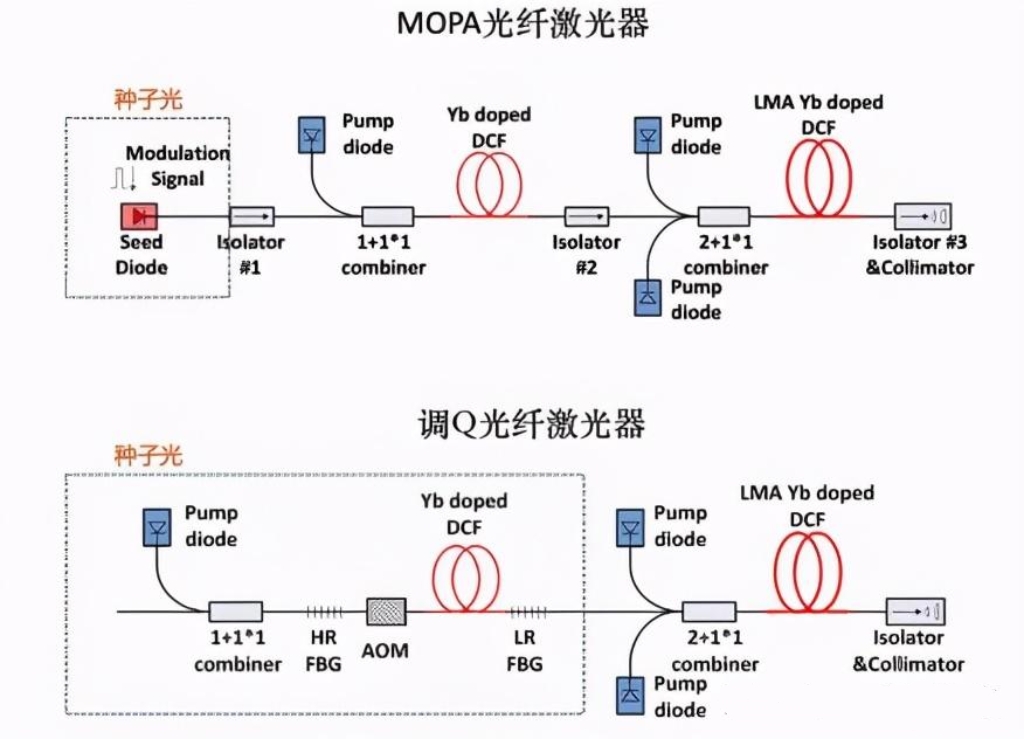
MOPA fiber laser VS Q-switched fiber laser
4. In-depth Comparison of Output Optical Parameters
Due to their different structures, MOPA and Q-switched lasers exhibit significant differences in their output optical parameters, representing the largest gap between them. Let’s examine each in detail:
4.1. Pulse Width Control Capability
Pulse width is one of the core parameters determining processing accuracy and heat-affected zone control. Pulse width refers to the duration of a single laser pulse on the material surface. A shorter pulse width results in more concentrated laser energy release, reducing the time for heat to diffuse and thus significantly reducing the heat-affected zone and improving processing accuracy.
MOPA fiber lasers offer independently adjustable output pulse widths. Their pulse width range is typically 2 ns to 500 ns.
Q-switched fiber lasers do not offer adjustable output pulse widths; the pulse width is generally fixed at a specific value between 80 ns and 140 ns. For example, 80 ns, 100 ns, 120 ns, 140 ns, etc., can only be a specific value and cannot be flexibly adjusted. The comparison charts of the two are as follows:
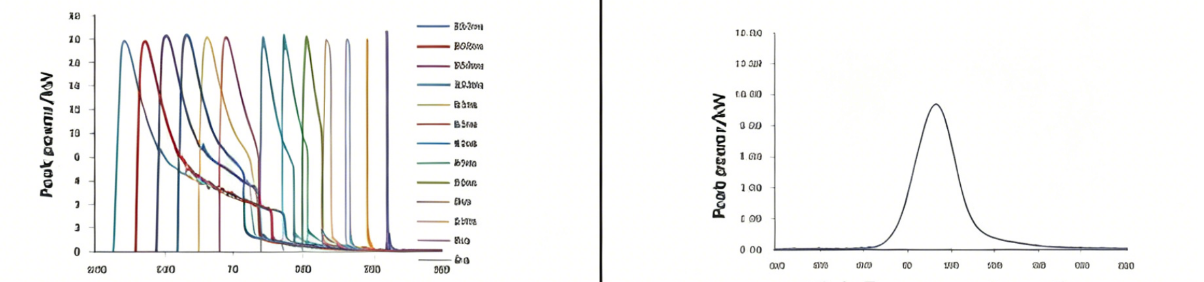
Comparison of pulse widths between MOPA fiber laser and Q-switched fiber laser
4.2. Repetition Rate Comparison
Repetition rate refers to the number of pulses a laser outputs per unit time, usually expressed in Hz, kHz, or MHz. A higher repetition rate means more laser pulses can be output per unit time, thus directly affecting processing speed, processing efficiency, and energy continuity during high-speed scanning.
MOPA fiber lasers have a significant advantage in repetition rate, with a wider output frequency range, reaching up to the MHz level. Even at high repetition rates, MOPA can maintain a high peak power output, thus ensuring both processing efficiency and quality.
In contrast, traditional Q-switched fiber lasers, limited by Q-switching operating conditions, have a relatively narrow output frequency range, typically only reaching about 100kHz at high frequencies, significantly limiting their flexibility in high-frequency processing scenarios.
4.3. Peak Power Comparison
In nanosecond pulsed laser processing, what truly determines the instantaneous processing capability of materials is not just the average power, but the peak power.
Peak power refers to the maximum energy intensity released by a single laser pulse in a very short time. Higher peak power means a more concentrated energy absorption by the material in an instant, making rapid melting, vaporization, or microstructural alteration easier.
Many people mistakenly believe that “higher average power means stronger processing capabilities.” However, for nanosecond pulse processing, peak power is often more important than average power.
MOPA fiber lasers, because their pulse width and repetition frequency can be independently adjusted, can more flexibly allocate single-pulse energy according to different processing needs, maintaining a high peak power output even at high repetition frequencies.
In contrast, traditional Q-switched fiber lasers, due to their stronger pulse parameter coupling, have relatively limited flexibility in peak power adjustment, making them less adaptable to complex and precision machining than MOPA. The figure below shows a comparison of the optical parameters of the two types of lasers.
5. Typical Application Scenarios Comparison
Q-switched fiber lasers, due to their mature structure, low cost, and high stability, are still widely used in:
Ordinary metal marking
Hardware engraving
Deep engraving
Ordinary QR code marking
Industrial parts marking
Conventional metal processing, etc.
For most standard industrial processing scenarios, Q-switched fiber lasers can already meet basic needs, thus maintaining a very large market share in the low-to-mid-end industrial market.
In contrast, MOPA fiber lasers, due to their wide parameter adjustment range, can not only cover the processing applications of conventional nanosecond lasers, but also utilize their unique narrow pulse width, high repetition rate, and high peak power to achieve some unique precision processing applications. For example:
5.1. Black Marking on Anodized Aluminum
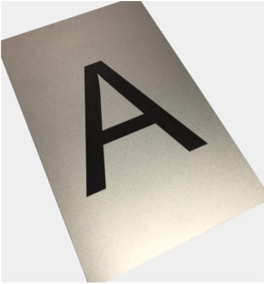
The casings of 3C products are mostly made of thin alumina material. The successful application of MOPA lasers with narrow pulse width and high repetition rate parameters for black marking on the surface of anodized aluminum material is a milestone in its explosive growth. Furthermore, different grayscale effects can be achieved by combining different parameters.
Similar applications include the removal of alumina sheet surfaces. Using MOPA fiber lasers with narrow pulse width parameters, high peak power can be achieved to remove the anode layer while reducing heat transfer and accumulation, making the material less prone to deformation and resulting in a finer, brighter texture. This is one of the landmark applications that has led to the rapid popularization of MOPA fiber lasers.
MOPA Laser Marking On Aluminium
5.2. Stainless Steel Color Marking
Stainless steel color marking is one of MOPA’s most representative high-end applications and a process that is difficult to achieve with traditional Q-switched lasers. Because Q-switched lasers have fixed pulse widths and limited heat input control capabilities, it is difficult to stably control the thickness of the oxide layer on the stainless steel surface and achieve a stable and consistent color effect.
MOPA, however, can precisely control the oxidation reaction on the stainless steel surface by adjusting optical parameters, thereby stably forming oxide films of different thicknesses. When light interferes, a color effect is produced. This color is not a sprayed coating but a structural color formed on the material surface, thus making the marking more durable.

MOPA Laser On Stainless Steel
5.3. Dissimilar Metal Welding
Due to the significant difference in melting/boiling points between dissimilar metals, conventional heat conduction welding methods cannot establish effective weld points. Another landmark application of MOPA fiber lasers is dissimilar metal welding, which utilizes their unique narrow pulse width and high peak power to reduce the formation of intermetallic compounds, thereby creating a robust connection structure.
6. Cost and Market Positioning Differences
The biggest advantage of Q-switched fiber lasers lies in their lower cost. Due to their relatively simple structure, mature technology, and low maintenance difficulty, they still hold a significant share in the general industrial processing market, especially in the following applications where they remain the mainstream choice:
20W, 30W, 50W metal marking
General metal engraving
Deep engraving
Conventional industrial marking, etc.
In contrast, MOPA fiber lasers, due to their more complex seed source, higher precision drive control system, and multi-stage amplification structure, generally have a higher overall cost than Q-switched solutions. However, the advantages of MOPA are also very significant, including:
Higher processing accuracy
Lower thermal impact
More flexible parameter adjustment
Stronger process compatibility
Therefore, MOPA has become an increasingly important core solution in high-value-added industries such as:
Precision machining
High-end 3C electronics
Stainless steel color marking
New energy welding
Semiconductor and micromachining
Conclution
Overall, Q-switched lasers and MOPA lasers are not simple substitutes, but rather two products with different target markets: Q-switched lasers are more suitable for conventional industrial processing and cost-sensitive markets, while MOPA lasers are more suitable for high-precision, high-end machining markets. In the future, a market structure of “long-term coexistence and complementary applications” is more likely, rather than MOPA lasers completely replacing Q-switched lasers.
If you are unsure which laser product is suitable for your project, please feel free to contact ZS Machinery. Our professional engineering team can recommend the most suitable product for you.
Differences Between Continuous Wave Lasers and Pulsed Lasers