Laser Marking Carbon Fiber: Methods, Challenges and Best Practices
Introduction
With the development of lightweight manufacturing, carbon fiber has become one of the most important high-performance materials in modern industry. Thanks to its advantages of lightweight construction, high strength, corrosion resistance, and fatigue resistance, carbon fiber is widely used in automotive manufacturing, aerospace, unmanned aerial vehicles (UAVs), medical devices, and high-end consumer products.
At the same time, requirements for product traceability, brand identification, and regulatory compliance are becoming increasingly stringent. Whether it is product serial numbers, QR codes, certification marks, or brand logos, manufacturers need to create permanent, clear, and wear-resistant markings on carbon fiber surfaces.
However, because carbon fiber is a composite material with physical properties that differ significantly from metals, many companies often ask the following questions when selecting a marking solution:
- Can carbon fiber be laser marked?
- Will laser marking damage carbon fiber materials?
- Which type of laser is best for carbon fiber marking?
This article provides a comprehensive overview of the principles, applications, technical challenges, and equipment selection recommendations for carbon fiber laser marking.
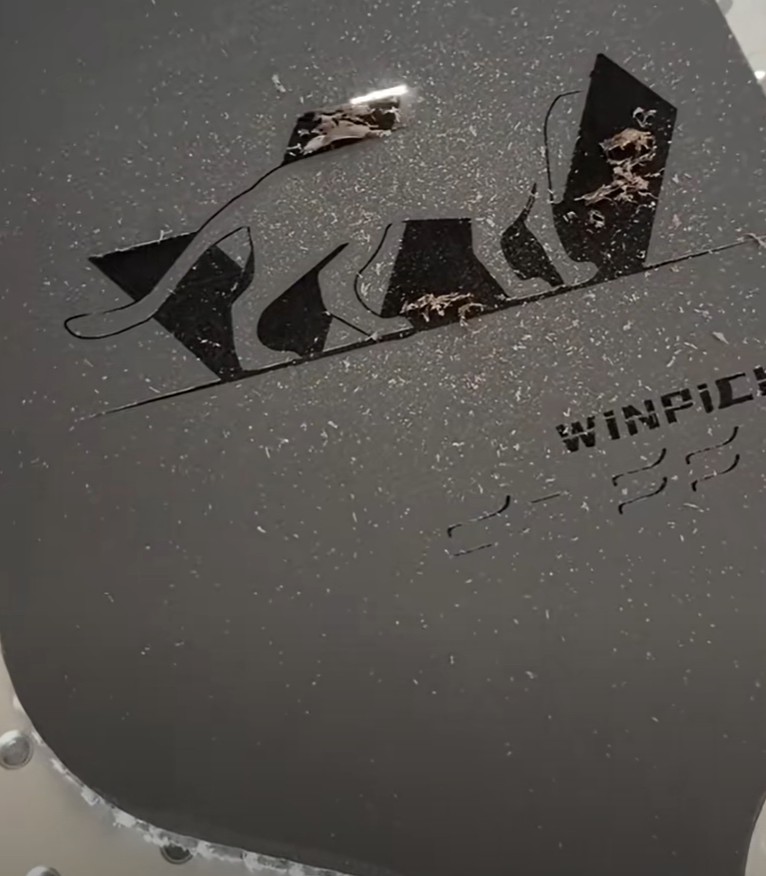
Laser Marking on carbon fiber racket
What Is Carbon Fiber?
Carbon fiber is not a single material. Instead, it is a composite material made of carbon fiber filaments combined with a resin matrix.Compared with traditional steel or aluminum alloys, carbon fiber offers the following characteristics:
- High strength
- Lightweight
- Corrosion resistance
- Excellent fatigue resistance
- Low thermal expansion coefficient
- Modern and high-tech appearance
For these reasons, carbon fiber has become a key material for many high-end products.
Why Is Carbon Fiber Marking More Difficult Than Metal Marking?
Many people assume that laser marking simply involves engraving a pattern onto the surface of a material. However, things are not that simple when it comes to carbon fiber.
Metal materials can generally withstand relatively high levels of heat, while carbon fiber composites contain resin layers. If laser energy is not properly controlled, it may result in:
- Surface burning
- Resin carbonization
- Material discoloration
- Fiber exposure
- Delamination
Especially in high-value industries such as aerospace and medical devices, even minor surface damage may affect product quality and customer acceptance.Therefore, the key challenge of carbon fiber laser marking is not whether it can be marked, but how to achieve high-quality markings without damaging the material.
Can Carbon Fiber Be Laser Marked?
The answer is yes.
In fact, laser marking has become one of the most widely used permanent identification technologies for carbon fiber products.
By properly controlling laser energy and processing parameters, clear, permanent, and high-contrast markings can be created on carbon fiber surfaces.
Common marking content includes:
- Product serial numbers
- QR codes
- Data Matrix codes
- Brand logos
- Anti-counterfeiting marks
- Certification marks
- Production batch information
- Product traceability codes
Compared with labels, inkjet printing, or traditional printing methods, laser marking requires no consumables and does not suffer from peeling, fading, or wear. As a result, an increasing number of manufacturers are adopting laser marking as a replacement for conventional identification methods.
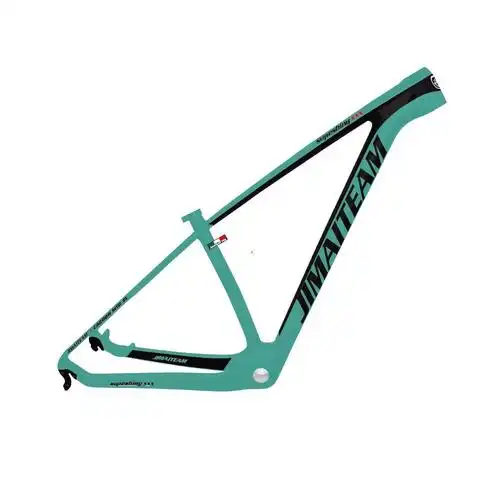
carbon fiber bicycle frame
Will Laser Marking Damage Carbon Fiber?
This is one of the most common concerns among customers.
In reality, whether laser marking damages carbon fiber depends largely on the laser type and parameter settings.
If the laser power is too high or heat is excessively concentrated, it may cause:
- Resin ablation
- Surface yellowing
- Carbonization marks
- Structural damage to the material
However, when an appropriate laser type is selected and parameters such as power, frequency, and scanning speed are properly adjusted, the heat-affected zone can be minimized to an extremely small area.
Which Laser Is Best for Carbon Fiber Marking?
Carbon fiber materials consist of carbon fiber filaments and a resin matrix. Compared with traditional metal materials, the resin layer is much more sensitive to heat.If laser energy is not properly controlled, it can easily cause surface burning, resin carbonization, discoloration, and deterioration of the product’s appearance.
Therefore, the goal of carbon fiber marking is not only to achieve permanent identification but also to minimize the heat-affected zone while maintaining excellent marking quality.
Based on current industrial applications, UV laser marking machines are widely recognized as the ideal choice for carbon fiber marking.
UV Laser Marking Machine
UV lasers operate at a wavelength of 355 nm. Compared with conventional fiber lasers, their shorter wavelength provides a higher absorption rate on carbon fiber materials.
During processing, material modification is primarily achieved through photochemical reactions rather than thermal effects. For this reason, UV laser processing is often referred to as a “cold processing” technology.
This processing method effectively reduces heat accumulation and minimizes thermal damage to the resin layer, resulting in finer and more stable marking quality.
For carbon fiber products, UV lasers offer several advantages:
- Extremely small heat-affected zone
- Reduced risk of burning or yellowing
- Cleaner marking edges
- Suitable for high-precision QR codes and Data Matrix codes
- Excellent reproduction of logos and graphic details
- Preserves the original texture and surface appearance of carbon fiber
Particularly in high-end carbon fiber manufacturing, product value depends not only on performance but also on appearance quality.Traditional marking methods can easily damage the overall visual appeal of the material, whereas UV lasers can create permanent markings without physical contact while preserving the premium appearance of the product.
For example, premium bicycle frame manufacturers often need to add brand logos and product numbers while preserving the carbon fiber weave pattern. UAV manufacturers require clear serial numbers and traceability information without affecting structural integrity through thermal damage. Medical devices and electronic products also demand higher QR code readability and marking precision.
In these applications, UV lasers can deliver high-contrast, permanent, and highly precise marking results.
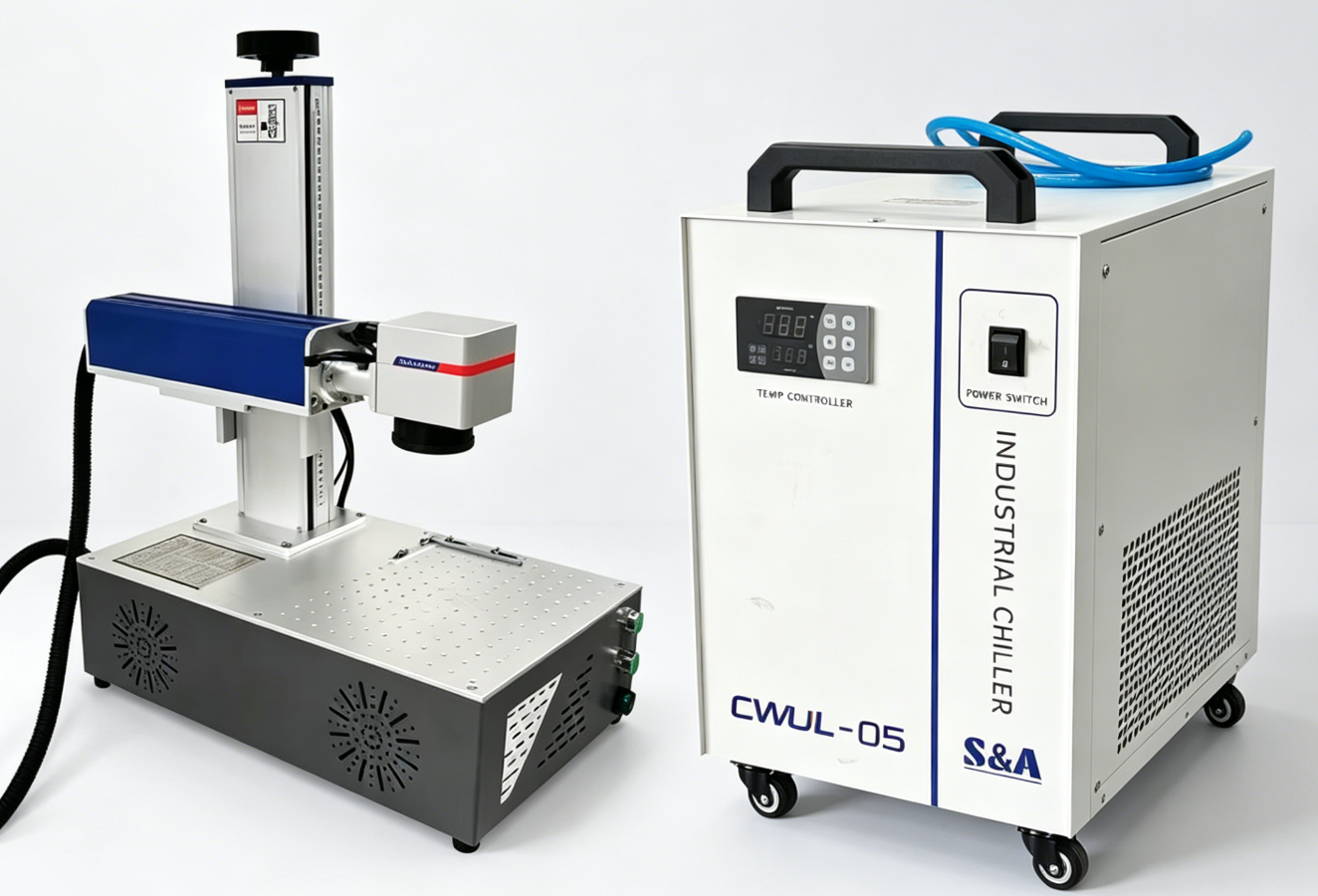
Desktop UV laser marking machine and chiller
Main Applications of Carbon Fiber Laser Marking
Thanks to the advantages of high precision, minimal heat impact, and permanent marking, UV laser technology has been widely adopted in the production of various carbon fiber products. As product traceability requirements continue to increase, more manufacturers are replacing traditional labels and inkjet printing with laser marking solutions.
1.Automotive Industry
Lightweight vehicle design has become a major trend in the global automotive industry. Especially in the electric vehicle sector, carbon fiber materials are widely used in body panels, interior trim components, battery protection structures, and high-performance parts.
For automotive manufacturers, every component requires complete traceability information. From raw material batches and production dates to assembly records, all information must be managed through permanent identification.
As a result, laser marking is commonly used to mark:
- Part numbers
- Product models
- Serial numbers
- Data Matrix codes
- Quality traceability QR codes
- Certification marks
Compared with traditional labels, laser markings will not peel off due to heat, vibration, or long-term use, making them more suitable for the demanding environments of the automotive industry.
2.UAV Industry
Due to its lightweight and high-rigidity characteristics, carbon fiber has become one of the primary materials used in UAV frames and structural components.
UAV manufacturers typically need to mark product serial numbers, batch information, and brand identifiers on frame surfaces for quality control and after-sales traceability.
Because UAV components are often small and require strict weight and structural integrity standards, traditional mechanical engraving is not an ideal solution.
UV lasers can perform highly precise marking without physical contact. Even tiny QR codes and complex graphics can maintain excellent readability while ensuring that the mechanical performance of carbon fiber components remains unaffected.
3.Bicycle and Sporting Goods Industry
In the high-end sporting goods market, carbon fiber has become synonymous with performance and quality.
Whether for road bike frames, mountain bikes, golf clubs, tennis rackets, or fishing rods, a large number of products are manufactured using carbon fiber composites.
These products not only require product identification and traceability information but also demand premium visual appearance.
Traditional labels can age and peel over time, while ink printing may wear away during use.
Laser marking creates permanent identification directly on the material surface. It preserves the texture and appearance of carbon fiber while permanently displaying brand logos, model information, and anti-counterfeiting codes.
For premium brands, this marking method not only improves product durability but also enhances brand image.
4.Medical Device Industry
The medical industry has extremely strict requirements for product identification.
Many medical devices and healthcare support products are manufactured using carbon fiber materials, including:
- Medical imaging equipment components
- CT scanner tabletops
- X-ray equipment structural parts
- Rehabilitation assistive devices
- Medical support structures
These products are often required to comply with UDI (Unique Device Identification) regulations.
UDI codes must remain clearly readable throughout the entire product lifecycle, making permanent marking essential.
UV lasers can produce highly precise QR codes and alphanumeric markings while avoiding significant thermal damage to the material. As a result, they are widely used throughout the medical device manufacturing industry.
5.Aerospace Industry
Aerospace is one of the most mature application sectors for carbon fiber materials.
Carbon fiber composites are extensively used in aircraft structural components, satellite parts, aircraft interiors, and unmanned aerial systems.
Compared with other industries, aerospace manufacturers face even stricter requirements for traceability and quality management.
Every component must contain complete production and maintenance records, including:
- Part numbers
- Manufacturing batches
- UID codes
- Maintenance records
- Quality traceability data
Because any material damage may affect product safety, traditional mechanical engraving methods are gradually being phased out.
With its non-contact processing capability and extremely small heat-affected zone, UV laser technology has become an important solution for marking aerospace carbon fiber components.
6.Consumer Electronics Industry
In recent years, an increasing number of high-end consumer electronic products have adopted carbon fiber materials.
Examples include:
- Laptop housings
- Gaming equipment enclosures
- Smart wearable devices
- Mobile phone accessories
- Premium audio equipment
These products typically require exceptionally high appearance quality.
Laser marking not only enables precise logos and product information but also preserves the original premium texture and visual appeal of the material.
For brand manufacturers, this permanent and high-quality marking solution can effectively enhance product value and market competitiveness.
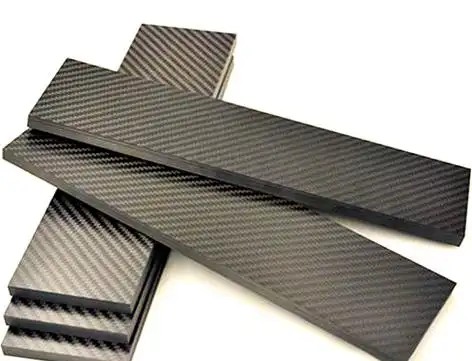
carbon fiber sheet
Conclusion
With the widespread application of carbon fiber materials in aerospace, automotive manufacturing, drones, medical devices, and high-end consumer goods, the demand for permanent marking and product traceability is constantly growing. Compared to traditional inkjet printing and labeling methods, laser marking can achieve high-precision, permanent marking effects without consumables.
For carbon fiber materials, the appropriate selection of laser equipment and optimization of processing parameters are crucial. Among them, UV lasers, with their advantages of low heat-affected zone, fine marking, and low material damage, have become the ideal choice for marking many high-end carbon fiber products. Through scientific process solutions, companies can not only achieve clear and reliable product marking but also maximize the preservation of the appearance quality and structural performance of carbon fiber materials.
If you are looking for a laser marking solution suitable for carbon fiber products, please contact ZS Machinery. We can provide you with professional equipment selection and free sample services based on your material type, marking content, and production needs.
Laser Marking Titanium: A Complete Guide to Titanium Laser Marking