Laser Marking Gold Guide
Gold is one of the most valuable precious metals in the world and is widely used in jewelry, investment gold bars, commemorative coins, watches, and high-end gift products. As demand for product traceability, brand building, and personalized customization continues to grow, more and more manufacturers are adopting laser marking technology to create permanent markings on gold products.

Laser Marking On Gold Ring
What is Gold Laser Marking?
Laser Marking Gold is a non-contact processing technology that uses a high-energy laser beam to interact with the surface of gold. Through microscopic surface modification, localized oxidation, or minimal material removal, the laser creates permanent markings on gold products.
Unlike traditional mechanical engraving, which requires direct contact between cutting tools and the material, laser marking can achieve highly precise and consistent results without physically touching the gold surface. Controlled by computer software, the laser can quickly mark text, graphics, and coding information on gold jewelry, gold bars, commemorative coins, and other precious metal products.
Common marking content includes:
Brand logos
Company trademarks
Product models
Serial numbers
QR codes
Anti-counterfeiting traceability codes
Purity markings (999, 9999, etc.)
Commemorative text
Personalized custom designs
Why Does Gold Need Laser Marking?
Gold is a precious metal that combines commodity value, investment value, and collectible value. Compared with ordinary metal products, gold products require higher standards of identification, authenticity verification, and brand credibility. Therefore, whether it is a gold bar, gold coin, jewelry item, or high-end customized gift, relevant information is usually marked directly on the product surface.
For investment gold bars and precious metal products
Weight, purity, brand name, and serial number are directly related to product value and market circulation. Common markings such as 999 Gold, 9999 Gold, brand logos, and unique serial numbers must remain clearly visible over time for future trading, authentication, and traceability.
In the jewelry industry
Marking serves a greater purpose in brand recognition and personalization. Consumers often pay close attention to brand names, trademarks, and purity markings when purchasing gold jewelry. In addition, more jewelry brands now offer custom engraving services such as commemorative dates, initials, names, and special messages, adding sentimental value and uniqueness to each piece.
For anti-counterfeiting and product traceability
As the precious metals market continues to develop, demand for anti-counterfeiting and product traceability is also increasing. Many manufacturers now add QR codes, anti-counterfeiting codes, or unique identification numbers to gold products to establish complete product management systems and prevent counterfeit products from entering the market.
Traditional stamping, mechanical engraving, and printing methods can provide some marking capabilities, but they often suffer from limited precision, visible wear, or insufficient flexibility. Laser marking, on the other hand, can create highly precise, permanent, and personalized markings while maintaining the overall appearance of gold products. As a result, it has become an important identification technology in the modern gold processing industry.
Does Laser Marking Gold Cause Gold Loss?
This is one of the most common concerns among gold processing customers.
The answer is yes—laser marking removes an extremely small amount of material. However, for most gold marking applications, the material loss is typically negligible.
First, it is important to understand that laser marking is not the same as deep engraving.
In most gold product applications, laser marking is primarily used for brand logos, purity marks, product numbers, or personalized text. These markings usually affect only a very thin surface layer by modifying the surface or removing a tiny amount of material to create a permanent mark. As a result, they have virtually no impact on the overall weight or value of the gold product.
Of course, if a customer requires relief effects, deep engraved patterns, or large-area decorative graphics, the laser must remove more material, resulting in greater gold loss. These processes are closer to Laser Engraving rather than Laser Marking. In such cases, enclosed machine designs can be used, allowing periodic collection and recovery of precious metal particles to minimize material loss.
How Much Gold Is Actually Lost?
Using a 10-gram gold ring as an example:
A standard logo marking operation typically removes less than 0.001 grams of gold, which is often below the measurement accuracy of most weighing devices.
Therefore, for the vast majority of jewelry manufacturers, the amount of gold removed during laser marking can be considered negligible.
What Types of Gold Laser Marking Are Available?
Depending on processing requirements, gold laser processing is generally divided into two primary methods.
Surface Marking
This is the most common processing method and is mainly used for:
Logos
Trademarks
Product information
Key characteristics include:
Minimal material loss
Fast processing speed
Smooth surface finish
Suitable for mass production
Laser Engraving
Laser engraving removes a portion of the material to create a recessed effect.
It is mainly used for:
Decorative patterns
Relief effects
Premium decorative applications
Characteristics include:
Strong three-dimensional appearance
Excellent permanence
Longer processing time
Which Laser Machine Is Suitable for Gold Marking?
Gold is a high-value precious metal that requires excellent marking precision, minimal material loss, and superior visual appearance. Based on more than ten years of laser marking industry experience, ZS Machinery recommends the following two solutions.
50W Fiber Laser Marking Machine
The 50W fiber laser marking machine is the solution we most frequently recommend to customers marking gold products.
Because gold is a highly reflective metal, our practical testing experience shows that lower-power laser machines often struggle to produce ideal marking results. A 50W system offers a good balance between processing speed and marking quality.
Although lower-power machines can still complete marking tasks, the processing speed is generally slower. In some cases, a single marking pass may not produce sufficient contrast, requiring multiple passes. This can negatively affect the gold surface while also reducing production efficiency.
For most applications such as:
Jewelry logos
Purity markings
Serial numbers
Product information
A 50W fiber laser marking machine provides stable and reliable performance.
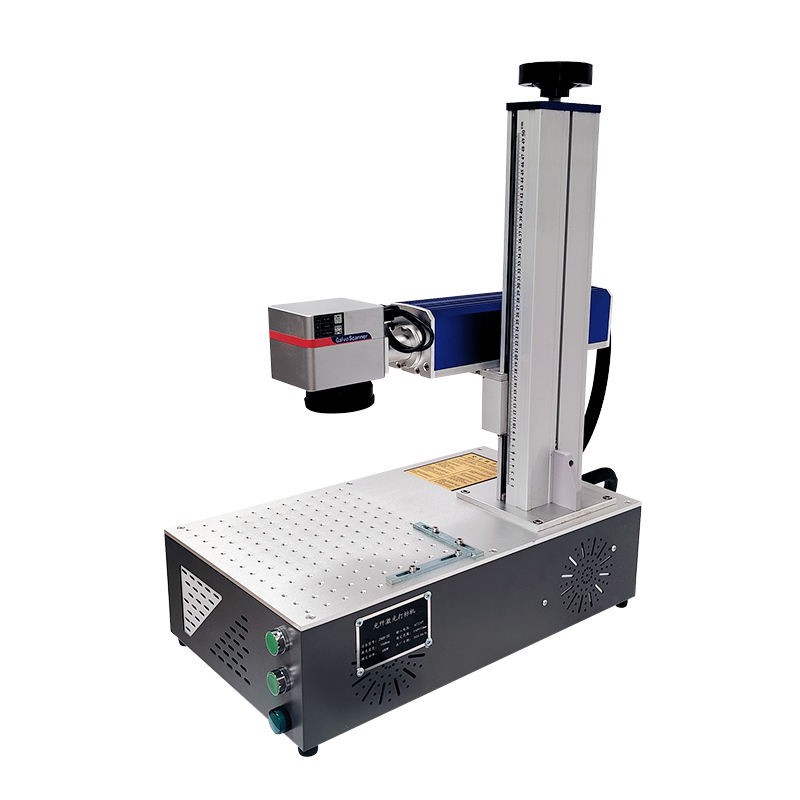
50W fiber Laser Marking Machine
MOPA Fiber Laser Marking Machine
Compared with standard fiber lasers, MOPA lasers offer a much wider pulse adjustment range, allowing more precise control of laser energy output. This helps reduce heat influence while improving detail quality.
Key advantages include:
Sharper marking edges
Better clarity for micro text
Superior performance on fine logos
Higher QR code readability
Less impact on gold surfaces
Better suited for high-value products
For premium jewelry brands, custom-made jewelry, commemorative gold coins, and precision precious metal products, MOPA lasers can deliver more refined visual results while maintaining exceptional accuracy.
If your primary needs involve standard logos, serial numbers, and product information, a 50W fiber laser marking machine is more than capable of meeting production requirements. However, if you place greater emphasis on brand image, intricate designs, and premium product appearance—and have a larger equipment budget—a MOPA fiber laser marking machine is usually the better choice.
How Does Gold Laser Marking Work?
For gold jewelry, gold bars, and precious metal gift products, the laser marking process is relatively straightforward. Using a standard desktop 50W fiber laser marking machine as an example, operators can typically handle daily production tasks after basic training.
Step 1: Create or Import Marking Content
First, import the content to be marked into the laser marking software.
Depending on the product, marking content may include:
Brand logos
Trademark graphics
Gold purity markings (999, 9999, etc.)
Product numbers
Serial numbers
QR codes
Personalized engraving
Most laser marking software allows direct text input and also supports importing files in formats such as:
AI
DXF
PLT
BMP
JPG
PNG
For custom jewelry businesses, names, commemorative dates, and personal messages are often added according to customer requirements.
Step 2: Position and Secure the Gold Product
Select the appropriate fixture or positioning jig based on the product shape.
Common products include:
Gold rings
Necklace pendants
Gold bars
Gold coins
Bracelets
Gold jewelry components
For circular products such as rings and bracelets, a rotary attachment is often used to enable circumferential engraving and continuous 360-degree marking.
Proper positioning ensures consistent logo placement and improves production consistency.
Step 3: Adjust Focus and Perform a Sample Test
Because gold surfaces are highly reflective, focus adjustment is usually required before formal processing.
The operator adjusts the worktable or focusing mechanism to ensure the laser focal point is precisely positioned on the gold surface.
Before mass production, many jewelry factories perform a test marking on a sample piece to verify:
Logo size
Text clarity
Position accuracy
Marking depth
This helps avoid testing directly on high-value products.
Step 4: Set Laser Parameters
Processing parameters are adjusted according to gold purity, product size, and marking requirements.
Main parameters include:
Laser power
Marking speed
Frequency
Hatch spacing
Number of passes
For example:
Surface logo marking typically uses higher speed and lower energy settings.
Deep engraving, relief patterns, or personalized engraving require increased processing time and laser energy.
For high-value gold products, manufacturers generally prefer shallow marking methods to maintain clarity while minimizing material removal.
Step 5: Start Laser Marking
Once the parameters have been confirmed, processing can begin.
The laser beam automatically follows the programmed path to complete the marking process without contacting the product surface or creating mechanical pressure.
For most gold products:
Simple logos usually require only a few seconds
Ring inner-band engraving typically takes less than one minute
QR code and serial number marking is also very fast
This makes laser marking ideal for both customized jewelry production and batch manufacturing.
Step 6: Quality Inspection and Mass Production
After marking is completed, operators typically inspect:
Logo completeness
Character edge quality
Marking position accuracy
QR code readability
Surface finish quality
Once the sample meets requirements, full-scale production can begin.
Conclusion
As the jewelry industry and precious metals market continue to grow, laser marking has become an essential technology for gold product identification, brand development, and personalized customization. Compared with mechanical engraving and traditional etching processes, laser marking offers higher precision, lower material loss, permanent results, and greater automation.
For gold jewelry, gold bars, commemorative coins, and premium gift products, fiber laser marking machines and MOPA fiber laser marking machines have become the most widely used gold marking solutions.
If you are looking for laser marking equipment for gold, 18K gold, white gold, rose gold, or other precious metal products, ZS Machinery can provide professional equipment recommendations and free sample testing services based on your specific products and processing requirements.
How to Choose a Laser Etching Company