Industrial Laser Engraver for Automated Production Lines
Modern manufacturing is no longer about producing a single product. It is about producing thousands—or even millions—of identical products every month while maintaining consistent quality, complete traceability, and maximum production efficiency.Whether you manufacture automotive components, electronic products, medical devices, metal parts, cables, food packaging, or consumer goods, every product leaving the factory requires permanent identification.
Traditional desktop laser engravers require manual loading and unloading, making them unsuitable for continuous industrial production. As manufacturing moves toward Industry 4.0, manufacturers increasingly require laser systems capable of operating continuously without interrupting the production line.
This is where an Industrial Laser Engraver becomes the ideal solution.

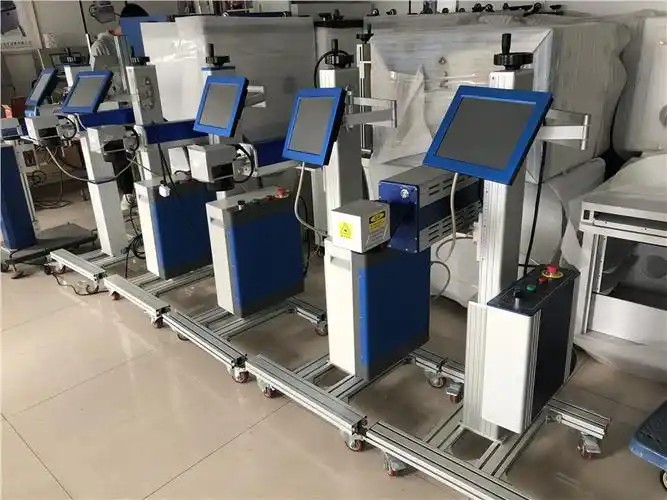
Flying UV Laser Marking Machine
What Is an Industrial Laser Engraver?
An Industrial Laser Engraver is an automated laser marking system designed to operate directly on a production line rather than as a standalone workstation.Unlike desktop laser engravers, products do not stop for marking. Instead, they continue moving along the conveyor while the laser synchronizes with the production speed and performs high-speed engraving in real time.
The entire process is controlled automatically through industrial communication systems, allowing manufacturers to permanently engrave identification information without reducing production efficiency.
A typical industrial laser engraving system consists of:
- Laser source
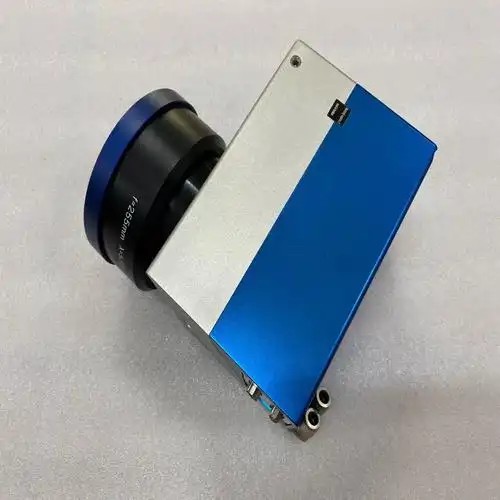
- Galvanometer scanning head
- Industrial controller
- Encoder
- Photoelectric sensor
- Conveyor system
- PLC communication module
- Vision positioning system (optional)
- Smoke extraction system
- MES/ERP communication interface
Once integrated into the production line, the laser operates automatically whenever a product reaches the marking position.No manual intervention is required.
How Does an Industrial Laser Engraver Work?
Although laser marking appears simple from the outside, industrial production requires multiple systems to work together simultaneously.
The process typically follows these steps:
Step 1 – Product Detection
A photoelectric sensor detects that a product has entered the engraving area.
Step 2 – Conveyor Speed Measurement
An encoder continuously measures conveyor speed and transmits real-time movement data to the laser controller.
This ensures that laser marking remains perfectly synchronized with moving products.
Step 3 – Data Acquisition
The controller receives production data from:
- MES
- ERP
- PLC
- Barcode database
- Production management software
The marking content may include:
- Variable QR Codes
- Date Codes
- Batch Numbers
- Serial Numbers
- Data Matrix Codes
- Logos
- Product IDs
Every product can receive completely unique information.
Step 4 – Flying Laser Marking
Instead of stopping production, the galvanometer dynamically compensates for conveyor movement while engraving.
This process is commonly known as Flying Laser Marking.
Products continue moving throughout the entire marking cycle.
Step 5 – Vision Inspection (Optional)
A vision camera automatically verifies:
- QR readability
- Character quality
- Position accuracy
- Missing marks
NG products can automatically be rejected from the production line.
Available Laser Types
Different materials require different laser wavelengths.ZS Machinery offers three industrial laser technologies.
Fiber Laser Industrial Engraver
Fiber lasers are the most widely used industrial engraving systems for metal materials.
Typical applications include:
- Stainless Steel
- Carbon Steel
- Aluminum
- Brass
- Copper
- Titanium
- Nickel
- Gold
- Silver
Typical industries include:
- Automotive Parts
- Metal Fabrication
- Hardware
- Bearings
- Hand Tools
- Machinery Components
- Aerospace Parts
Available powers 20W-300W.
For deep engraving applications such as molds, industrial nameplates, and steel components, higher power models significantly improve engraving efficiency.
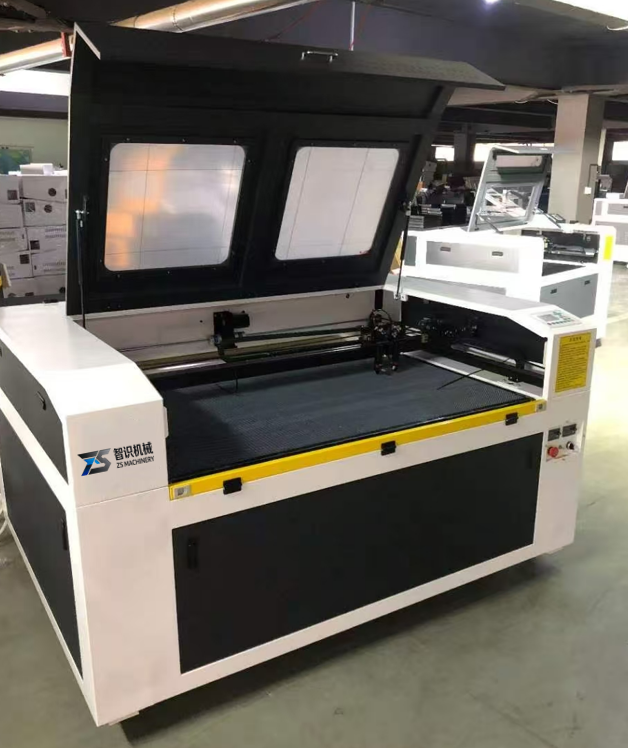
CO₂ Industrial Laser Engraver
CO₂ laser systems are designed primarily for organic and non-metallic materials.Suitable materials include:
- Paper
- Wood
- Leather
- Acrylic
- Glass
- Rubber
- Cardboard
- Packaging Materials
- Bamboo
- Ceramics
Typical industries include:
- Food Packaging
- Beverage Industry
- Pharmaceutical Packaging
- Wooden Crafts
- Leather Goods
- Gift Manufacturing
CO₂ lasers are particularly suitable for high-speed date coding and packaging production lines.
CO2 Laser Engraving Machine
UV Industrial Laser Engraver
UV lasers operate using a much shorter wavelength, producing extremely small heat affected zones.They are ideal for precision industries.
Applications include:
- PCB
- Flexible PCB
- Electronic Components
- Medical Packaging
- Plastic Bottles
- Transparent Plastics
- HDPE
- PP
- PET
- Glass
- Medical Devices
Because UV lasers generate minimal thermal stress, they are widely used wherever material damage must be minimized.
Why Flying Laser Marking Is Better Than Offline Engraving
Many manufacturers initially purchase desktop laser engravers.As production volume increases, manual engraving quickly becomes a bottleneck.An industrial laser engraver eliminates this problem.Advantages include:
- Continuous 24/7 operation
- No manual loading
- Automatic product detection
- Automatic serial number generation
- Automatic QR code generation
- No production interruption
- Higher consistency
- Lower labor cost
- Easy factory automation
For manufacturers producing thousands of products daily, flying laser marking often increases productivity several times compared with manual operation.
Typical Industrial Applications
Industrial laser engravers are now used across nearly every manufacturing industry.
Automotive Industry
Laser engraving is used for:
- Engine Parts
- Brake Components
- Bearings
- Transmission Parts
- Chassis Components
- VIN Identification
- Traceability Codes
Metal Fabrication
Common applications include:
- Steel Plates
- Stainless Steel Sheets
- Pipes
- Hardware
- Industrial Tools
- Machine Components
Electronics Industry
Laser systems engrave:
- PCB
- Circuit Boards
- Connectors
- Batteries
- Semiconductor Components
- Electronic Housings
Medical Industry
Medical manufacturers use laser engraving for:
- Surgical Instruments
- Medical Devices
- UDI Codes
- Traceability Information
- Stainless Medical Parts
Permanent marking ensures compliance with international medical regulations.
Food and Beverage Industry
Industrial CO₂ laser engravers are widely used for:
- Packaging Dates
- Batch Codes
- Expiration Dates
- QR Codes
- Bottle Caps
- Labels
Cable Industry
Laser engraving replaces ink printing by permanently marking:
- Cable Specifications
- Meter Counting
- Production Dates
- Brand Logos
Seamless Integration with Smart Factories
One of the greatest advantages of an industrial laser engraver is its ability to integrate with existing automation equipment.
ZS Machinery systems support communication with:
- PLC
- MES
- ERP
- Vision Systems
- Barcode Readers
- Industrial Robots
- Conveyor Systems
- Automatic Feeders
- Automatic Reject Systems
Communication protocols can be customized according to customer requirements, allowing our laser engravers to become part of a complete smart manufacturing ecosystem.
How to Choose the Right Industrial Laser Engraver
Choosing the correct system depends primarily on your production requirements.
If you process metal parts, a Fiber Laser system is generally the best option.
If your products are primarily packaging materials, paper, leather, or wood, a CO₂ Laser system offers better performance.
For PCB manufacturing, medical products, electronic components, or heat-sensitive plastics, a UV Laser provides the highest marking quality.
Other factors to consider include:
- Production speed
- Material type
- Conveyor speed
- Required marking depth
- QR code size
- Factory automation level
- Future expansion plans
An experienced laser supplier should evaluate these factors before recommending a configuration.
Why Choose ZS Machinery
Successful production line integration requires expertise in mechanical design, automation control, software development, motion synchronization, industrial communication, and long-term system stability.At ZS Machinery, we focus on delivering complete industrial laser processing solutions rather than standalone machines.
Our expertise includes:
- Industrial Fiber Laser Marking Systems
- CO₂ Laser Marking Systems
- UV Laser Marking Systems
- Production Line Integration
- PLC Communication
- MES & ERP Connectivity
- Vision Positioning
- Robot Integration
- Customized Automation Solutions
Beyond laser marking, we also provide one-stop solutions for laser cutting and laser welding, helping manufacturers build efficient, intelligent, and fully integrated production systems.
Whether you require a standalone engraver or a fully automated production line, our engineering team can design a solution tailored to your products, factory layout, and manufacturing process.
Request a Custom Industrial Laser Engraving Solution
Every production line is different.Whether you need a Fiber, CO₂, or UV industrial laser engraver, ZS Machinery can provide equipment selection, automation design, sample testing, software customization, and complete production line integration.
Contact our engineering team today to discuss your application and receive a customized industrial laser engraving solution designed specifically for your manufacturing requirements.
20W Fiber Laser vs 30W Fiber Laser: Is Saving $100 Really Worth It?