Cable Laser Marking: The Complete Guide to Laser Cable Identification
Cable laser marking technology has become an essential part of modern wire and cable manufacturing. Whether producing power cables, automotive wiring, communication cables, fiber optic cables, or industrial control cables, manufacturers must permanently print product information directly onto the cable jacket throughout the production process.
Today, more cable manufacturers are using laser cable marking machines. Laser technology produces permanent, high-contrast markings without ink, solvents, or direct contact with the cable surface. The marking remains readable even after years of installation, exposure to oil, sunlight, moisture, abrasion, or high temperatures.
More importantly, modern flying laser marking systems can be fully synchronized with cable extrusion lines, enabling continuous high-speed production without slowing down the manufacturing process.
This guide explains how cable laser marking works, how it integrates into production lines, which laser technologies are suitable for different cable materials, and why laser marking has become the preferred identification solution for modern cable manufacturers worldwide.
Cable Laser Marking
How Electrical Cables Are Manufactured And Marked
To understand why laser marking has become so important, it helps to understand how a cable is manufactured.Although different cable types use different materials and structures, the overall production process is remarkably similar across the industry.
A typical cable manufacturing line consists of the following stages:
Copper Rod → Wire Drawing → Annealing → Stranding → Insulation Extrusion → Cooling → Online Laser Marking → Meter Counting → Take-up → Packaging
Each process performs a specific function before the finished cable reaches the customer.
Step 1 — Wire Drawing
The process begins with large-diameter copper or aluminum rods.Drawing machines gradually reduce the wire diameter through multiple dies until it reaches the required conductor size.
For example:
- 0.5 mm²
- 1.5 mm²
- 2.5 mm²
- 6 mm²
- 16 mm²
The surface quality of the conductor directly affects electrical performance and flexibility.
Step 2 — Annealing
Drawing hardens the conductor.Annealing heats the metal under controlled conditions to restore flexibility.Without annealing, the conductor would become brittle and difficult to bend.
Step 3 — Stranding
Instead of using one solid conductor, most industrial cables consist of many fine wires twisted together.Stranding improves:
flexibility,fatigue resistance,vibration resistance and Installation performance.
Automotive cables, robotic cables and drag-chain cables all rely heavily on stranded conductors.
Step 4 — Insulation and Jacket Extrusion
This is the most critical stage.Molten polymer is extruded around the conductor to create the cable insulation or outer jacket.
The most common jacket materials include:
| Material | Typical Applications |
|---|---|
| PVC | Power cables, building wires |
| PE | Communication cables |
| XLPE | High-voltage power cables |
| LSZH | Railway, subway, public buildings |
| TPU | Robotics and automation |
| Silicone Rubber | Medical and high-temperature cables |
| TPE | Flexible industrial cables |
Each material has different laser absorption characteristics, which directly affects the choice of laser source.
Step 5 — Online Laser Marking
Unlike desktop laser machines, the cable never stops moving.Instead, the laser synchronizes its scanning speed with the production line, allowing permanent information to be marked continuously while the cable travels at full speed.
Depending on the extrusion line, production speeds may range from:
- 50 m/min
- 120 m/min
- 200 m/min
- 300 m/min
Some high-speed communication cable lines exceed 500 meters per minute, making precise synchronization essential.
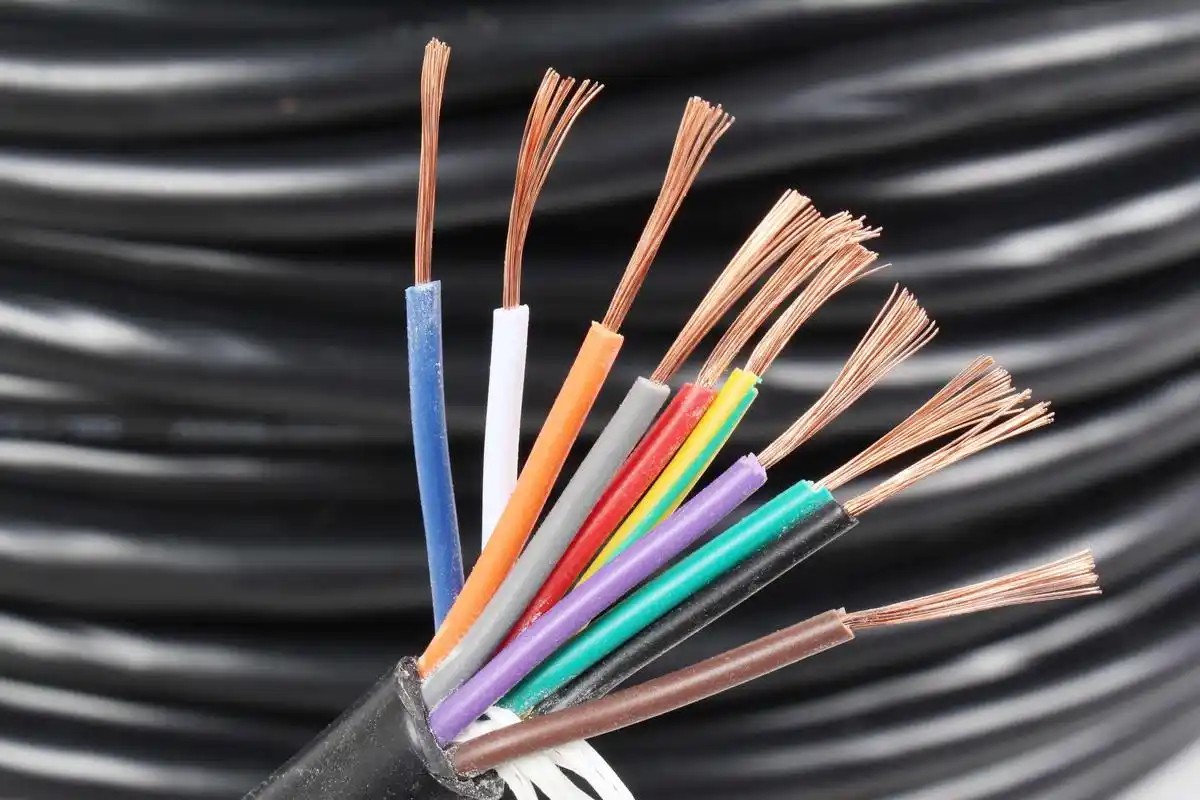
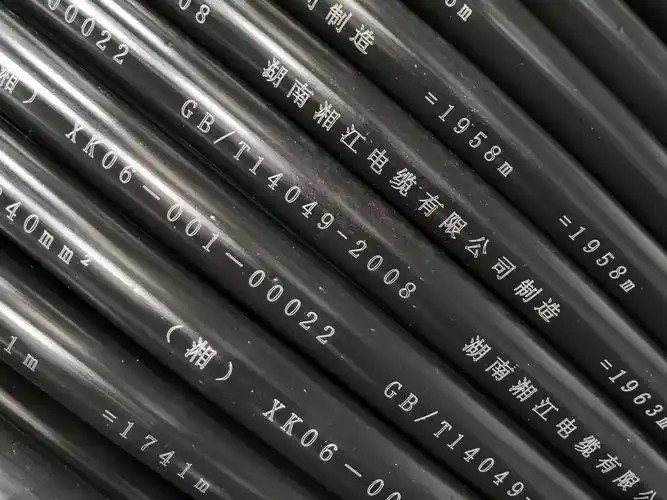
Cable pictures
Why Permanent Cable Identification Matters
Many people assume the printed information on a cable is simply for branding.In reality, it serves multiple critical functions throughout the cable’s entire lifecycle.A modern cable typically contains information such as:
- Manufacturer name
- Company logo
- Cable model
- Voltage rating
- Conductor size
- Temperature rating
- Fire resistance classification
- UL certification number
- CE marking
- Production date
- Batch number
- Meter marking
- Customer-specific information
For example, a power cable may be marked as:
ZS MACHINERY
H07V-K
450/750V
1.5 mm²
CE
100 mFor industries such as automotive wiring, aerospace, rail transportation, medical devices, and industrial automation, permanent identification is often required by international standards and customer specifications.
How Flying Laser Marking Works on a Cable Production Line
Unlike a desktop laser engraver that marks one stationary product at a time, a cable laser marking machine operates on a continuously moving production line. The cable never stops, yet every character, logo, and meter mark must appear in exactly the correct position.
This is achieved through flying laser marking technology.
Instead of moving the product under a stationary laser, the laser beam dynamically compensates for the cable’s movement in real time. The result is permanent, high-quality marking without interrupting production.
This technology has become the standard solution for modern wire and cable manufacturers because it combines high speed, excellent marking quality, and full production automation.
The Principle of Flying Laser Marking
A flying laser marking system is essentially synchronized with the production line.As the cable moves forward, an industrial encoder continuously measures its speed and position.The encoder sends this information to the laser controller, which instantly calculates how the scanning mirrors should move.
Rather than firing at a fixed point, the galvanometer scanner “tracks” the moving cable while the laser writes the required information.Because the calculation is completed in milliseconds, the text appears perfectly stationary even though the cable may be moving at over 200 meters per minute.
This synchronization process is repeated thousands of times every second throughout production.
Typical Production Line Layout
A typical cable extrusion line using laser marking is arranged as follows:
Extruder
      │
Cooling Tank
      │
Air Knife
      │
Encoder
      │
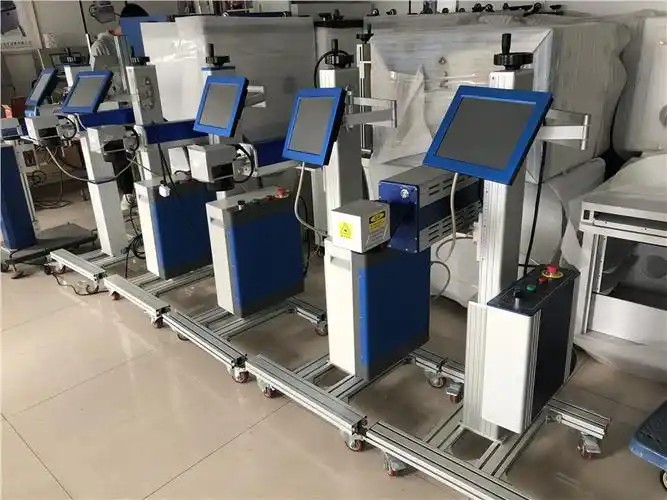
Flying Laser Marking Machine
      │
Meter Counter
      │
Spark Tester (Optional)
      │
Take-up Machine
Flying UV Laser Marking Machine
Which Cable Materials Can Be Laser Marked?
One of the first questions customers ask is:
“Can a laser mark my cable material?”
The answer depends not only on the jacket material itself but also on its color, additives, production process, and the laser source being used.
Although hundreds of cable compounds are available on the market, most industrial cables use one of the following materials.
1.PVC (Polyvinyl Chloride)
PVC is by far the most common cable jacket material in the world.
It is widely used for:
- Building wire
- Household electrical cables
- Low-voltage power cables
- Industrial control cables
- General-purpose wiring
PVC offers excellent processability and low manufacturing cost, making it the standard choice for many applications.
Laser marking on PVC is generally straightforward, especially when the material contains laser-sensitive additives supplied by the compound manufacturer.
2.PE (Polyethylene)
Polyethylene is widely used in communication and outdoor cables because of its excellent electrical insulation and weather resistance.
Common applications include:
- Communication cables
- Coaxial cables
- Outdoor signal cables
- Fiber optic cables
PE is generally more difficult to mark than PVC because of its lower laser absorption.
3.XLPE (Cross-Linked Polyethylene)
XLPE is commonly used for:
- Medium-voltage cables
- High-voltage power cables
- Renewable energy cables
- Industrial power distribution
These cables often operate under harsh environmental conditions, making permanent identification especially important.
Typical markings include:
- Voltage class
- Conductor size
- Manufacturer
- Standard number
- Meter count
Because these cables remain in service for decades, laser marking provides a much more durable solution than ink-based printing.
4.LSZH (Low Smoke Zero Halogen)
As fire safety standards continue to improve, LSZH cables have become increasingly popular.
They are commonly installed in:
- Airports
- Railways
- Hospitals
- Data centers
- Commercial buildings
- Tunnels
LSZH compounds are more sensitive than PVC, so selecting appropriate laser parameters is essential.
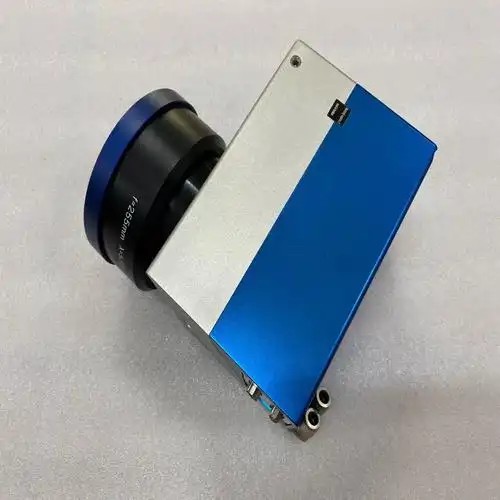
A properly configured UV laser can produce clean, high-contrast markings while minimizing thermal effects on the cable jacket.
5.TPU and TPE
Flexible cables used in robotics and industrial automation frequently use TPU or TPE jackets.
Typical applications include:
- Robot cables
- Drag chain cables
- Industrial sensors
- Automated production equipment
These materials offer excellent flexibility and abrasion resistance but require careful parameter optimization during laser marking.
When configured correctly, laser marking produces permanent identification without affecting the cable’s flexibility or mechanical performance.
6.Silicone Rubber
Medical devices, laboratory equipment, and high-temperature applications often use silicone-insulated cables.
These products demand extremely clean marking because they are frequently used in regulated industries.
UV laser systems are generally preferred due to their low heat input and excellent marking precision.
Choosing the Right Laser Technology
Not every laser source performs equally on every cable material.Understanding the strengths of each technology helps manufacturers select the most suitable system.
Fiber Laser
Fiber lasers are widely recognized for marking metals.In the cable industry, however, they are typically used for:
- Stainless steel cable tags
- Aluminum identification plates
- Metal nameplates
- Wire harness identification labels
Although fiber lasers can mark certain engineering plastics containing laser additives, they are generally not the first choice for marking standard PVC or PE cable jackets.
If your production mainly involves metal identification components associated with cables rather than the cable insulation itself, a fiber laser offers excellent speed, reliability, and operating cost.
CO₂ Laser
CO₂ lasers have been used in cable manufacturing for many years and remain a common solution for high-speed production.
They perform well on many polymer materials, particularly when cable compounds are specifically formulated for laser marking.Advantages include:
- High production speed
- Stable continuous operation
- Mature industrial technology
- Suitable for many extrusion lines
For manufacturers producing large volumes of standard electrical cables, CO₂ laser marking remains a proven and economical solution.
UV Laser
UV laser technology has become increasingly popular for premium cable manufacturing.Unlike infrared lasers, UV lasers use a much shorter wavelength, allowing energy to be absorbed more efficiently by many plastics.
This produces several advantages:
- Smaller heat-affected zone
- Sharper characters
- Cleaner edges
- Better contrast
- Reduced risk of material deformation
UV lasers are particularly suitable for:
- Medical cables
- Communication cables
- High-end electronics
- White cable jackets
- Transparent materials
- Small-diameter cables
Although UV laser systems require a higher initial investment, they often provide superior marking quality for demanding applications.
Typical Cable Applications
Different industries require different identification standards.
A modern cable laser marking machine must therefore be capable of handling a wide range of products.
Power Cables
Power cables usually require straightforward but highly durable information such as:
- Cable specification
- Voltage rating
- Manufacturer
- Standard number
- Meter marking
Because these products are installed for decades, permanent readability is essential.
Automotive Wiring
Automotive manufacturers impose extremely strict quality standards.
Laser marking may include:
- Part numbers
- Batch numbers
- Supplier codes
- Traceability information
- QR Codes
Permanent identification simplifies vehicle maintenance and warranty management.
Medical Cables
Medical equipment requires exceptionally clean marking.
Typical products include:
- Patient monitoring cables
- Surgical equipment
- Diagnostic instruments
UV laser systems are commonly selected because they produce precise markings while minimizing thermal damage.
Fiber Optic Cables
Fiber optic communication cables often have very small diameters.
Marking must remain legible without affecting cable performance.
Typical information includes:
- Fiber count
- Cable model
- Manufacturer
- Production date
High-resolution UV laser systems are especially well suited to these applications.
EV High-Voltage Cables
The rapid growth of electric vehicles has significantly increased demand for high-voltage cable production.
These cables typically require permanent identification including:
- Voltage class
- Orange safety marking
- Manufacturer
- Production batch
- Certification information
As production volumes continue to grow, fully automated flying laser marking has become the preferred solution for many EV cable manufacturers.
Typical Questions from Cable Manufacturers
Over the years, we have worked with customers producing power cables, automotive wiring, communication cables, and industrial control cables. The questions they ask are often very similar.
Will laser marking damage the cable jacket?
No.
When the correct laser type and parameters are selected, laser marking only modifies a very thin surface layer of the jacket without affecting its electrical insulation or mechanical performance.
Is laser marking fast enough for continuous extrusion?
Yes.
Modern flying laser marking systems are specifically designed for continuous production.
With encoder synchronization, the laser automatically follows changes in line speed and maintains consistent marking quality throughout production.
Can the laser automatically change the marking content?
Yes.
The software can generate variable information automatically, including:
- Meter numbers
- Production dates
- Batch numbers
- Serial numbers
- QR Codes
- Customer-specific data
This eliminates manual editing and reduces operator error.
Does laser marking require consumables?
No.
Unlike inkjet printers, laser systems require:
- No ink
- No solvent
- No ribbons
- No labels
Routine maintenance is generally limited to cleaning optical components and following standard preventive maintenance procedures.
Can one laser machine mark different cable sizes?
Yes.
As long as the cable remains within the marking field of the scanning head, the same system can handle multiple cable diameters after appropriate parameter adjustment.
Why Choose ZS Machinery
At ZS Machinery, we understand that a cable laser marking machine is not simply another piece of equipment—it is part of a complete production solution.
Our engineering team works closely with cable manufacturers to ensure every system matches the customer’s production process, cable materials, and automation requirements.
We provide solutions for:
- Power cable production
- Automotive wiring
- Communication cables
- Fiber optic cables
- Medical cables
- Industrial control cables
- High-voltage EV cables
Our systems support multiple laser technologies, including:
- Fiber Laser
- CO₂ Laser
- UV Laser
Depending on the production line, we can also provide:
- Flying laser marking systems
- Encoder synchronization
- PLC communication
- MES integration
- Automatic serial number generation
- QR code marking
- Vision positioning
- Customized production line integration
Before equipment delivery, we can perform free sample testing using your own cable materials and recommend the most suitable laser configuration based on actual marking results rather than theoretical specifications.
Whether you are upgrading an existing extrusion line or building a new automated cable production facility, our goal is to help you achieve stable production, permanent identification, and lower long-term operating costs.
CO2 Galvo Laser: Complete Guide to High-Speed Laser Marking and Engraving Systems