CO2 Galvo Laser: Complete Guide to High-Speed Laser Marking and Engraving Systems
A CO2 galvo laser is a high-speed laser processing system that uses a galvanometer scanning head to control the movement of the laser beam instead of traditional mechanical axes. Compared with conventional CO2 laser engraving machines, a CO2 galvo laser offers significantly faster marking speed, higher efficiency, and better suitability for industrial production environments.
With a wavelength of 10.6μm, CO2 lasers have excellent absorption characteristics on non-metal materials such as plastics, wood, glass, leather, rubber, and packaging materials. When combined with a high-speed galvanometer scanner, CO2 laser technology becomes an ideal solution for industrial marking, coding, engraving, and online production applications.
Today, CO2 galvo laser marking machines are widely used in industries including packaging, electronics, automotive components, cable manufacturing, consumer products, and industrial automation.
What Is a CO2 Galvo Laser?
A CO2 galvo laser is a laser marking system that combines a CO2 laser source with a galvanometer scanning system.
The word “galvo” comes from galvanometer, a high-speed motor system that controls small mirrors to change the direction of the laser beam.Instead of physically moving the laser head along X and Y axes, the galvo scanner rapidly adjusts the laser path using two mirrors:
- X-axis scanning mirror
- Y-axis scanning mirror
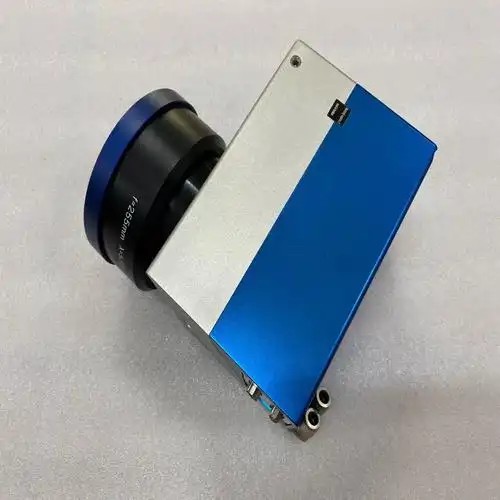
The laser beam is reflected through these mirrors and focused onto the material surface through an F-theta lens.
The basic structure is:
CO2 Laser Source
↓
Beam Expansion System
↓
Galvanometer Scanner
↓
F-Theta Lens
↓
Material Surface
Because the mirrors move electronically rather than mechanically, the scanning speed is much faster than traditional motion systems.
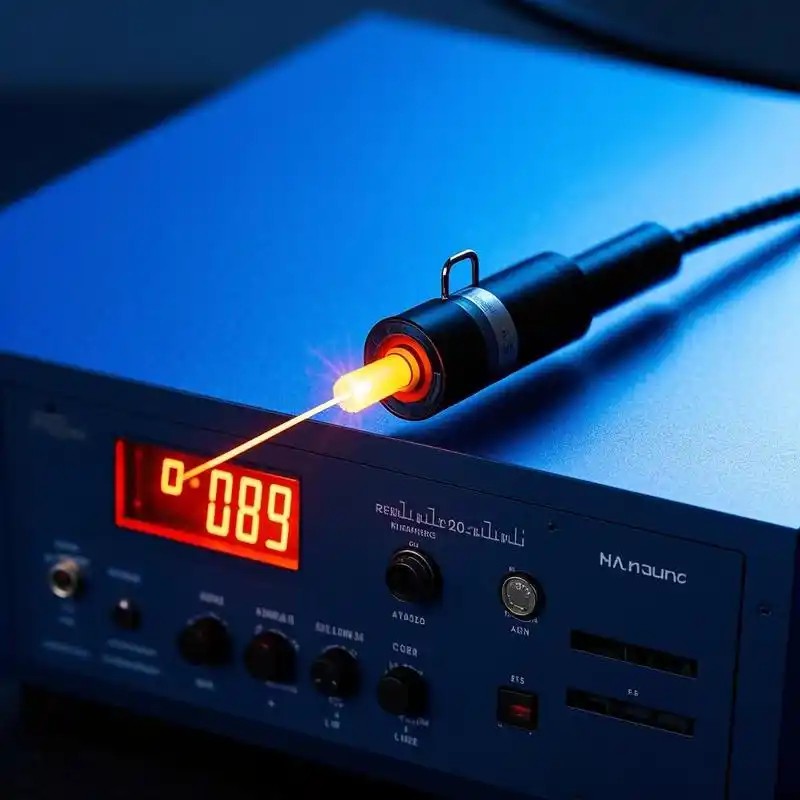
High speed CO2 Laser Source
How Does a CO2 Galvo Laser Work?
The working principle begins inside the CO2 laser source.
A CO2 laser generates infrared laser energy by exciting a gas mixture containing:
- Carbon dioxide (CO₂)
- Nitrogen (N₂)
- Helium (He)
The generated laser wavelength is approximately:10.6 microns (10.6μm)
This wavelength is strongly absorbed by many organic and polymer materials.
When the laser beam reaches the material surface, the energy causes:
- Material evaporation
- Surface carbonization
- Color change
- Surface modification
- Controlled material removal
The final effect depends on:
- Laser power
- Marking speed
- Frequency
- Focus position
- Material characteristics
For example:
On plastic:
The laser may create a high-contrast mark by changing the surface structure.
On wood:
The laser removes material to create engraved patterns.
On glass:
The laser produces microscopic cracks and surface modification.
CO2 Galvo Laser vs Traditional CO2 Laser Engraver
Although both systems use CO2 laser technology, their applications are very different.
Traditional CO2 Laser Engraving Machine
A conventional CO2 laser engraver usually works by moving:
- Laser head
- Working table
- Mechanical X/Y axis
The advantages include:
- Large working area
- Ability to cut thick materials
- Suitable for engraving large graphics
Typical applications:
- Acrylic cutting
- Wood engraving
- Large signage production
- Crafts manufacturing
However, mechanical movement limits the marking speed.
CO2 Galvo Laser System
A CO2 galvo laser uses optical scanning instead of mechanical movement.
Advantages:
- Much faster marking speed
- Higher positioning accuracy
- Less mechanical wear
- Better for automation
- Suitable for production lines
Typical applications:
- Product identification
- Serial number marking
- Barcode marking
- Packaging coding
- Industrial component marking
The difference can be summarized as:
| Traditional CO2 Laser | CO2 Galvo Laser | |
|---|---|---|
| Movement method | Mechanical axis | Galvanometer scanner |
| Speed | Medium | Very high |
| Large cutting area | Excellent | Limited |
| Industrial marking | Good | Excellent |
| Production line integration | Limited | Excellent |
| Maintenance | More mechanical parts | Lower mechanical wear |
A simple way to understand the difference:
A traditional CO2 laser is mainly a cutting and engraving machine.
A CO2 galvo laser is mainly a high-speed industrial marking system.
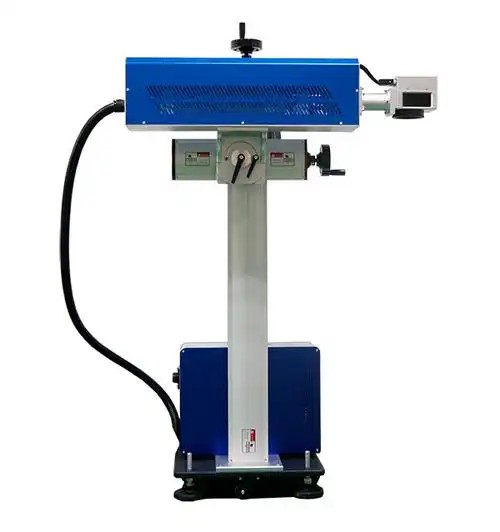
Flying CO2 Laser Marking Machine
What Materials Can a CO2 Galvo Laser Process?
One of the biggest advantages of CO2 laser technology is its excellent performance on non-metal materials.
Plastic Materials
CO2 galvo lasers are widely used for plastic marking.
Common materials include:
- ABS
- PC
- PVC
- Nylon
- Acrylic
- Polypropylene
- Engineering plastics
Applications include:
- Electronic housings
- Automotive plastic parts
- Switches
- Connectors
- Consumer products
Typical markings:
- Logo
- Product model
- Serial number
- Safety symbols
- Traceability codes
Wood
CO2 lasers are naturally absorbed by wood materials.
Applications include:
- Furniture components
- Wooden gifts
- Decorative products
- Packaging boxes
- Custom products
The laser can create:
- Deep engraving
- Fine patterns
- Text
- Images
Glass
Glass is another classic application for CO2 lasers.
Applications include:
- Beverage bottles
- Cosmetic packaging
- Glass containers
- Decorative products
The laser creates controlled surface modification, producing a permanent frosted appearance.
Leather and Textile Materials
CO2 galvo lasers are widely used in:
- Leather products
- Shoes
- Bags
- Clothing accessories
Advantages:
- No mechanical contact
- High flexibility
- Suitable for customized production
Packaging Materials
The packaging industry is one of the largest applications.
Products include:
- Plastic bottles
- Film packaging
- Cartons
- Food packaging
Laser marking can replace traditional printing methods for:
- Date codes
- Batch numbers
- Barcodes
- Production information
Because there are no inks or solvents, laser marking provides a cleaner production environment.
CO2 Galvo Laser Applications
Industrial Product Marking
Modern factories require permanent identification.
CO2 galvo lasers can mark:
- Product numbers
- Logos
- QR codes
- Safety information
- Production data
Cable and Wire Marking
In cable manufacturing, CO2 galvo laser systems can be integrated into extrusion lines.
Applications include:
- PVC cables
- PE cables
- Communication cables
- Industrial wires
The laser works together with:
- Encoder
- PLC system
- Production controller
allowing continuous flying marking during production.
Electronics Industry
Electronic products often contain plastic components requiring permanent identification.
Examples:
- Chargers
- Switches
- Connectors
- Plastic housings
CO2 laser marking provides:
- Fine characters
- Permanent marks
- No consumables
Automotive Components
Automotive suppliers use CO2 lasers for marking:
- Plastic interior parts
- Engine components
- Electrical connectors
Traceability information helps manufacturers manage quality control.
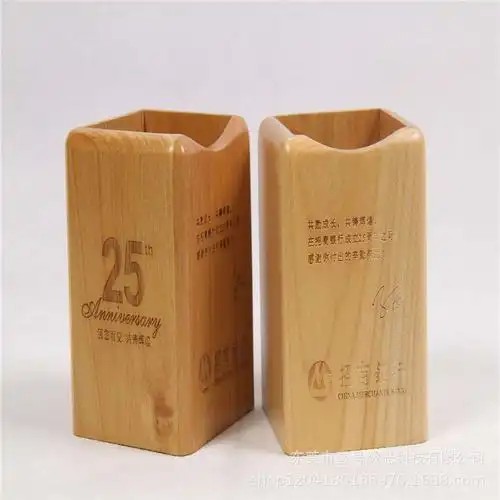
CO2 Laser Marking On Wood
CO2 Galvo Laser for Industrial Flying Marking
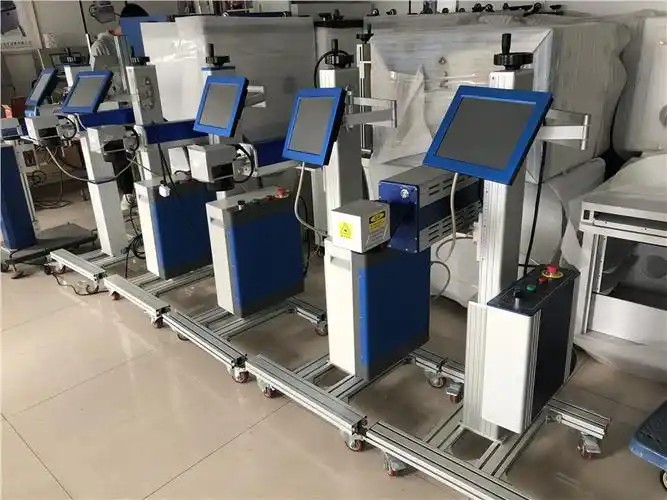
One of the most important advantages of a CO2 galvo laser is its ability to integrate into automated production lines.
A typical system includes:
Production Line
↓
Product Sensor
↓
Encoder
↓
CO2 Galvo Laser Marker
↓
Inspection System
↓
PackagingCO2 Galvo Laser Power Selection
CO2 galvo laser systems are available in different power levels.
Common options include:
10W-20W CO2 Galvo Laser
Suitable for:
- Plastic marking
- Packaging
- Light engraving
- Small components
30W-60W CO2 Galvo Laser
The most common industrial range.
Suitable for:
- Faster production
- Deeper engraving
- Larger marking areas
100W+ CO2 Galvo Laser
Used for:
- Deep engraving
- Heavy-duty applications
- High-speed industrial processing
Higher power does not always mean better results.
The correct configuration depends on:
- Material
- Required depth
- Production speed
- Marking quality
CO2 Galvo Laser vs Fiber Laser
Many customers ask whether they should choose CO2 or fiber laser technology.
The answer depends mainly on the material.
| CO2 Laser | Fiber Laser | |
|---|---|---|
| Wavelength | 10.6μm | 1064nm |
| Plastic | Excellent | Limited |
| Wood | Excellent | No |
| Glass | Excellent | No |
| Metal | Limited | Excellent |
| Stainless steel | Special applications | Excellent |
Fiber lasers are the preferred choice for metals.
CO2 lasers are the preferred choice for non-metal materials.
CO2 Galvo Laser vs RF CO2 Laser
For industrial applications, the laser source type also matters.
Traditional glass tube CO2 lasers:
Advantages:
- Lower cost
- Simple structure
Disadvantages:
- Shorter lifetime
- Lower frequency response
- Less suitable for high-speed marking
RF CO2 lasers:
Advantages:
- Better beam quality
- Faster response
- Higher stability
- Longer lifetime
For continuous industrial production, RF CO2 laser sources are usually the preferred solution.
How to Choose a CO2 Galvo Laser System?
Before purchasing a system, manufacturers should consider:
Material
What materials need to be processed?
Plastic, glass, wood, or packaging materials require different parameters.
Production Speed
For automated production lines, the laser must match the maximum line speed.
Marking Area
Common scanning fields include:
- 70×70mm
- 110×110mm
- 175×175mm
- 300×300mm
Larger fields provide more working area but slightly reduce energy density.
Automation Requirements
Industrial users should consider:
- Encoder integration
- PLC communication
- MES connection
- Vision inspection
Why Choose ZS Machinery
ZS Machinery provides complete laser processing solutions for industrial customers.
Our solutions include:
- CO2 galvo laser marking systems
- Fiber laser marking machines
- UV laser marking systems
- Flying marking solutions
- Automation integration
We help customers select the right laser technology according to:
- Material characteristics
- Production requirements
- Marking speed
- Product quality standards
From individual marking machines to complete production line integration, ZS Machinery focuses on providing reliable and practical laser processing solutions.Fell free to contact us if you need any marking solutions.
Top 5 Mini Laser Engraving Machine Brands for Metal in 2026: Complete Buying Guide