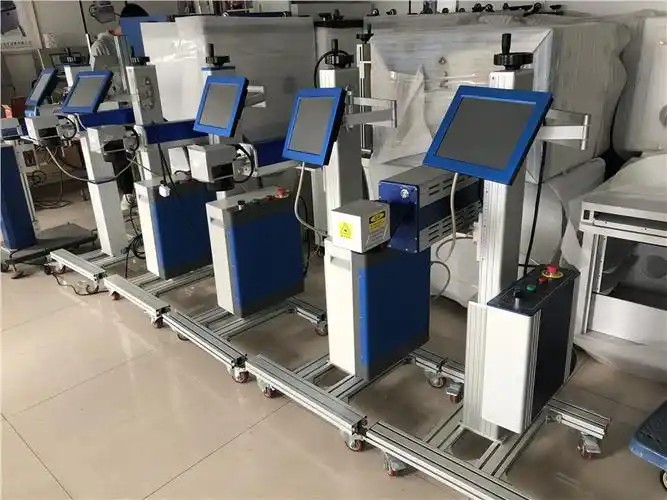
Galvo Scanner for Laser Marking: How Laser Galvanometer Scanners Work
A galvo scanner for laser marking is one of the most important components in a modern laser marking machine. Unlike a conventional engraving system that moves the entire laser head or worktable mechanically, a galvo scanning system changes the direction of the laser beam by rapidly rotating small mirrors. This allows the laser to move across the marking field at extremely high speed.
A complete laser marking system is not simply a laser source. It combines the laser source, galvo scanner, scanning lens, control system, software, and material-processing parameters to produce the final marking result.Understanding how these components work together is important when choosing a fiber, CO₂, or UV laser marking machine, especially for high-speed industrial applications.
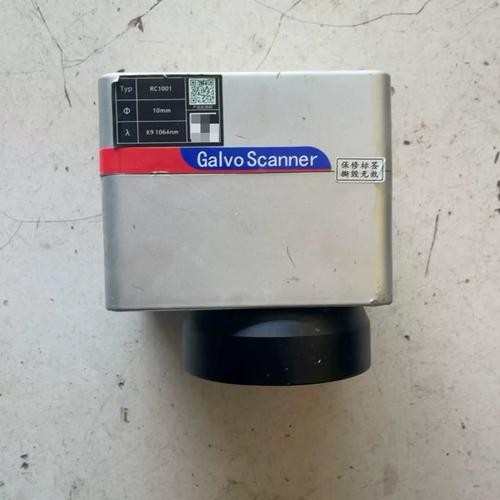
Jin Hai Chuang Laser marking machine galvanometer
What Is a Galvo Scanner?
A galvo scanner, also called a galvanometer scanner or laser galvanometer scanner, is an optical beam-steering system.Its primary function is to control the position of the laser beam.A simplified laser marking system can be represented as:
Laser Source → Beam Delivery → Galvo Mirrors → F-Theta Lens → Workpiece
The galvo scanner normally contains two scanning axes.One mirror controls the beam movement primarily in one direction, while the second mirror controls the other direction.By coordinating these two mirrors, the laser beam can rapidly scan across a two-dimensional marking area.
The important point is that the galvo scanner is not the laser source.A fiber laser, CO₂ laser, or UV laser generates the laser beam. The galvo scanner controls where that beam goes.Therefore:
The laser determines how the material interacts with the beam, while the galvo scanner determines how the beam is positioned and moved.This distinction is important when evaluating laser marking equipment.
How Does a Galvo Scanner Work?
The operating principle is relatively simple, although the control system behind it can be highly precise.A typical system contains two major scanning mirrors.
First Galvo Mirror
The first mirror changes the beam angle in one direction.
Second Galvo Mirror
The second mirror changes the beam angle in the perpendicular direction.By controlling both mirrors simultaneously, the laser beam can be positioned at different points within the marking field.For example, the controller may command the laser to move from:Point A → Point B → Point C → Point D
The mirrors rotate by extremely small angles to redirect the beam along the required path.Because the mirrors are lightweight, they can change position much faster than a large mechanical laser head or worktable.This is the fundamental reason galvo systems are so effective for high-speed laser marking.
What Is Inside a Galvo Scanning System?
A galvo scanner is more than just two mirrors.A typical system may include:
Galvanometer Motor
The motor converts electrical control signals into precise angular movement.
Scanning Mirror
The mirror reflects the laser beam while changing its direction.
Position Feedback
The system needs to know the actual position of the mirror so that the controller can accurately control the beam.
Driver and Controller
The electronics coordinate the movement of the two scanning axes and synchronize the laser with the beam position.The quality of these components can influence:
- Scanning speed
- Positioning accuracy
- Repeatability
- Marking quality
- Dynamic response
This is why two laser marking machines with similar laser power can still produce different results.
Why Is Galvo Scanning So Fast?
The biggest advantage of a galvo system is that it moves the laser beam, rather than physically moving a heavy laser head.Consider a traditional mechanical system.The machine may need to move:Motor → Rail → Laser Head → LensThe mechanical components have mass and inertia.
A galvo system instead moves a small mirror:Electrical Signal → Galvo Motor → Mirror → Laser BeamThe moving mass is much smaller.As a result, the beam can change direction rapidly.
For applications where the laser must repeatedly draw relatively small patterns, this can provide a major productivity
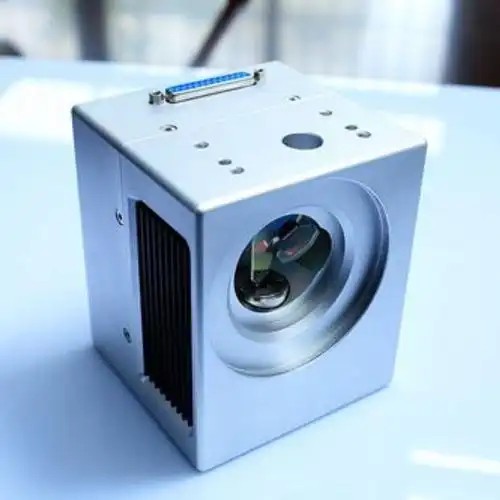
Galvanometer system
advantage.
Galvo Scanner vs. XY Gantry System
Galvo and XY gantry systems are not competitors in every application.They are designed around different priorities.
| Feature | Galvo Scanner | XY Gantry |
|---|---|---|
| Beam movement | Optical | Mechanical |
| Scanning speed | Very high | Generally lower |
| Small detailed marking | Excellent | Good |
| Large-area processing | Limited by lens | Excellent |
| Cutting | Limited | Excellent |
| Engraving | Excellent | Excellent |
| High-speed marking | Excellent | Good |
| Production-line marking | Very suitable | Application dependent |
A galvo system is generally optimized for high-speed marking and engraving.
A gantry system is more suitable when the machine needs to cover a very large working area or perform cutting operations.
Therefore, it would be incorrect to say that a galvo scanner is simply “better” than a gantry system.The better solution depends on the application.
What Is an F-Theta Lens?
The F-Theta lens is another critical part of a galvo laser marking system.The galvo mirrors control the direction of the laser beam, but the beam still needs to be focused onto the workpiece.The F-Theta lens performs this optical function.It is designed to create a relatively flat and usable scanning field so that the laser can be focused across the marking area.Different lenses provide different marking fields.Common configurations may include:
- 70 × 70 mm
- 110 × 110 mm
- 175 × 175 mm
- 200 × 200 mm
- 300 × 300 mm
The appropriate lens depends on the application.
A larger marking field can process larger products, but there are usually trade-offs involving:
- Spot size
- Energy density
- Resolution
- Focal characteristics
- Marking quality
Therefore:A larger marking field does not automatically mean a better laser marking system.
For fine engraving, a smaller field may provide a smaller and more concentrated spot.
For large products, a larger field may be more convenient.
The lens should therefore be selected according to the actual workpiece and marking requirements.
What Determines Galvo Marking Quality?
It is easy to assume that the galvo scanner alone determines marking quality.In reality, several components work together.
Laser Source
The laser source determines important characteristics such as:
- Wavelength
- Average power
- Pulse characteristics
- Energy distribution
These characteristics determine how the material absorbs the laser.
Galvo Scanner
The galvo system affects:
- Beam positioning
- Scanning speed
- Repeatability
- Dynamic response
F-Theta Lens
The lens affects:
- Marking area
- Spot size
- Focus
- Resolution
Software
The software determines how the marking path is generated.
It can affect:
- Vector movement
- Hatch patterns
- Jump movements
- Acceleration
- Marking strategy
Material Parameters
Finally, the material itself plays a major role.Laser power, speed, frequency, pulse width, hatch spacing, number of passes, and other parameters all influence the final result.Therefore, a high-quality mark is the result of:Laser + Galvo + Lens + Software + Parameters + Material rather than a single component.
What Is the Difference Between Galvo Speed and Marking Speed?
This is an important point when comparing laser marking machines.Manufacturers may advertise a galvo scanning speed such as:7,000 mm/s or another high maximum value.However, this does not mean that every material can be marked at that speed while maintaining the required quality.Actual production speed depends on:
- Laser power
- Material
- Marking depth
- Line spacing
- Hatch pattern
- Pulse frequency
- Graphic complexity
- Acceleration and deceleration
- Required contrast
For example, deep engraving generally requires more laser energy than a simple surface mark.A QR code may require a different strategy from a large filled logo.Therefore:Maximum galvo speed is not the same as actual production speed.When evaluating a machine, it is more useful to ask for a sample test using the actual material and marking requirements.
Which Lasers Can Use Galvo Scanners?
Galvo scanning technology can be combined with different laser sources.The three common configurations are:
- Fiber laser + galvo
- CO₂ laser + galvo
- UV laser + galvo
The galvo principle is similar, but the laser wavelength and material interaction are different.
Fiber Laser Galvo
Fiber laser galvo systems are widely used for metal marking.Typical materials include:
- Stainless steel
- Carbon steel
- Aluminum
- Brass
- Copper
- Titanium
Applications include:
- Industrial components
- Tools
- Automotive parts
- Jewelry
- Metal nameplates
- Electronic components
- Serial numbers
- QR codes
MOPA fiber lasers can provide additional flexibility for specialized applications such as fine marking, certain plastics, and color marking on suitable stainless steel surfaces.
CO₂ Galvo
CO₂ galvo systems use a much longer infrared wavelength and are mainly suitable for non-metal materials.Typical applications include:
- Wood
- Acrylic
- Leather
- Paper
- Cardboard
- Packaging
- Glass
- Certain plastics
CO₂ galvo systems are particularly attractive when high-speed marking or engraving is required on non-metal products.For example, a packaging production line may use a CO₂ galvo laser to add variable information while products continuously move through the production process.
UV Galvo
UV laser galvo systems are commonly used for applications where a shorter wavelength and more controlled material interaction are advantageous.Potential applications include:
- Plastics
- Electronics
- Glass
- Sensitive materials
- Fine-detail marking
- Specialty components
UV lasers are often considered when thermal damage must be minimized or when the material does not respond well to conventional infrared laser wavelengths.
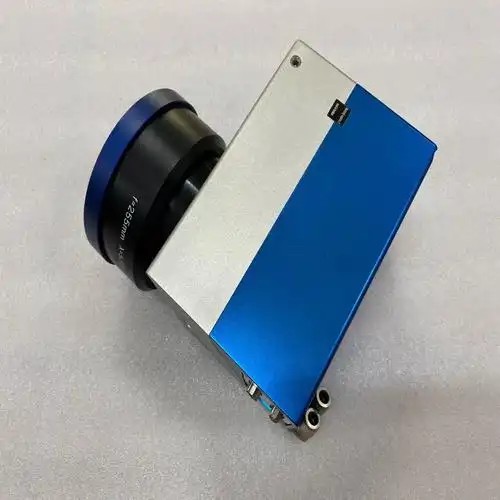
Laser marking machine galvanometer
Galvo Scanner for Industrial Production Lines
One of the most important applications of galvo scanning is industrial automation.A traditional marking process might be:Load Product → Stop → Mark → Remove Product
A production-line system can instead use:Detect → Track → Mark → Continue
The galvo scanner can rapidly direct the laser beam while the product moves through the marking area.Additional components can include:
- Conveyor
- Photoelectric sensor
- Encoder
- PLC
- Machine vision camera
- Industrial controller
The encoder can provide information about conveyor movement, allowing the marking system to synchronize the laser with product speed.This approach is commonly referred to as flying laser marking.It is particularly useful for continuous or high-volume production involving:
- Cables
- Wires
- Packaging
- Bottles
- Electronic products
- Industrial components
In this type of application, the galvo scanner becomes part of the overall automation system rather than simply a component inside a desktop marking machine.
Galvo Scanner for Curved and 3D Surfaces
Standard galvo marking is primarily designed for relatively flat surfaces.When the workpiece has significant height differences or complex curvature, maintaining the correct focal position becomes more difficult.This is where dynamic focusing becomes important.A conventional system can be thought of as:X + Y
An advanced system can add:X + Y + Z.The Z component dynamically adjusts the focal position according to the surface geometry.This allows laser processing on:
- Curved surfaces
- Uneven surfaces
- Three-dimensional components
- Large-height-difference workpieces
This technology is helping galvo systems move beyond conventional two-dimensional marking toward 3D laser processing.
Common Galvo Scanner Problems
Although galvo systems are highly precise, problems can still occur.
Distorted Marking
Possible causes include:
- Incorrect lens calibration
- Galvo calibration errors
- Incorrect software parameters
- Optical alignment problems
Uneven Marking
Potential causes include:
- Incorrect focus
- Lens contamination
- Inappropriate laser parameters
- Material inconsistency
Marking Appears Too Slow
The galvo scanner itself may not be the problem.The actual limitation could come from:
- Insufficient laser power
- Excessive marking depth
- Incorrect hatch settings
- Low pulse frequency
- Multiple required passes
- Complex graphics
This is why troubleshooting should consider the complete laser processing system rather than looking at the galvo scanner alone.
How to Choose a Galvo Scanner?
When choosing a galvo scanning system, consider several factors.
1. Laser Wavelength
The scanner must be compatible with the laser wavelength.Fiber, CO₂, and UV laser systems require different optical configurations.
2. Marking Field
Choose a suitable field according to the product size and required resolution.A larger field is useful for larger products, while a smaller field may provide better spot characteristics for fine marking.
3. Scanning Speed
Higher scanning speed can be valuable for high-volume production, but it should be considered together with laser power and actual processing requirements.
4. Positioning Accuracy
Precision applications such as electronics, jewelry, and small components may require greater attention to positioning accuracy and repeatability.
5. Lens Selection
The lens should match the desired marking area and focal requirements.
6. Laser Power
Laser power should be selected according to the material, marking depth, speed, and production volume.Simply selecting the highest-power laser is not necessarily the best approach.
The Future of Galvo Scanning Technology
Galvo scanning technology continues to develop alongside laser sources and industrial automation.Several trends are particularly important.
Higher-Speed Digital Control
More advanced controllers can improve synchronization between the laser, scanner, and production system.
Machine Vision
Cameras can identify workpieces and automatically locate the marking position before the laser starts.
AI-Assisted Calibration
Artificial intelligence and automated vision systems may increasingly assist with calibration, positioning, and quality inspection.
Dynamic Focusing
Dynamic focusing allows galvo systems to process surfaces with greater height variation and three-dimensional geometry.
Beam Shaping
Advanced optical systems can control the shape and distribution of laser energy to improve specialized processing.These developments are gradually changing the role of a galvo scanner.It is no longer simply a device that moves a laser beam from one point to another.It is becoming part of a larger intelligent laser processing system.
Final Thoughts
The galvo scanner is one of the key technologies behind modern high-speed laser marking. By steering the laser beam with rapidly controlled mirrors instead of physically moving the laser head, a galvo system can achieve extremely fast and precise marking.
However, the scanner is only one part of the system. The laser wavelength, laser power, F-Theta lens, controller, software, and processing parameters all need to match the application.
At ZS Machinery, we provide laser marking solutions using different laser sources and scanning configurations. We help customers select the appropriate laser power, galvo scanner, F-Theta lens, marking area, and machine configuration according to their material and production requirements.
If you are unsure which galvo laser system is suitable for your application, sample testing with your actual material and marking requirements is the best way to determine the right configuration.
Best Fiber Laser Engraver for Different Applications