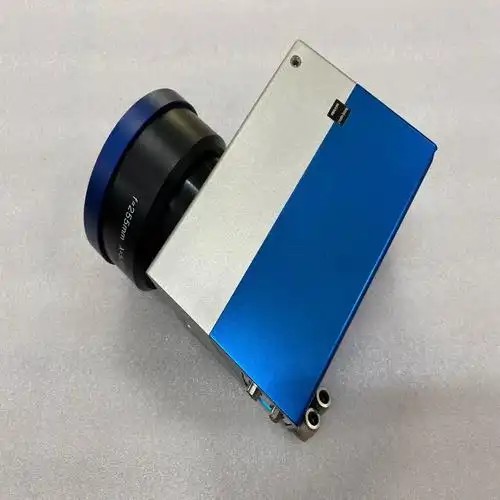
Laser Marking Equipment: Types, Wavelengths, and How to Choose the Right Machine
Laser marking equipment is widely used in manufacturing to mark serial numbers, QR codes, barcodes, logos, product information, and traceability codes on different materials. Although buyers may use terms such as laser marking equipment, laser marking machine, and laser marker, they generally refer to the same category of industrial equipment.
However, not all laser marking machines can process the same materials. The most important factor to consider first is the laser source and its wavelength, because different materials absorb different wavelengths of laser light. This determines which materials a machine can mark effectively and what kind of marking results it can produce.
In this guide, we explain the main types of laser marking equipment, compare their wavelengths and applications, and clarify the differences between laser technology and machine designs such as desktop, cabinet, and handheld systems.
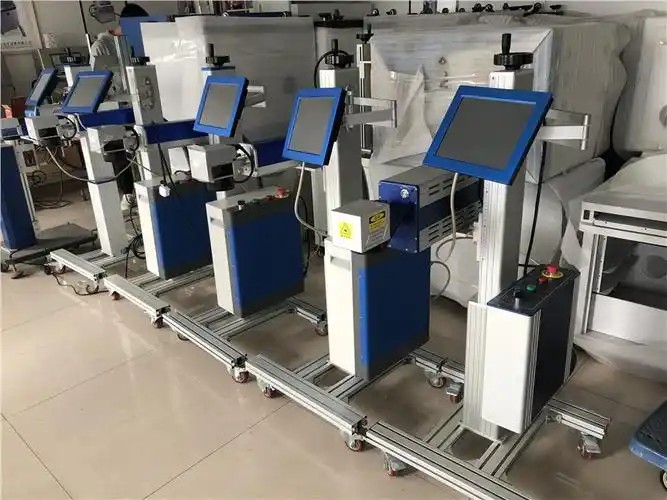
Laser marking equipment
1. What Is Laser Marking Equipment?
Laser marking equipment uses a focused laser beam to create text, graphics, identification codes, or other patterns on a material’s surface. Depending on the material and process parameters, the laser can change the surface color, modify a coating, remove material, or create a deeper engraved mark.
Common applications include:
- Serial numbers, QR codes, and barcodes on industrial components
- Logos and product identification on metal parts
- Batch numbers and expiration dates on packaging
- Fine text and codes on electronic components
- Decorative patterns on jewelry, gifts, and consumer products
- Permanent identification marks for product traceability
A typical laser marking system consists of a laser source, a beam delivery system, a scanning head or motion system, a focusing lens, a controller, and marking software. Depending on the application, it may also include a worktable, enclosure, camera, conveyor, rotary axis, or automated loading system.
Before choosing a machine’s physical design, it is important to identify the material to be marked and the required result. These factors determine which laser technology is suitable.
2. Types of Laser Marking Equipment by Wavelength
Industrial laser marking equipment can be classified by the wavelength of its laser source. The main categories include fiber, CO₂, UV, and green laser marking systems. Other specialized laser sources are available for particular applications.
2.1 Fiber Laser Marking Equipment — Approximately 1064 nm
Fiber laser marking machines typically operate at a wavelength of around 1064 nm in the near-infrared range. They are widely used for direct marking and engraving of metals.
Common applications include:
- Stainless steel and carbon steel
- Aluminum and aluminum alloys
- Brass and copper, depending on the application
- Titanium and other metal components
- Industrial tools, machine parts, nameplates, and hardware
- Some engineering plastics and coated materials
Fiber lasers can produce different marking effects, including surface discoloration, engraving, and deeper material removal. The result depends on laser power, pulse characteristics, scanning speed, frequency, and other processing parameters.
For example, a 30W or 50W fiber laser marker may be suitable for many routine metal identification applications. Higher power may be preferable when faster processing or deeper engraving is required.
MOPA fiber lasers are a specialized type of pulsed fiber laser with adjustable pulse duration. They offer additional process control for applications such as color marking on stainless steel and certain marking effects on anodized aluminum.
For most manufacturers looking for general-purpose metal marking equipment, a fiber laser is the natural starting point.
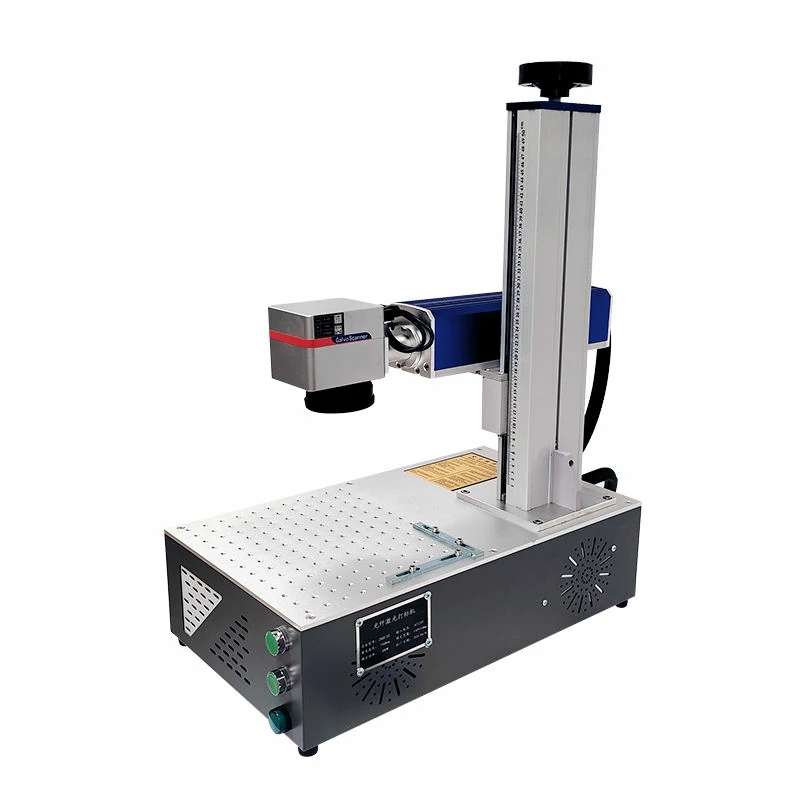
Small Fiber Laser Marker
2.2 CO₂ Laser Marking Equipment — Typically 10.6 μm
CO₂ laser marking equipment commonly uses a wavelength of approximately 10.6 μm, although other CO₂ wavelengths are also used in some systems.
Unlike fiber lasers, CO₂ lasers are particularly suitable for many non-metallic materials because these materials absorb the CO₂ laser wavelength effectively.
Typical applications include:
- Wood and bamboo
- Leather and paper
- Cardboard and packaging materials
- Acrylic and selected plastics
- Rubber and other organic materials
- Glass surface marking, depending on the process
CO₂ laser marking systems are commonly used in packaging, signage, promotional products, crafts, and industrial non-metal identification.
However, a standard CO₂ laser is generally not the first choice for directly marking bare metal. Special marking compounds or coatings may allow certain surface-marking applications, but this is different from direct metal marking with a fiber laser.
If your products are mainly made of wood, leather, paper, acrylic, or other compatible non-metals, CO₂ laser marking equipment may be a more appropriate choice than a fiber laser.
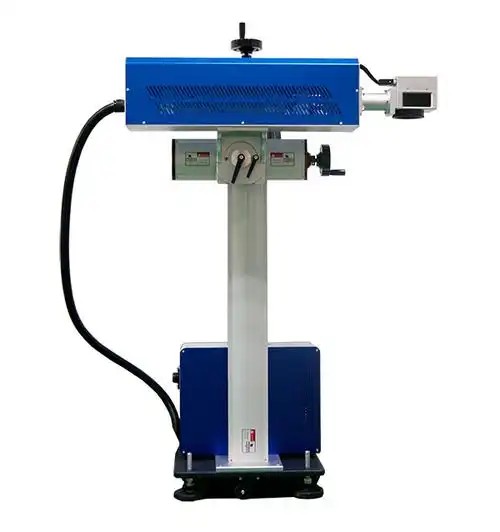
Flying CO2 Laser Marking Machine
2.3 UV Laser Marking Equipment — Typically 355 nm
UV laser marking machines commonly operate at a wavelength of 355 nm. Their short wavelength allows them to process many materials with a relatively small heat-affected area when the process is properly configured.UV laser marking is often selected when fine details, high-contrast marks, or reduced thermal damage are important.
Typical applications include:
- Plastic housings and components
- Electronic components and circuit boards
- Glass products and selected ceramic materials
- Medical-device components
- Thin films and selected packaging materials
- Small QR codes, fine text, and precision identification marks
UV lasers can be useful for plastics that are difficult to mark cleanly with a conventional infrared fiber laser. They can also process selected glass and electronic applications that require fine features.
However, UV is not automatically suitable for every plastic or glass product. Different resin formulations, pigments, coatings, glass types, and surface finishes can produce different results.
For this reason, sample testing is particularly important when selecting UV laser marking equipment for a specific product.
2.4 Green Laser Marking Equipment — Typically 532 nm
Green laser marking equipment generally operates at a wavelength of 532 nm, in the visible-light range.Green lasers can be advantageous for certain materials that interact differently with green light than with near-infrared light. They are especially relevant to some applications involving highly reflective metals and delicate components.
Typical applications include:
- Copper components and electrical conductors
- Gold and selected precious-metal components
- Certain electronic and semiconductor applications
- Selected plastics and other materials requiring specialized processing
Copper and gold can be challenging to process with conventional infrared lasers under some conditions because of their reflective properties. A green laser may offer better absorption or more suitable processing behavior for specific applications.
Nevertheless, a green laser is not necessarily better than a fiber laser for every copper or gold marking task. The required marking depth, contrast, production speed, surface condition, and material composition all matter.
Green laser systems are more specialized than standard fiber laser markers. They are worth evaluating when conventional wavelengths do not provide the desired processing results.
2.5 What About Red and Blue Laser Marking Equipment?
Red and blue light can also be found in laser equipment, but their roles should be distinguished from those of the main industrial marking wavelengths described above.
Red laser light is commonly used as a visible aiming beam to show where the marking will occur. A red positioning light does not necessarily mean that the machine uses a red laser to process the material.
Blue laser systems, often associated with wavelengths around 450 nm, are used in selected industrial laser-processing applications. Blue light can interact favorably with certain materials, including some copper-processing applications. However, blue lasers are not as widely used as standard fiber, CO₂, and UV sources in general-purpose industrial laser marking equipment.
If you encounter a product described as a red or blue laser marker, check the actual processing laser’s wavelength and specifications. The color of a visible aiming beam alone does not identify the machine’s primary laser source.
2.6 Other Specialized Laser Sources
Some industrial marking systems use other laser technologies, including solid-state sources such as Nd and ultrafast lasers such as picosecond or femtosecond systems.These technologies can be relevant to specialized applications requiring particular pulse characteristics, fine features, or controlled material modification.
However, they should not be treated as simple additional wavelength categories. For example, an Nd laser can operate at 1064 nm, while picosecond and femtosecond lasers describe pulse duration rather than one specific wavelength.
For most general industrial purchasing decisions, fiber, CO₂, UV, and green laser marking equipment provide a useful starting classification.
3. Laser Marking Equipment Comparison by Wavelength
The following table summarizes the main differences between the common laser marking technologies.
| Laser type | Typical wavelength | Main applications | Key consideration |
|---|---|---|---|
| Fiber laser | 1064 nm | Most common metal marking and engraving; some plastics | Versatile for industrial metal marking |
| CO₂ laser | 10.6 μm | Wood, leather, paper, acrylic, rubber, and other compatible non-metals | Not normally suitable for direct marking of bare metal |
| UV laser | 355 nm | Selected plastics, glass, electronics, and heat-sensitive components | Useful for fine details and reduced thermal impact |
| Green laser | 532 nm | Selected copper, gold, electronic, and specialized applications | Worth considering when material response requires it |
| Blue laser | Often around 450 nm | Specialized processing, including certain copper applications | Less common in general-purpose marking systems |
These are typical applications rather than absolute material-compatibility rules. A laser’s suitability depends on how the specific material absorbs the wavelength and how the process is configured.
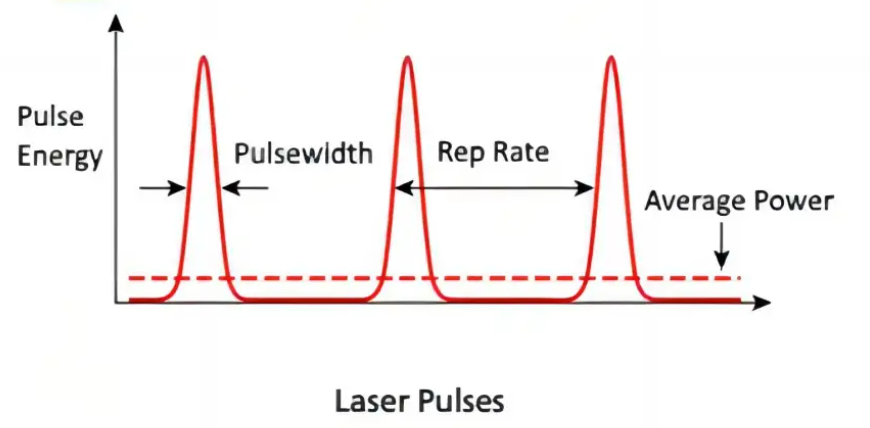
Paulse laser diagram
4. Why Does Wavelength Matter More Than Machine Appearance?
The wavelength of the laser source affects how the beam interacts with the material. If the material absorbs the laser energy effectively, the laser can produce the required surface change or material removal. If the material reflects too much of the energy or does not absorb it appropriately, the marking result may be weak, inconsistent, or unsuitable.
This is why the same machine design can produce very different results when fitted with different laser sources.
For example:
- A fiber laser marker is generally a strong choice for stainless-steel serial numbers.
- A CO₂ laser marker is usually more suitable for marking logos on wood or leather.
- A UV laser marker may be preferable for fine identification marks on certain plastic components.
- A green laser may be worth testing for specialized copper or gold marking applications.
Wavelength is the starting point, but it is not the only selection factor. Buyers should also consider laser power, pulse duration, marking speed, required depth, spot size, marking area, and the surface condition of the material.
The required marking effect also matters. Creating a dark mark, removing a coating, engraving a deep serial number, and producing a color mark are different processing objectives and may require different configurations.
5. Types of Laser Marking Machines by Structure and Application
In addition to classifying laser marking equipment by wavelength, manufacturers also describe machines according to their structure, installation method, and intended application.These categories do not necessarily indicate a different laser technology. A desktop, cabinet, or handheld machine may use the same type of laser source but have a different mechanical design.
5.1 Desktop Laser Marking Machine
A desktop laser marking machine is designed for convenient placement on a workbench or production table.
It is suitable for small parts, samples, tools, electronic components, jewelry, and other products that can be positioned within its marking area.
Desktop systems are often chosen by workshops, laboratories, small manufacturers, and production departments that need a compact marking solution.
5.2 Cabinet Laser Marking Machine
A cabinet laser marking machine integrates the laser marking system into a protective enclosure. Depending on the design, the enclosure may include a working platform, lifting axis, viewing window, interlocks, and other safety features.
Cabinet systems are commonly used for industrial production, repeatable marking tasks, and applications where operator protection and a more organized workstation are important.
They can be configured with fiber, UV, or CO₂ sources according to the material and application.
5.3 Handheld Laser Marking Machine
A handheld laser marking machine is designed to mark workpieces that are difficult to move or position under a conventional desktop marking head.
It can be useful for large components, installed equipment, molds, tools, and parts that require marking at different locations.
The term handheld describes the machine’s handling arrangement, not its wavelength. The appropriate laser source still depends on the material being marked.
When evaluating a handheld system, consider the weight and ergonomics of the marking head, working distance, positioning accuracy, cable arrangement, and whether the application requires an enclosed or otherwise controlled marking area.
5.4 Portable Laser Marking Machine
Portable laser marking equipment is designed for easier transport between workstations or job sites. Some systems are compact desktop units, while others are built around a handheld marking head and a separate control unit.
Portable equipment can be useful for maintenance departments, onsite identification, and marking large parts that cannot easily be brought to a fixed production station.
Portability does not determine material compatibility. The laser source and processing parameters remain the key factors.
5.5 Automated Laser Marking Equipment
Automated laser marking systems integrate the laser marker with production equipment such as conveyors, fixtures, rotary axes, robotic arms, vision cameras, and automatic loading or unloading mechanisms.They are commonly used when manufacturers need consistent positioning, repeatable processing, higher production efficiency, or integration with a traceability system.
For example, a vision-guided conveyor system can identify the position of each part before marking, while a rotary fixture can help process cylindrical components.
Automation is a separate design consideration from wavelength. A suitable laser source must first be selected for the material, after which the machine can be configured to match the production process.
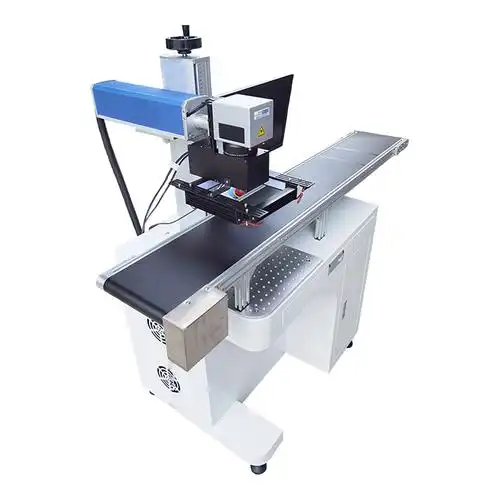
Vision CO2 Laser Marking Machine
6. How to Choose the Right Laser Marking Equipment
Choosing the right equipment starts with the actual marking requirement rather than the machine’s appearance or advertised power alone.
Step 1: Identify the Material
Determine whether the workpiece is metal, plastic, glass, wood, leather, or another material. For plastics, identify the resin type, color, and any relevant additives or coatings.
Step 2: Define the Required Marking Effect
Decide whether you need a surface color change, a high-contrast identification mark, coating removal, deep engraving, or a specialized effect such as color marking on stainless steel.
Different results may require different pulse characteristics and parameter settings, even when the material is the same.
Step 3: Determine the Production Requirements
Consider the size of the marking content, required cycle time, marking depth, part dimensions, daily output, and whether the system must be integrated into an existing production line.
These requirements help determine the necessary laser power, marking area, motion system, and level of automation.
Step 4: Choose the Machine Structure
Select a desktop, cabinet, handheld, portable, or automated configuration based on the workpiece and production environment.
For small parts, a desktop system may be sufficient. For industrial production, an enclosed cabinet or automated system may be more appropriate. For large workpieces, a handheld or movable marking system may offer greater flexibility.
Step 5: Test Representative Samples
Before purchasing equipment, test representative samples whenever possible. Confirm the marking contrast, readability, depth, consistency, processing time, and any effects on the material surface.
Sample testing is particularly important for plastics, coated materials, reflective metals, and applications requiring very fine or specialized marks.
7. Laser Marking Equipment from ZS Machinery
ZS Machinery provides laser marking solutions for different materials, workpieces, and production requirements. Available configurations can include fiber, CO₂, and UV laser marking systems, with machine structures ranging from compact desktop equipment to enclosed and customized automated systems.
Rather than selecting equipment by appearance or laser power alone, we recommend starting with the material, required marking effect, production volume, and installation conditions.
Our team can help evaluate the appropriate laser source, marking area, power, fixtures, vision positioning, and automation requirements for your application.
If you are selecting laser marking equipment for a new project, send us your material details, workpiece dimensions, marking content, and production requirements. Where appropriate, sample testing can help confirm the proposed solution before you invest in a machine.
Conclusion
Laser marking equipment is best classified in two complementary ways: by laser technology and wavelength, and by machine structure and application.
Fiber, CO₂, UV, and green lasers serve different material-processing needs. Desktop, cabinet, handheld, portable, and automated machines describe how the equipment is built and used.
Understanding this distinction makes it easier to choose a suitable laser marking solution. Start with the material and required marking result, then select the appropriate laser source and machine configuration to achieve reliable, repeatable production.