Four Types Metal Marking Machine Guide:Classification, Principles, and Industrial Applications
Introduction
In modern industrial manufacturing, product traceability, brand identification, QR code management, and part numbering have become important parts of standardized production. Therefore, equipment capable of leaving permanent or semi-permanent marks on metal surfaces, commonly known as Metal Marking Machines, is being increasingly used in industries such as automotive, electronics, hardware, medical devices, and aerospace.
When many people mention a metal marking machine, their first impression is usually a laser marking machine. However, from a broader perspective, any equipment capable of creating identifiable marks on metal surfaces can be classified as a metal marking machine. The essential difference between these devices lies in:
The principle by which they create marks on metal surfaces.
At present, the mainstream industrial metal marking machine can generally be divided into four types:laser marking, mechanical marking, inkjet marking, and chemical etching marking. In this article, ZS Machinery will introduce these four different types of metal marking machines in detail.
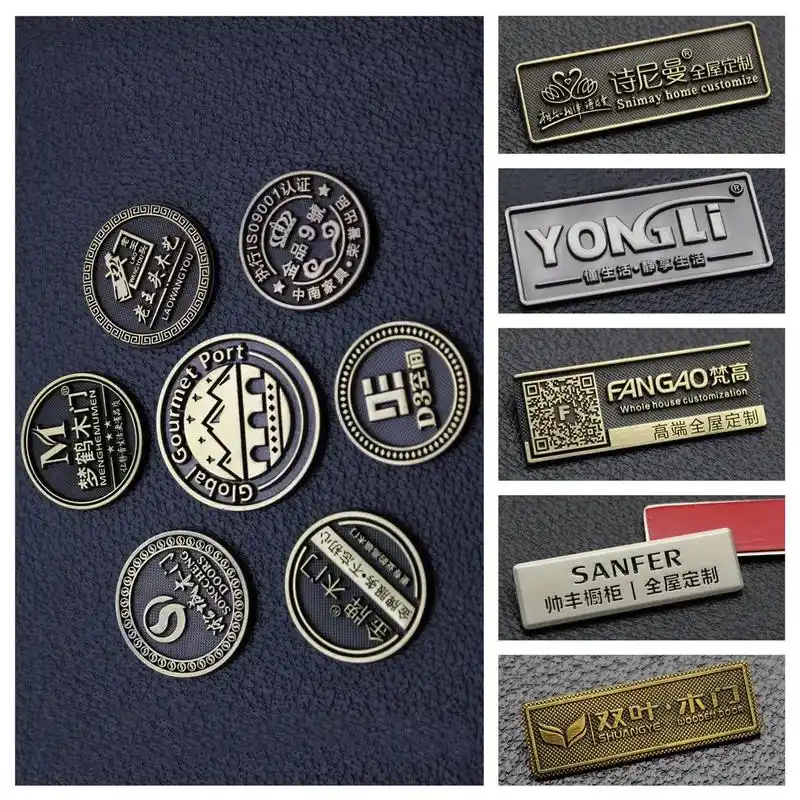
Metal Marking Samples
1. Laser Marking Machine
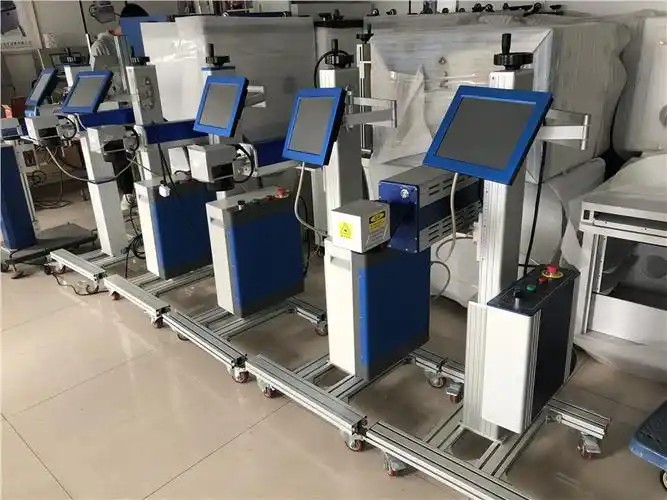
Laser marking machines are currently the most widely used and highly automated type of metal marking machine. They use high-energy laser beams to create permanent marks on metal surfaces through ablation, oxidation, discoloration, or melting processes. Since laser marking is a non-contact process, it offers advantages such as high precision, high speed, and low consumable costs.
Common Types of Laser Metal Marking Machines include:
1.1 Fiber Laser Marking Machine
This is currently the most mainstream equipment in the metal marking industry. It is mainly suitable for metal materials such as stainless steel, carbon steel, aluminum alloy, copper, and titanium alloy.It is widely used for metal marking in industries such as:
Hardware tools
Automotive parts
Electronic products
Nameplates
Medical devices
After years of development, fiber laser technology has become highly mature. Fiber laser marking machines feature fast marking speed, high stability, long service life, and low maintenance costs, making them a preferred choice across many industries.
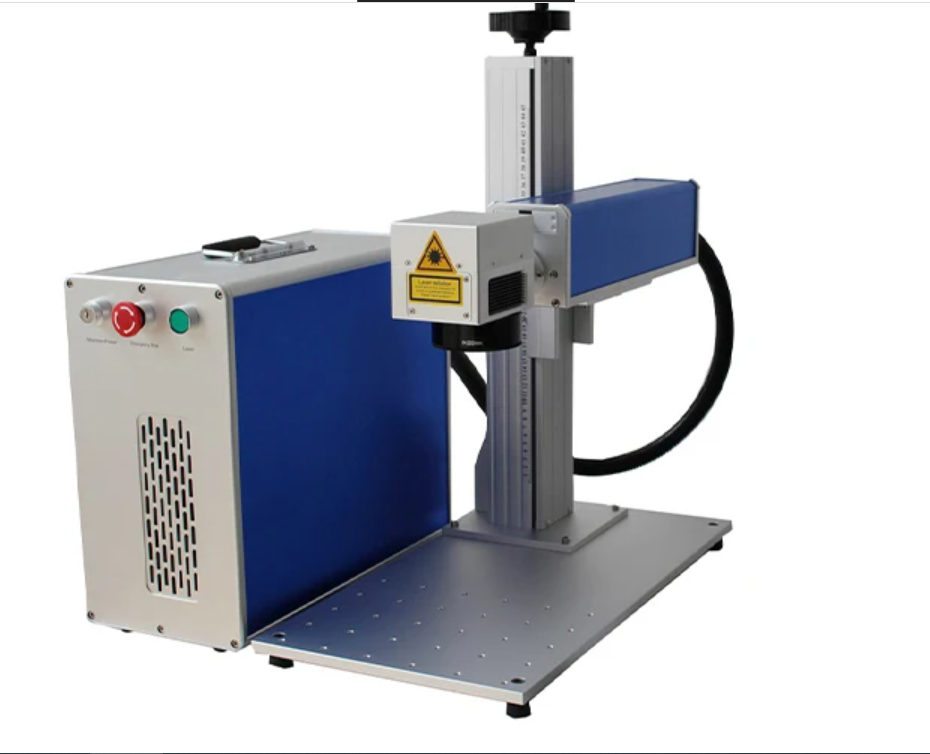
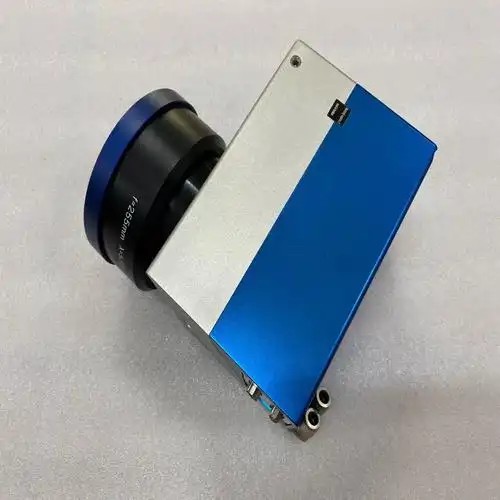
30W Fiber Laser Marking Machine
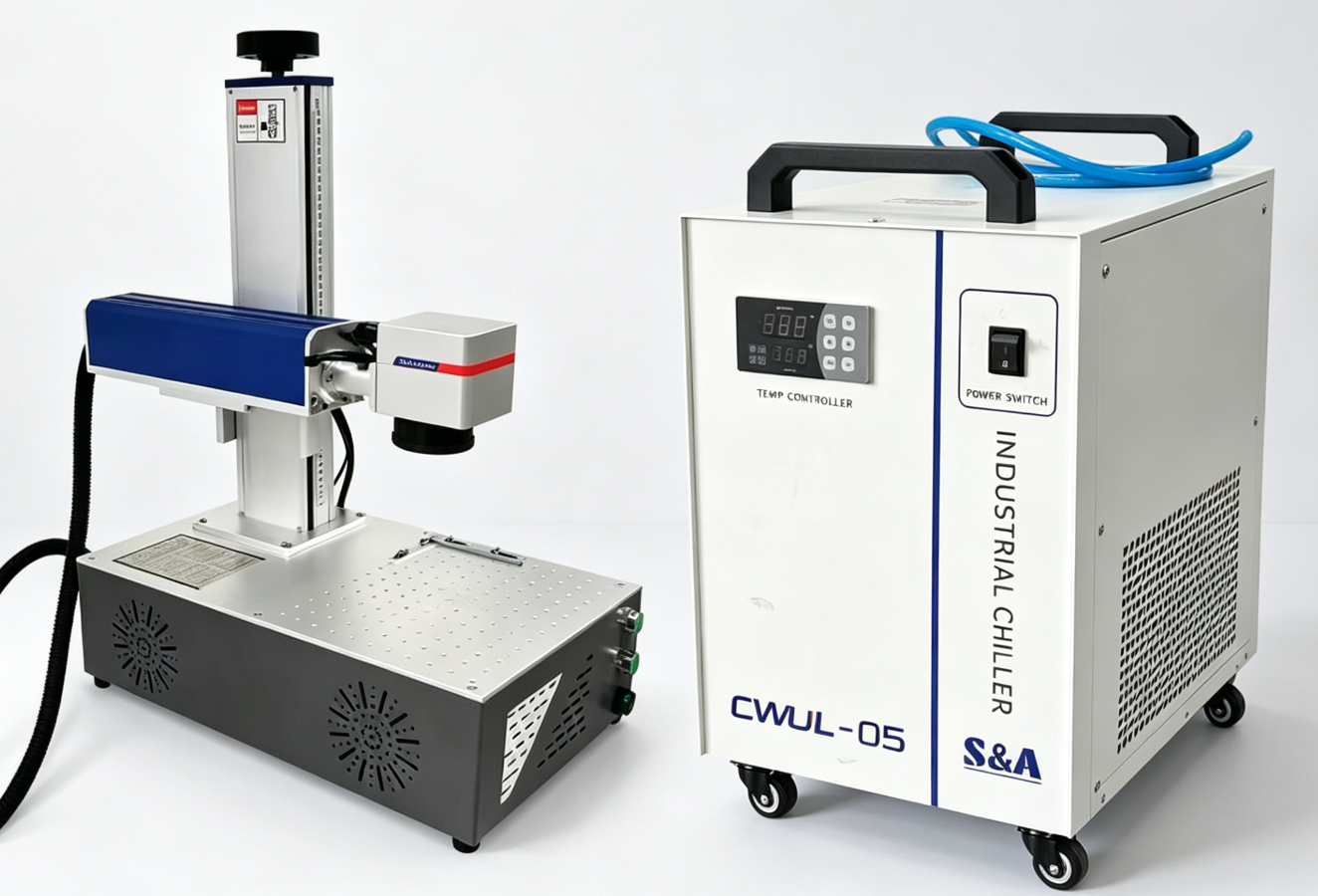
1.2 UV Laser Marking Machine
UV laser marking machines are suitable for almost all materials and are often referred to as universal marking machines. They typically use a 355nm wavelength ultraviolet laser, and their working principle mainly relies on photochemical reactions to process material surfaces.
When the ultraviolet laser irradiates the material surface, its shorter wavelength and higher photon energy can directly break molecular bonds on the material surface, causing decomposition or vaporization rather than simply melting the material through heat.
As a universal marking machine, UV laser systems are also widely used for metal marking. Compared with fiber lasers, UV laser marking provides finer processing quality, but the processing speed and laser power are usually lower.
1.3 MOPA Laser Marking Machine
MOPA is a pulse-adjustable fiber laser technology. Its biggest advantages include:
Color marking on stainless steel
Deep black marking on aluminum materials
It can achieve finer surface effects and is therefore widely used in high-end consumer electronics, decorative components, and brand logo industries.
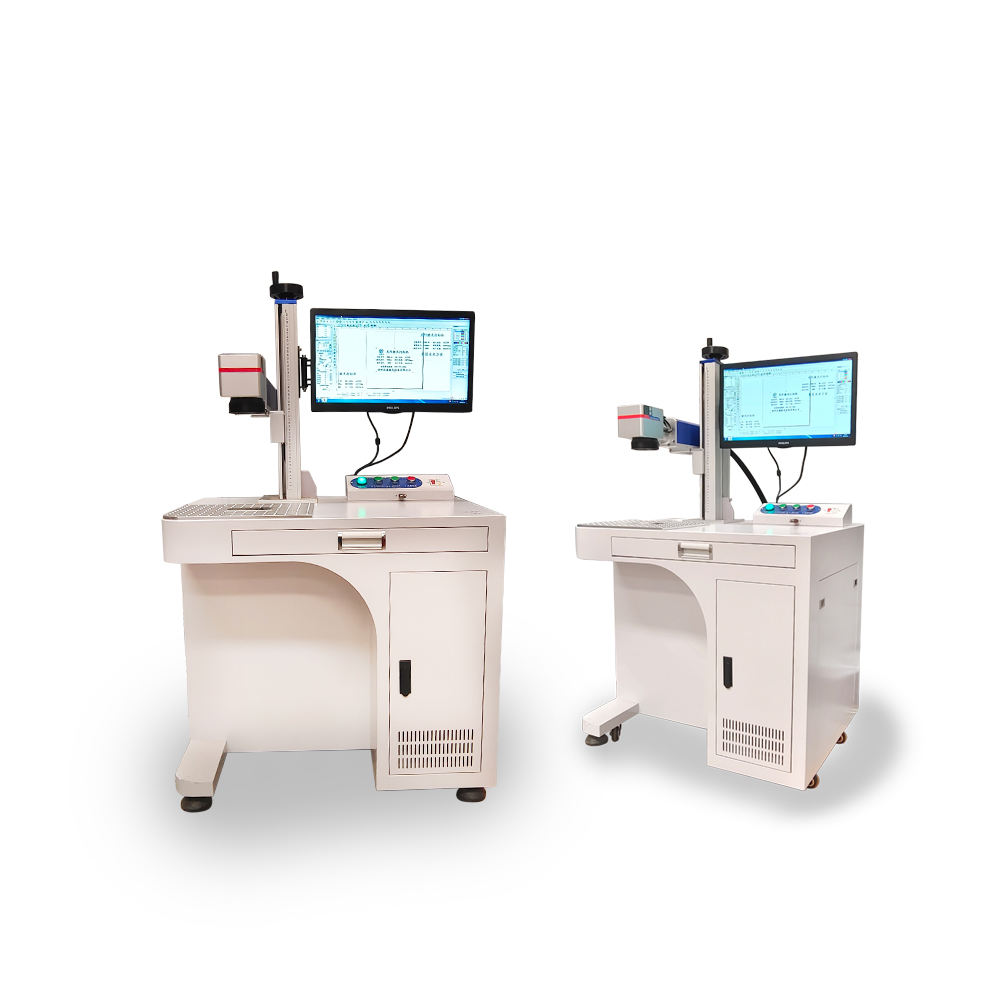
MOPA Laer Marking Machine
2. Mechanical Marking Machine
Mechanical marking equipment is a very classic type of metal marking machine in traditional industry. Its principle is to directly change the surface shape of the metal through mechanical force, thereby creating permanent marks.
Compared with laser marking, mechanical marking generally provides:
Deeper marking
Better wear resistance
Therefore, it is more suitable for heavy industrial environments.
However, mechanical marking also has obvious disadvantages compared with laser marking,include:
Higher noise levels
Lower precision
Possible mechanical stress on the workpiece surface, which may affect part shape.Mechanical Metal Marking Machine has the following types:
2.1 Dot Peen Marking Machine
This type of metal marking machine continuously impacts the metal surface with a high-speed pin, forming dense dot patterns that combine into characters, numbers, QR codes, or logos. Its core principle is similar to miniature high-speed stamping, where the machine controls the pin position through X/Y-axis movement to achieve automatic character arrangement.
Main features include:
Deep marking depth
Strong permanence
Suitable for harsh industrial environments
Strong adaptability to oily or rough surfaces
Common applications:
VIN code marking
Steel structure numbering
Industrial part traceability codes
Heavy machinery part numbering
Pipe and valve identification
This equipment is very common in automotive manufacturing, steel structure engineering, and large equipment manufacturing industries.
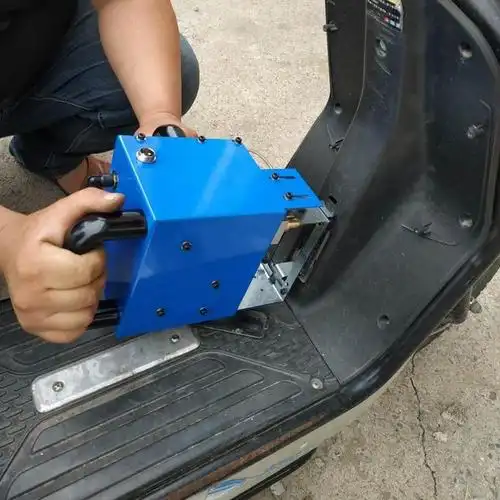
Motor Cycle Dot Peen Marking
2.2 Scribe Marking Machine
A scribe marking machine uses a carbide stylus to continuously contact the metal surface and create continuous-line characters through mechanical movement.
Unlike dot peen marking, it does not create characters through dot matrix impacts but through continuous engraving, resulting in smoother and more complete characters.
Main features:
Lower noise
Less vibration
More continuous fonts
Better surface quality
More suitable for precision part processing
Since the mechanical impact during scribing is relatively small, the damage to the workpiece surface is also reduced.
2.3 Stamping / Embossing Machine
Stamping and embossing equipment is a very traditional mechanical metal marking method. It applies strong mechanical pressure to the metal surface through molds, steel character heads, or embossing structures to create recessed or raised characters.
This method essentially belongs to plastic deformation forming rather than cutting processing.
Main features:
Deep marking depth
Permanent and wear-resistant
Difficult to wear off or detach
Suitable for thick metal materials
Although its automation level is lower than laser equipment, it still has extensive applications in heavy industry and traditional manufacturing.
2.4 Roll Marking
Roll marking uses rollers engraved with characters or patterns to continuously roll and emboss marks onto metal surfaces. This method is especially suitable for continuous materials or high-speed production lines.
Main features:
Fast processing speed
Suitable for continuous production
Stable marking depth
Suitable for cylindrical workpieces
Currently, roll marking remains a very practical traditional marking method in steel, pipe, and cable manufacturing industries.
3. Inkjet Marking Machine
Inkjet metal marking machines mainly create marks by applying ink onto metal surfaces. Strictly speaking, this method usually belongs to semi-permanent marking rather than engraving. However, due to its high speed and low cost, it is widely used in industrial production lines.Here are some common Types of Inkjet Metal Marking Machines:
3.1.CIJ Inkjet Printer
Uses continuous inkjet technology.
Suitable for:
Production dates
Batch numbers
High-speed production line coding
3.2.TIJ Thermal Inkjet
Offers higher precision and easier maintenance.
Commonly used in:
Packaging industry
Labeling industry
3.3.UV Printer
Uses UV-curable ink to create patterns on metal surfaces.
Its features include:
Full-color printing
Complex graphic printing
Photo-quality effects
Therefore, it is widely used in decorative nameplates, advertising signage, and consumer electronics housings.
4. Chemical Etching Marking Machine
Chemical etching marking is a metal marking process with a long history. It usually uses electrolytes or chemical corrosion principles to create permanent marks on metal surfaces. This method is also known as:
Electrochemical Marking
Electrolytic Etching
Its working principle is:
The equipment uses low-voltage current, electrolyte solutions, conductive templates, and related components to locally corrode the metal surface, thereby forming text or patterns.
Compared with laser marking,it’s Main features include:
Lower cost
No obvious heat effect
Less likely to cause material deformation
Differences Between Various Metal Marking Machines
| Type | Principle | Permanent | Typical Features |
|---|---|---|---|
| Laser Marking | Laser ablation / oxidation | ✔ | High precision, high automation |
| Mechanical Marking | Mechanical impact / engraving | ✔ | Deep marking, wear-resistant |
| Inkjet Marking | Ink adhesion | Semi-permanent | High speed, low cost |
| Chemical Etching Marking | Electrolytic corrosion | ✔ | Low heat impact, low cost |
Industrial Applications of Metal Marking Machines
Metal marking equipment has been widely used in modern industrial manufacturing.
Automotive Industry
Used for engine numbering, VIN codes, component traceability, and new energy battery identification.
Hardware Industry
Used for tool logos, specification markings, and brand identification.
Medical Device Industry
Used for surgical instrument numbering and permanent marking on stainless steel tools.
Electronics Industry
Used for QR codes, serial numbers, and precision housing marking.
Aerospace Industry
Used for high-reliability component traceability management.
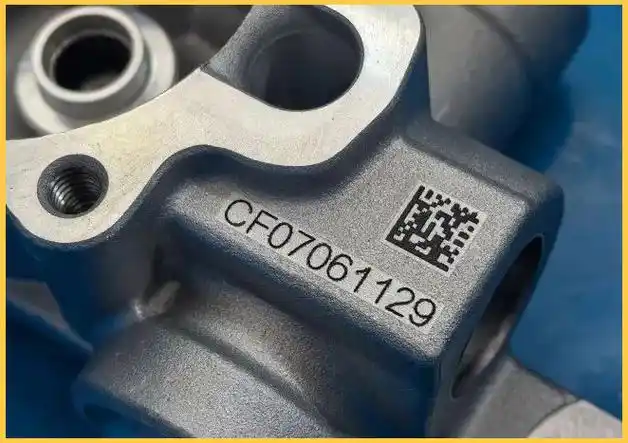
QR code laser marking samples of automotive parts
Development Trends of Metal Marking Machines
With the development of intelligent manufacturing, metal marking equipment is evolving toward:
Higher precision
Higher-speed automation
AI vision positioning
Automated production line integration
Color and precision processing
Among these technologies, laser marking is gradually becoming the mainstream solution for future industrial marking applications.
Conclusion
A metal marking machine does not only refer to laser marking equipment, but to all industrial devices capable of creating identifiable marks on metal surfaces.
The core difference between different types of equipment lies in their marking principles, including laser, mechanical, inkjet, and chemical etching technologies.
As industrial automation and product traceability demands continue to increase, metal marking machines are rapidly developing toward higher precision, greater intelligence, and more automation.
As a supplier specializing in marking equipment, ZS Machinery continues to monitor changes in global industrial marking demands, continuously optimize marking solutions, and provide efficient and highly stable metal marking equipment for more industries.
Is a 60W MOPA Fiber Laser Still Worth Buying? How Should You Choose the Right Power?