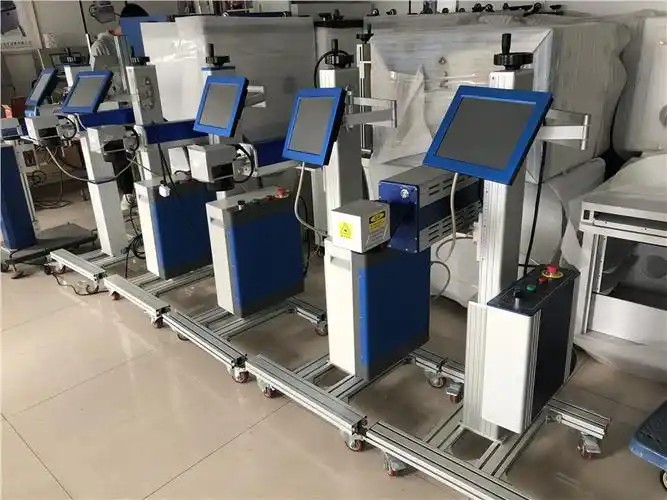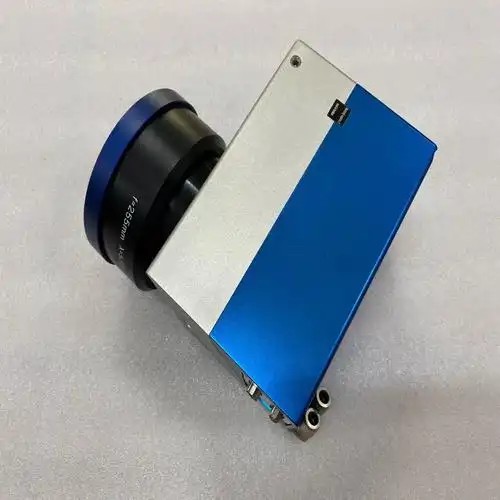
Metal Tag Engraving Machine: Methods, Materials, Applications and Automation
A metal tag engraving machine is used to permanently engrave or mark identification information on metal tags, nameplates, asset tags, equipment tags, and other industrial identification plates. Depending on the material, required depth, marking content, production volume, and automation requirements, metal tags can be processed using mechanical engraving, dot peen marking, chemical etching, or laser technology.
For modern industrial applications, fiber laser marking and engraving machines have become an increasingly practical solution because they offer high precision, digital control, fast processing, and straightforward integration with automated production systems.However, not every metal tag application requires deep engraving. In many cases, laser marking is sufficient for serial numbers, QR codes, barcodes, logos, and product identification.
The right machine therefore depends not only on the word “engraving,” but also on what the tag is made of, what information needs to be added, how many tags need to be processed, and how much of the process needs to be automated.
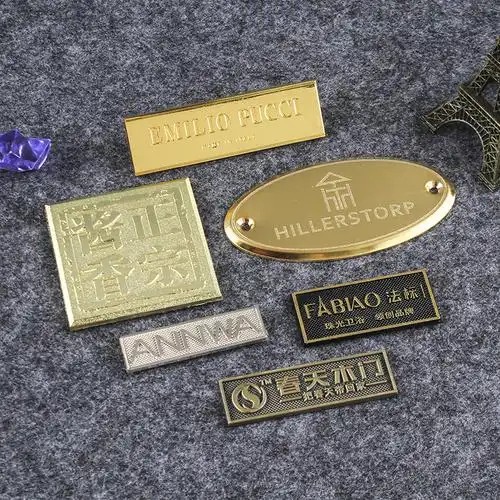
Metal Tags Marking Samples
What Is a Metal Tag?
A metal tag is a small metal plate or label used to identify, track, or provide information about a product, machine, component, asset, or piece of equipment.They are widely used because metal provides good durability and can withstand environments where paper or conventional adhesive labels may not be suitable.Typical metal tags include:
- Metal nameplates
- Asset tags
- Equipment identification tags
- Serial number tags
- Industrial identification tags
- Electrical tags
- Machine tags
- Component tags
- Cable identification tags
- Custom metal labels
A metal nameplate is one type of metal tag, but the two terms are not exactly interchangeable.
Types of Metal Tags
Different industries use metal tags for different purposes.
Metal Nameplates
Metal nameplates are commonly attached to:
- Industrial machines
- Motors
- Pumps
- Electrical equipment
- Control cabinets
- Generators
- Manufacturing equipment
They may contain:
- Manufacturer information
- Model number
- Serial number
- Voltage
- Power
- Technical specifications
- Product certification information
For industrial equipment, the mark must remain readable throughout the service life of the machine.
Asset Tags
Asset tags are designed to identify and track equipment or other physical assets.A typical asset tag may contain:
- Asset number
- QR code
- Barcode
- Company logo
- Identification code
For companies managing hundreds or thousands of machines, tools, or other assets, permanent metal tags can provide a more durable identification solution.
Serial Number Tags
Serial number tags are commonly used when individual products need to be distinguished from one another.For example:
Model: ZS-500
Serial No.: ZS20260826001
The serial number can be marked directly onto the metal tag using a laser marking system.When the numbers change from one tag to the next, the marking system can also be configured to process variable data.
Industrial Identification Tags
Industrial environments use many specialized metal identification tags.Examples include:
- Valve tags
- Component tags
- Equipment tags
- Pipe identification tags
- Maintenance tags
- Safety-related identification plates
The exact tag design varies by industry and application.
Electrical and Technical Tags
Electrical equipment often uses metal plates containing technical information.For example:
- Voltage
- Current
- Power
- Model
- Serial number
- Manufacturer
- Production date
Because these tags can remain attached to equipment for years, permanent marking is important.
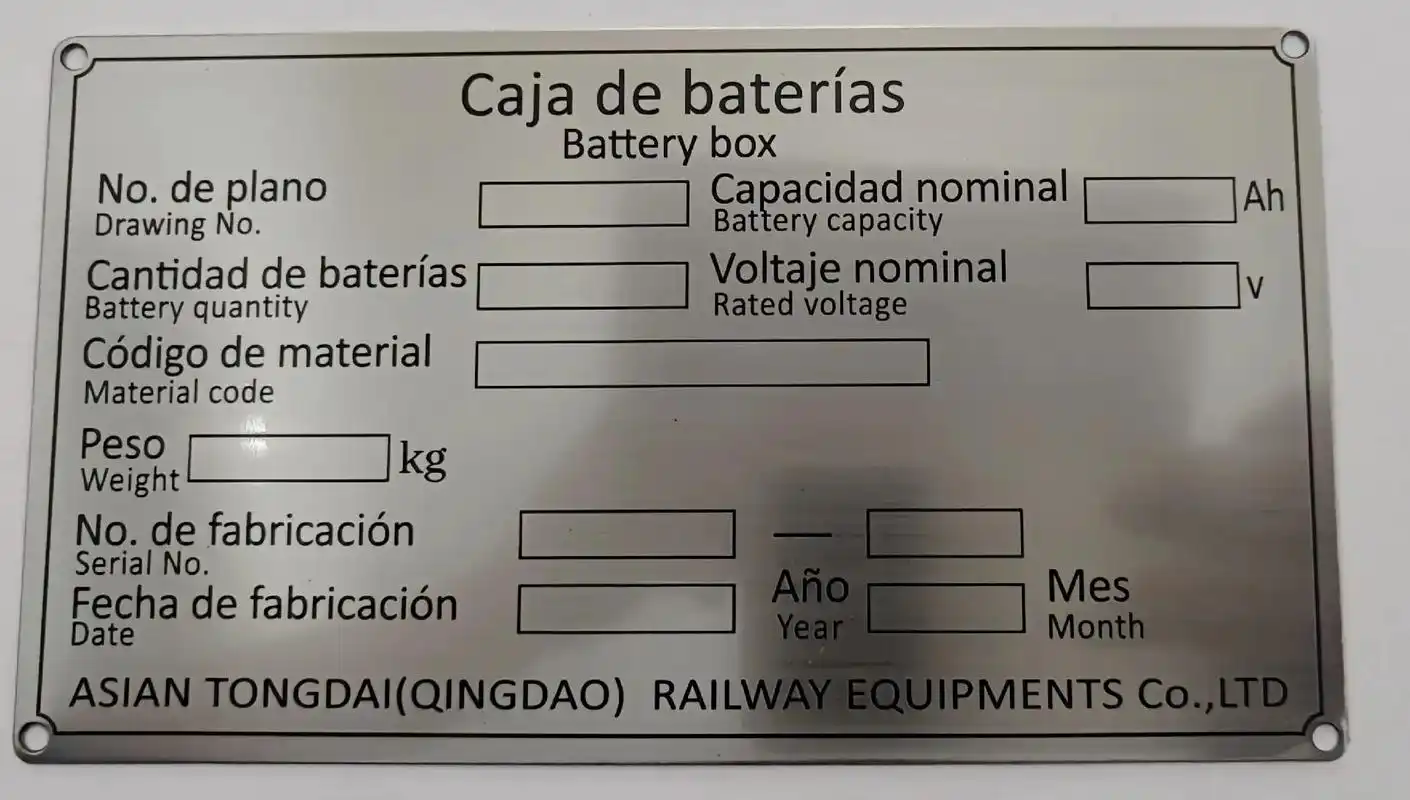
Metal Nameplate
What Metals Are Used for Metal Tags?
Metal tags can be manufactured from many different metals, but several materials are particularly common.
Stainless Steel
Stainless steel is widely used for industrial tags because it offers:
- Corrosion resistance
- Mechanical durability
- Good long-term stability
- A clean appearance
It is suitable for machine nameplates, industrial identification tags, equipment tags, and outdoor applications.
Aluminum
Aluminum is another common metal tag material because it is lightweight and easy to manufacture.Anodized aluminum is particularly suitable for laser marking.The laser can remove or modify the anodized surface layer to create a high-contrast mark while retaining the underlying aluminum.
This makes it popular for:
- Equipment labels
- Asset tags
- Nameplates
- Product identification
Brass Tags
Brass is often selected when appearance is important.It can be used for:
- Decorative nameplates
- Premium equipment plates
- Architectural tags
- Product identification
- Custom labels
Copper
Copper can also be used for metal tags, although its high reflectivity and thermal conductivity can make laser processing more demanding.Appropriate laser configuration and parameters are important when working with copper.
Steel and Other Metals
Other materials can include:
- Carbon steel
- Titanium
- Nickel alloys
- Various specialty metal sheets
The recommended laser parameters should always be determined according to the actual material.
What types of metal tag engraving machines are there?
Mechanical Metal Engraving Machine
Mechanical engraving machine uses a physical cutting tool to remove material from the metal surface.The basic process is:
Cutting Tool → Physical Contact → Material Removal → Engraved Mark
Mechanical engraving can produce genuine physical depth and has been used for metal plates and nameplates for many years.
Advantages
- Physical engraving depth
- Established technology
- Suitable for certain thick metal plates
Limitations
- Cutting-tool wear
- Mechanical contact
- Tool replacement
- Potentially slower processing for complex graphics
- Less convenient for frequent design changes
It can still be a suitable choice for some applications, particularly where conventional mechanical engraving is already part of the production process.
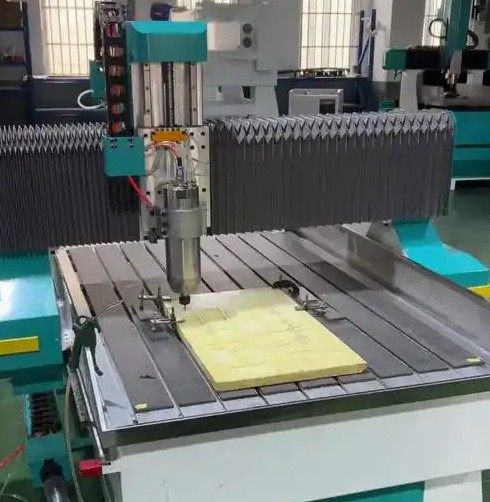
Mechanical metal engraving
Dot Peen Marking for Metal Tags
Dot peen marking uses a hardened stylus or pin to create a series of small indentations on the metal surface.The dots form letters, numbers, symbols, or other identification information.Dot peen marking is particularly common for industrial identification and traceability.Typical applications include:
- Serial numbers
- Part numbers
- Industrial components
- Heavy-duty identification
Advantages
- Permanent physical marks
- Suitable for harsh industrial environments
- Good durability
Limitations
- Mechanical contact
- Audible marking process
- Dot-based appearance
- Generally less suitable for high-quality decorative graphics
For industrial traceability, however, dot peen can be an effective technology.
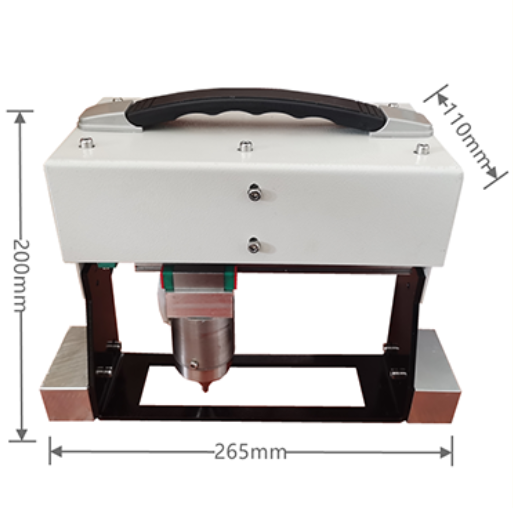
Electric dot peen mark machine
Chemical Etching for Metal Tags
Chemical etching uses a chemical process to remove selected areas of the metal surface.It can produce detailed marks and, depending on the process, relatively substantial engraving depth.However, chemical processing introduces additional considerations such as:
- Chemical handling
- Waste treatment
- Process management
- Production complexity
For modern production environments, manufacturers may prefer laser technology when they want a cleaner digital workflow and easier automation.
Laser Marking and Engraving Metal Tags
Laser technology provides a non-contact method of processing metal tags.Instead of physically touching the tag with a cutting tool or engraving needle, the laser beam interacts with the metal surface.Depending on the application, the laser can:
- Change the surface appearance
- Remove a coating
- Create contrast
- Remove metal
- Produce recessed engraving
For many industrial applications, fiber laser technology is the most practical laser solution for metal tags.
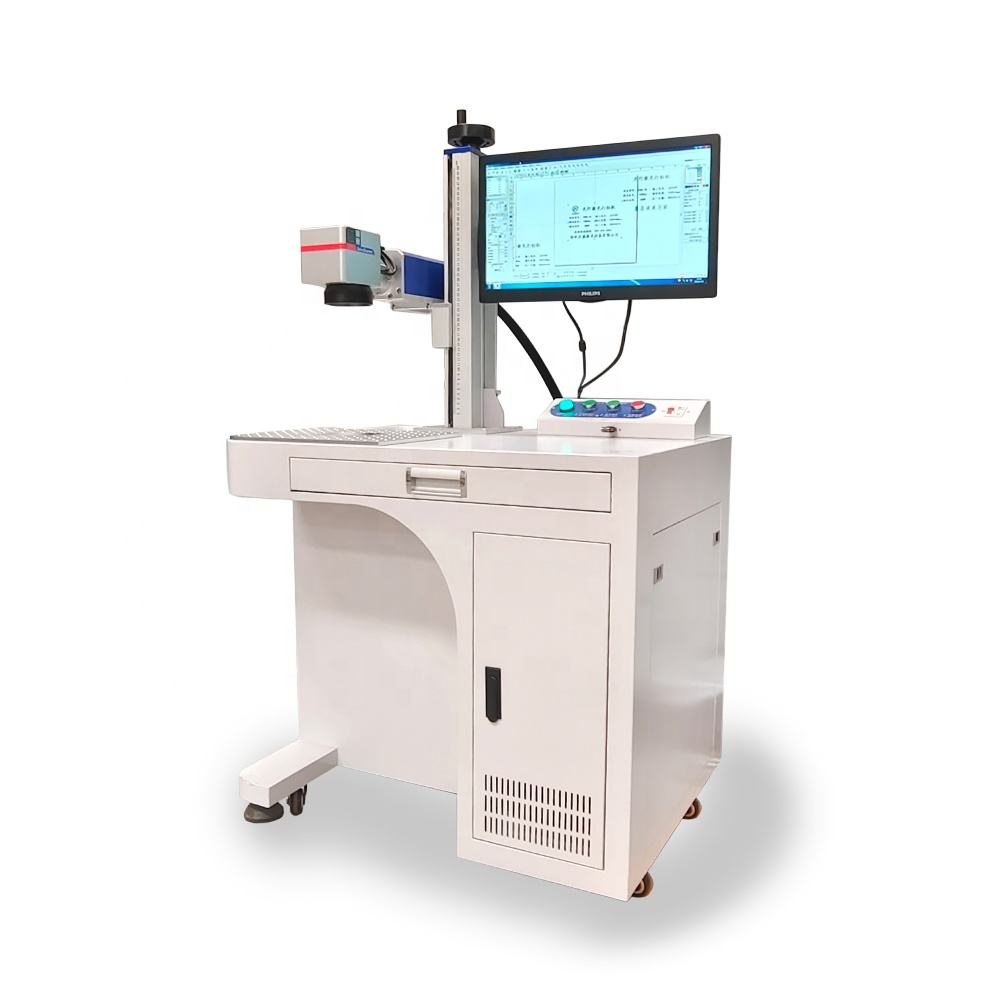
50W Fiber laser marking machine
Why Use a Fiber Laser for Metal Tags?
Fiber lasers are well suited to common metal tag materials such as:
- Stainless steel
- Aluminum
- Brass
- Steel
- Titanium
They offer several advantages.
Non-Contact Processing
There is no cutting tool physically touching the tag.
High Precision
Small text, logos, serial numbers, and machine-readable codes can be processed with high positional accuracy.
Digital Operation
The marking content can be changed directly through software.
No Engraving Tool Wear
There is no mechanical cutting bit that needs to be replaced because of normal tool wear.
Fast Processing
For many identification applications, laser marking can process tags quickly.
Easy Automation
Perhaps most importantly for industrial production, laser systems can be integrated with:
- Automatic feeders
- Positioning systems
- Sensors
- PLC controls
- Barcode readers
- Production lines
This makes laser technology particularly attractive when metal tag production needs to move from manual operation toward automation.
What Information Can Be Marked on Metal Tags?
A modern metal tag laser marking machine can process much more than simple text.Common content includes:
- Company logos
- Product names
- Model numbers
- Serial numbers
- QR codes
- Barcodes
- Data Matrix codes
- Asset numbers
- Production dates
- Batch numbers
- Technical specifications
One of the most important capabilities for industrial applications is variable data marking.Instead of producing 1,000 identical tags, the machine can mark 1,000 tags with different serial numbers.For example:
| Tag | Serial Number | QR Code |
|---|---|---|
| 001 | SN000001 | QR-001 |
| 002 | SN000002 | QR-002 |
| 003 | SN000003 | QR-003 |
| 004 | SN000004 | QR-004 |
This capability becomes especially important when laser marking is integrated into an automated production system.
Manual Metal Tag Engraving vs. Automatic Production
For small production volumes, a standard manual laser marking machine may be sufficient.The operator can manually perform:
Pick Tag → Position Tag → Mark → Remove Tag
This approach provides flexibility and is suitable when:
- Production volume is low
- Tag sizes change frequently
- Products are highly customized
- The operator needs to inspect every piece
However, when hundreds or thousands of tags need to be processed every day, repetitive manual handling can become a bottleneck.The operator must repeatedly:
- Pick up each tag
- Position it
- Start the marking process
- Remove the finished tag
- Load the next one
This is where automation becomes valuable.
Automatic Metal Tag Engraving Machine
A fully automated metal tag laser marking system can combine material handling, positioning, laser processing, and unloading into one workflow.A typical system can operate as:
Feeding → Picking → Positioning → Laser Marking → Returning / Unloading → Next Tag
Instead of manually positioning every tag, the operator only needs to place the tags in the designated loading area.The machine can then automatically perform the subsequent operations.
Automatic Feeding
The system can be designed according to the shape, thickness, and quantity of the metal tags.Depending on the application, the feeding mechanism may use a customized structure to separate and transfer individual tags.The exact mechanism should be designed around the actual tag rather than assuming that one feeder works for every type of metal plate.
Automatic Picking
After feeding, the system can automatically pick up the metal tag and transfer it to the marking position.This can reduce repetitive manual handling and improve production consistency.
Automatic Positioning
Correct positioning is critical for laser marking.The system can use mechanical fixtures, sensors, or other positioning methods to ensure that the tag is correctly located before marking.For products with strict positioning requirements, customized fixtures can be designed according to the exact tag geometry.
Automatic Laser Marking
Once the tag is positioned, the laser system performs the programmed marking task.Depending on the application, this may include:
- Text
- Logo
- Serial number
- QR code
- Barcode
- Data Matrix
- Variable production information
The marking content can also be changed automatically according to the production data.
Automatic Return or Unloading
After marking is complete, the system can automatically move the finished tag to the designated collection position.The complete process can therefore become:
Raw Tags → Automatic Feeding → Automatic Positioning → Laser Marking → Finished Tags
The operator does not need to manually handle every individual tag.
How Does an Automated Metal Tag Marking System Work?
A typical customized system can be organized around the following workflow:
Step 1 — Load the Tags
The operator places the unmarked metal tags in the designated loading area.
Step 2 — Automatic Pick-Up
The machine transfers individual tags into the processing position.
Step 3 — Automatic Positioning
The tag is aligned according to the programmed marking coordinates.
Step 4 — Laser Marking
The fiber laser marks the required information.
Step 5 — Data Update
If variable data is required, the next marking file or serial number can be loaded automatically.
Step 6 — Automatic Return or Unloading
The finished tag is moved to the collection area.
Step 7 — Repeat
The system continues processing the next tag.
This significantly reduces repetitive manual operations.
Automated Variable Data Marking
For high-volume production, automation is not only about moving the metal tag.The marking information itself can also be automated.For example, a manufacturer may need to produce 5,000 metal asset tags, with every tag carrying a different identification number.Instead of manually changing the text for every tag, the production system can use predefined data.The workflow can become:
Tag #001 → SN000001
Tag #002 → SN000002
Tag #003 → SN000003
and so on.
Depending on the project requirements, the system can be designed to work with external data sources or factory control systems.Potential integration options may include:
- Barcode scanners
- QR code readers
- PLC systems
- Databases
- MES systems
- Production-line control systems
The exact integration method depends on the customer’s existing production environment.
Fully Automatic Metal Tag Engraving from ZS Machinery
At ZS Machinery, we do not limit metal tag applications to standard desktop or manual laser marking machines.With more than ten years of experience in laser marking equipment and customized projects, we can develop automated laser marking systems according to the customer’s actual production requirements.The automation level can be designed around:
- Metal tag dimensions
- Tag thickness
- Tag shape
- Material
- Marking content
- Production volume
- Loading method
- Factory layout
- Required cycle time
For a suitable application, the system can combine:
Automatic Feeding
↓
Automatic Picking
↓
Automatic Positioning
↓
Laser Marking
↓
Automatic Returning / Unloading
The operator simply places the unprocessed metal tags in the designated loading position.And the machine then automatically completes the subsequent marking process.This approach is particularly useful for manufacturers that need to process large quantities of standardized metal tags.
When Should You Automate Metal Tag Engraving?
Automation is not necessarily required for every customer.A standard manual laser marking machine may be the better choice when:
- Production volume is small
- Tag designs change frequently
- Products are highly customized
- Operators already perform other inspection tasks
Automation becomes more attractive when:
- Production volume is high
- The tag dimensions are relatively standardized
- The same process is repeated continuously
- Labor costs are significant
- Consistent positioning is important
- Variable data needs to be generated automatically
- The customer wants to integrate marking into a production line
In other words, automation should be evaluated based on production economics and process requirements, not simply because an automated machine appears more advanced.
How to Choose a Metal Tag Engraving Machine
Before selecting a machine, consider the following factors.
1. Metal Material
Different metals have different laser absorption characteristics.The machine should be tested on the actual material.
2. Tag Size
The required marking area determines the appropriate optical configuration and working field.
3. Tag Thickness
Thickness is particularly important when deep engraving or mechanical processing is required.
4. Marking Content
Determine whether you need:
- Text
- Logo
- Serial number
- QR code
- Barcode
- Data Matrix
5. Required Depth
If you only need identification information, laser marking may be sufficient.If you need physical material removal, a deeper engraving configuration may be more appropriate.
6. Production Volume
A few dozen tags per day may not justify complex automation.
Thousands of tags per day may make automatic feeding and positioning much more attractive.
7. Variable Data
If every tag has different information, make sure the control system can support the required data workflow.
8. Future Production
If production volume is expected to increase, it may be worth considering an automation-ready machine from the beginning.
Final Thoughts
A metal tag engraving machine can be used for much more than traditional nameplate engraving. Metal tags are used for equipment identification, asset management, product traceability, serial numbers, electrical information, and many other industrial applications.
Mechanical engraving, dot peen marking, chemical etching, and laser processing all have their own advantages. However, for manufacturers looking for high precision, digital control, fast design changes, permanent identification, and automation, fiber laser technology offers a particularly flexible solution.
If you are producing metal nameplates, asset tags, equipment tags, serial number plates, or other metal identification tags, the best machine depends on your material, tag dimensions, marking requirements, production volume, and desired level of automation. ZS Machinery can evaluate these requirements and develop a laser marking solution around your actual production process rather than simply supplying a standard machine.
Plastic Label Engraving Machine: How to Mark and Engrave Plastic Labels