CNC Laser Marking Machine: When Do You Really Need One?
A CNC laser marking machine is designed for applications where laser marking requires more than simply scanning a small fixed area with a galvanometer.For standard products such as metal parts, nameplates, tools, and electronic components, a conventional galvo laser marking machine is often the better choice. It is compact, fast, and well suited to marking QR codes, serial numbers, logos, and other identification information.
However, when the workpiece becomes larger, the marking positions become more complicated, or the customer needs accurate movement between multiple locations, a mechanical CNC system can provide much greater flexibility.This raises an important question:
When do you actually need a CNC laser marking machine instead of a conventional galvo laser marker?
The answer depends mainly on the size of the workpiece, the number and location of marking areas, positioning requirements, three-dimensional movement, rotary marking, and the level of automation required.
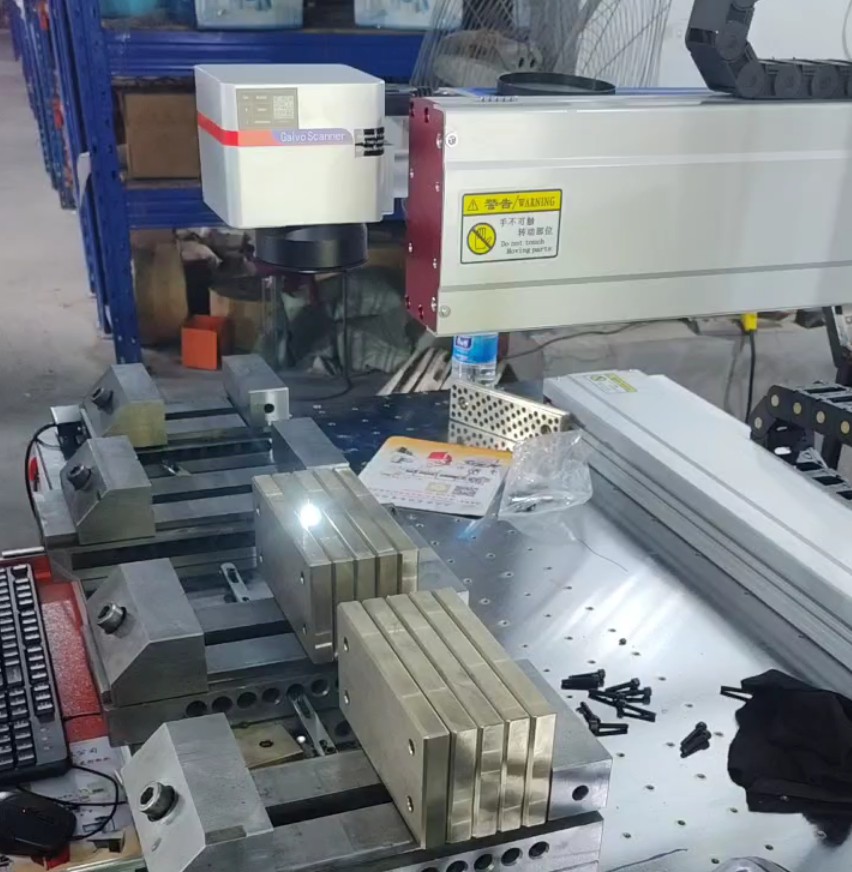
CNC Laser Marking on stainless steel
What Is a CNC Laser Marking Machine?
CNC stands for Computer Numerical Control. In a CNC laser marking machine, a computer controls mechanical motion axes such as X, Y, Z, or A according to programmed coordinates.The laser itself may still use a galvanometer scanning system. The difference is that the machine has additional mechanical movement for positioning the laser or workpiece.A typical CNC laser marking system may include:
- Fiber, UV, or CO₂ laser source
- Galvanometer scanning head
- X/Y mechanical axes
- Z-axis for height adjustment
- Rotary axis for cylindrical workpieces
- CNC motion controller
- Industrial computer
- Positioning or fixture system
- Optional vision system
- Optional automatic loading and unloading
This means that CNC and galvo are not necessarily competing technologies.They can work together.The mechanical CNC axes can move the laser system to the correct location, while the galvanometer performs high-speed laser scanning within that local marking area.This combination is particularly useful for large workpieces and automated marking applications.
CNC Does Not Simply Mean “Computer-Controlled”
One common misunderstanding is that any laser marking machine controlled by a computer can be called a CNC laser marking machine.This is not technically accurate.
Almost all modern laser marking machines are computer-controlled. A standard galvo fiber laser marker, for example, uses software and a computer to control the laser, marking pattern, speed, power, and other parameters.However, a CNC system specifically refers to computer-controlled mechanical movement.
For example, a conventional galvo marker may work like this:Computer → Control Card → Galvanometer → Laser BeamThe galvanometer mirrors move the laser beam across the marking field without mechanically moving the laser head.
A CNC laser marking system adds mechanical movement:Computer → CNC Controller → X/Y/Z/A Motion → Laser PositioningThe laser can therefore reach different physical locations on a large workpiece.This distinction is important when choosing equipment.
Galvo Laser Marking Machine vs CNC Laser Marking Machine
For many applications, a conventional galvo laser marker is actually the better solution.Galvo systems use high-speed scanning mirrors to move the laser beam across a defined marking field. Common marking areas include 70 × 70 mm, 110 × 110 mm, 175 × 175 mm, 200 × 200 mm, or larger fields depending on the optical configuration.They are especially suitable for:
- QR codes
- Barcodes
- Serial numbers
- Product logos
- Part numbers
- Date codes
- Small graphics
- Metal nameplates
- Electronic components
- Jewelry
- Small and medium-sized metal parts
The main advantage is speed.If the customer has thousands of small parts and only needs to mark one QR code on each part, adding CNC mechanical axes may not provide any benefit.A standard galvo machine can often complete the job more simply and efficiently.A CNC system becomes more useful when the laser needs to move between different physical areas or positions.
A Simple Comparison
| Requirement | Galvo Laser Marker | CNC Laser Marking Machine |
|---|---|---|
| Small workpieces | Excellent | Suitable |
| Small marking area | Excellent | Suitable |
| High-speed marking | Excellent | Suitable |
| QR codes and serial numbers | Excellent | Excellent |
| Large workpieces | Limited | Excellent |
| Multiple marking positions | Limited | Excellent |
| Coordinate-based positioning | Limited | Excellent |
| X/Y mechanical movement | No | Yes |
| Z-axis movement | Optional | Common |
| Rotary axis | Optional | Easy to integrate |
| Large pipes and shafts | Limited | Excellent |
| Automatic positioning | Possible | Excellent |
| Complex automation | Limited | Excellent |
The important point is that CNC is not automatically better than galvo.It is better when the application requires mechanical movement and positioning.
When Do You Really Need A CNC Laser Marking Machine?
1. When the Workpiece Is Too Large for the Galvo Field
This is one of the most common reasons to use a CNC laser marking machine.Imagine a manufacture needs to mark a 1,000 × 500 mm steel plate.A conventional galvo system may have a 150 × 150 mm or 300 × 300 mm marking field.The laser can mark within that field, but it cannot directly reach every position on the entire steel plate.A CNC system can solve this problem.
The mechanical X/Y axes move the laser system to different areas of the workpiece. Once the laser reaches the required position, the galvanometer can perform high-speed marking within that local area.For example:
Move to Position A → Mark → Move to Position B → Mark → Move to Position C → MarkThis allows a relatively small laser scanning field to be used across a much larger workpiece.
Typical applications include:
- Large steel plates
- Steel structures
- Large machinery
- Construction components
- Large molds
- Heavy industrial parts
- Long metal profiles
- Large fabricated components
2. One Workpiece Has Multiple Marking Positions
This is another situation,the workpiece does not necessarily have to be extremely large.Sometimes the problem is simply that one product needs to be marked in several different locations.For example, a large mechanical component may require:
- Product model on one side
- Serial number near a mounting hole
- QR code on another surface
- Company logo in a designated area
With a standard galvo machine, the operator may need to reposition the workpiece manually.With CNC movement, the machine can use programmed coordinates.The system can automatically:
- Move to the first position.
- Mark the required information.
- Move to the second position.
- Mark the second area.
- Continue to other positions.
- Return to the starting position.
This can make production more consistent and reduce manual positioning.
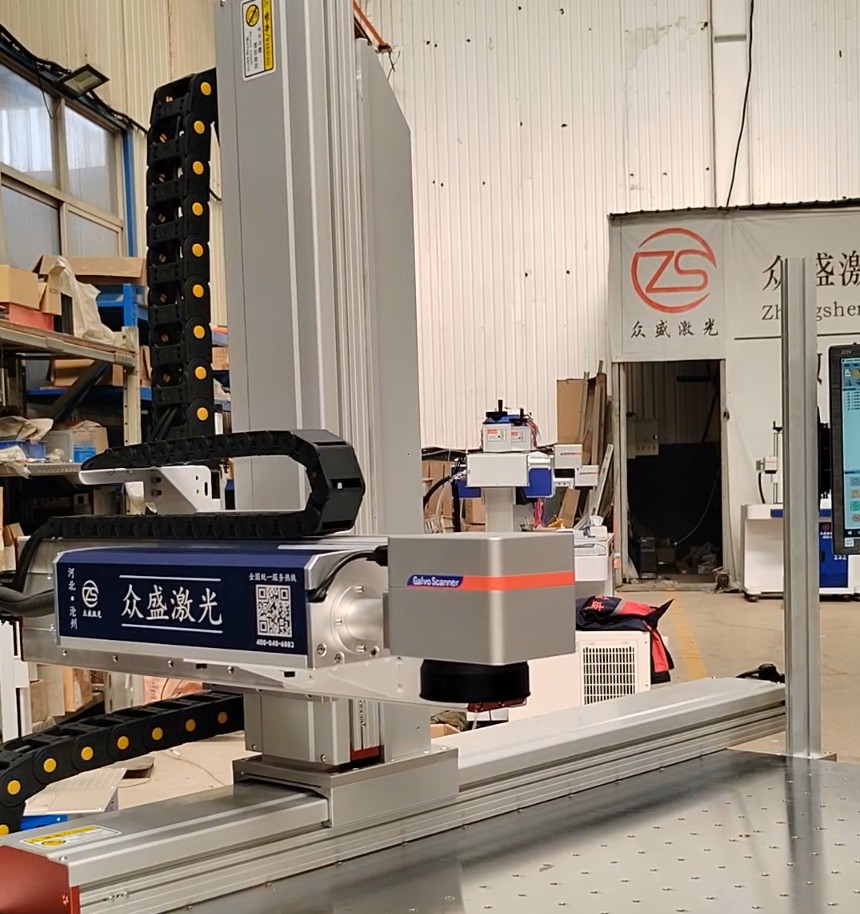
CNC Laser Marking
3. Accurate Coordinate Positioning Is Important
Another advantage of CNC is coordinate-based positioning.Suppose a customer requires a mark to be placed exactly 350 mm from the edge of a metal component.Or perhaps a part contains several holes, and the laser must mark a serial number next to each hole.
In this situation, the challenge is not simply the size of the marking area.The machine needs to know where the laser should physically move.CNC axes can provide programmed positioning based on machine coordinates.This is especially useful when the marking position is an important part of the manufacturing process.For repeated production, the machine can return to the same programmed coordinates for every workpiece.
4. When Different Workpiece Heights Require Z-Axis Movement
A standard galvo marking machine generally works within a defined focal range.If the surface height changes significantly, the laser may need to be refocused.A CNC laser marking system can include a motorized Z-axis.The Z-axis can move the laser head or optical system to different heights according to the programmed position.This is useful for:
- Large mechanical components
- Molds
- Automotive parts
- Irregular metal structures
- Components with different surface heights
For more complex applications, X, Y, and Z movement can be combined with a galvo scanner.The CNC axes handle positioning and height, while the galvo handles fast laser scanning.
5. When You Need Rotary Laser Marking on Large Cylindrical Parts
Cylindrical workpieces create another common requirement.Examples include:
- Pipes
- Shafts
- Rollers
- Cylindrical mechanical parts
- Large rings
- Flanges
- Tubes
A rotary axis can rotate the workpiece while the laser marks its surface.For a simple small ring, a standard rotary attachment on a galvo marking machine may be enough.For larger or more complex cylindrical components, a CNC-controlled rotary axis can provide more flexibility.The machine can coordinate:X/Y positioning + Z height adjustment + A-axis rotation + laser scanning.This allows marking around the circumference of a cylindrical part without manually repositioning it.
6. When You Need Automation
CNC becomes even more valuable when laser marking is part of an automated production process.Instead of asking an operator to place each part manually under the laser, a customized CNC laser marking system can be integrated with other equipment.A typical process may look like:
Loading → Positioning → CNC Movement → Laser Marking → Inspection → UnloadingDepending on the production requirements, the system can also integrate:
- Automatic loading
- Automatic unloading
- Pneumatic fixtures
- Electric fixtures
- Vision positioning
- Barcode reading
- QR code reading
- OCR
- Mark verification
- Conveyor systems
- Production-line communication
For example, an operator could place multiple workpieces in a defined loading area.The system then identifies their positions, moves to each part, completes the marking process, and performs inspection automatically.This is very different from simply buying a desktop laser marking machine.The laser becomes one part of a complete production system.
Does a Larger Marking Area Always Require CNC?
Not necessarily.
This is another important point when choosing a machine.A larger optical marking field can sometimes be achieved by selecting a different field lens.For example, a customer may move from a 110 × 110 mm field to 200 × 200 mm or 300 × 300 mm.However, increasing the optical field does not mean that the machine can automatically mark an unlimited area.There are trade-offs involving:
- Optical design
- Spot size
- Marking resolution
- Laser power density
- Working distance
- Lens selection
- Marking quality
If the required area is still within a practical galvo field, a standard galvo system may be sufficient.
If the workpiece extends far beyond that field and requires marking at many physical locations, mechanical CNC movement becomes more practical.
What Materials Can Be Marked With a CNC Laser Marking Machine?
The material capability depends primarily on the selected laser source and application.Fiber lasers are widely used for metals such as:
- Stainless steel
- Carbon steel
- Aluminum
- Brass
- Copper
- Titanium
- Alloy steel
Depending on the laser configuration and application, fiber lasers can perform surface marking, engraving, deeper engraving, and some light cutting or material removal.
UV and CO₂ laser systems may be selected for different material requirements, particularly when non-metallic materials are involved.Therefore, CNC describes the movement system, not the laser wavelength.A CNC laser marking machine can be built around different laser technologies depending on the customer’s application.
How Do You Know If You Actually Need CNC?
A simple way to evaluate the requirement is to ask the following questions:
Is the workpiece small and the marking area fixed?
If yes, a standard galvo laser marking machine is usually sufficient.
Is the workpiece much larger than the galvo marking field?
If yes, consider a CNC system.
Does one workpiece require marking in many different locations?
If yes, CNC movement can provide significant advantages.
Does the laser need to move to programmed coordinates?
If yes, CNC is worth considering.
Does the workpiece have large height differences?
If yes, a CNC Z-axis may be useful.
Does the workpiece need controlled rotation?
Consider a CNC rotary axis.
Does the customer want automatic loading, marking, inspection, and unloading?
A customized CNC laser marking system may be the better solution.
When a Standard Galvo Laser Marking Machine Is Better
CNC should not be added simply because it sounds more advanced.For many marking applications, it creates unnecessary complexity and cost.A standard galvo fiber laser is often the better option when:
- The workpiece is relatively small.
- The marking position is fixed.
- The marking area fits within the selected lens field.
- High marking speed is the main priority.
- The operator can easily position the workpiece.
- There is no requirement for large mechanical travel.
- No complex automation is required.
For example, if a factory produces 10,000 stainless steel parts per month and only needs to mark a QR code and serial number in the same location, a conventional galvo fiber laser marking machine can be an efficient solution.There is no need to turn a simple marking application into a complex CNC system.
Custom CNC Laser Marking Solutions From ZS Machinery
Not every CNC laser marking application requires the same configuration.The ideal system depends on the customer’s workpiece and production process.At ZS Machinery, we can develop customized laser marking systems according to the workpiece size, marking locations, material, production volume, positioning requirements, and automation level.
Depending on the application, a system can be configured with:
- Fiber, UV, or CO₂ laser sources
- Galvanometer scanning
- CNC X/Y/Z axes
- Rotary axes
- Customized fixtures
- Vision positioning
- Automatic loading and unloading
- QR/barcode integration
- Mark inspection
- Production-line integration
For large or unusual workpieces, we can also evaluate the marking process and recommend whether a standard galvo machine, a CNC system, or a CNC + Galvo configuration is the most practical solution.The goal is not simply to use more axes.
The goal is to choose the simplest laser marking system that can reliably complete the required production process.
Laser Marking and Cutting Machine: Can a Laser Marker Really Cut Metal?