Color Laser Engraving on Metal: How Laser Parameters Create Different Colors
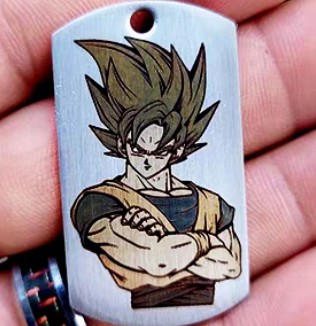
Color laser engraving on metal is becoming increasingly popular for jewelry, decorative products, consumer goods, nameplates, and premium industrial components. Unlike conventional printing or coating, laser color marking can create visual effects directly on the metal surface without adding ink or paint.
But how does a laser actually create different colors?
The answer is more interesting than simply changing the laser power. Different colors are produced by controlling the interaction between the laser pulse and the metal surface. Parameters such as pulse width, power, speed, frequency, hatch spacing, and focus all influence the final result.For applications where color quality and parameter flexibility are important, MOPA fiber lasers are widely used because their pulse characteristics can be adjusted over a relatively broad range.
This guide explains how color laser engraving on metal works, how different colors are produced, how multi-color designs are processed, and how to develop reliable laser parameters for stainless steel and other metals.
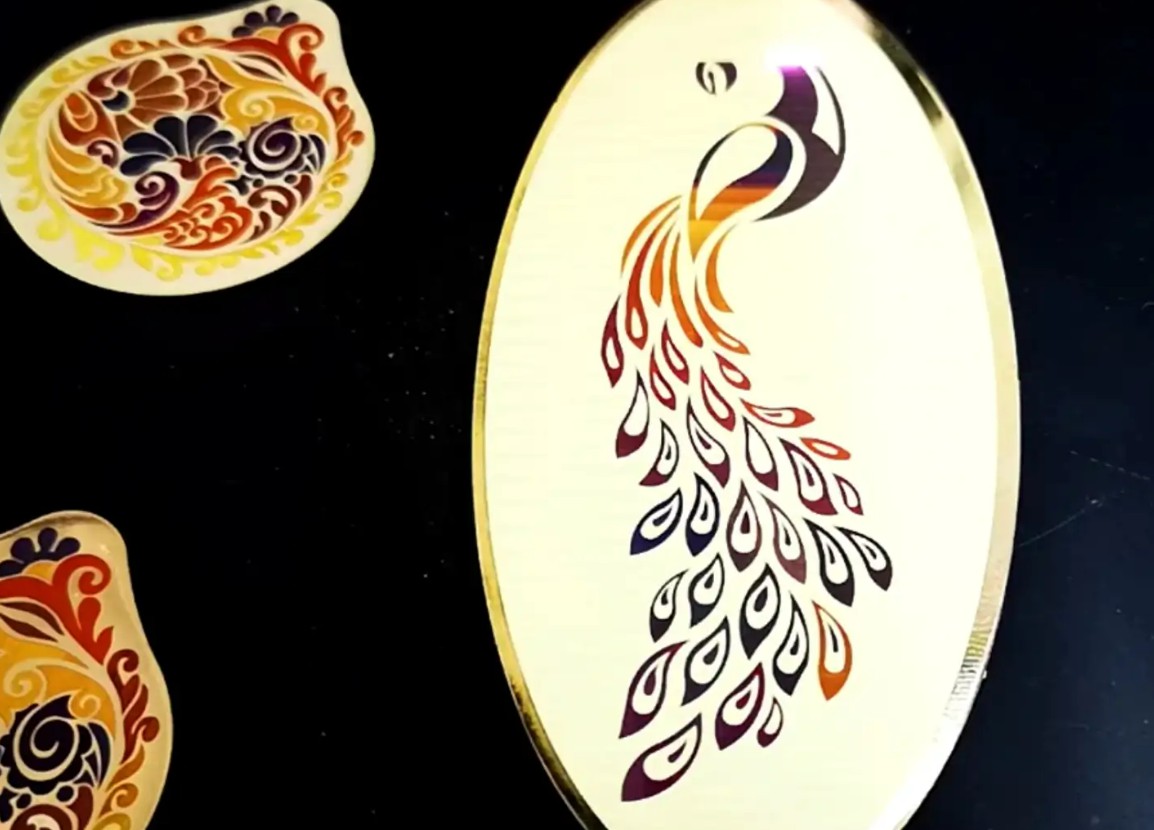
Laser-etched iridescent effects on stainless steel
How Does Color Laser Engraving on Metal Work?
The laser does not normally generate colored light and “paint” the metal.Instead, color is produced by changing the condition of the metal surface.
When a laser beam interacts with a metal such as stainless steel, the energy can create a controlled thermal effect on the surface. Under suitable conditions, a very thin surface layer can form or change. The optical properties of this layer affect how light is reflected from the surface.As a result, the surface can appear in different colors.
A simplified process can be understood as:
Laser parameters → thermal interaction → surface layer → light reflection/interference → visible color
This is why color marking requires much more precise parameter control than ordinary black marking.If the laser energy is too low, the desired surface effect may not develop properly. If the energy is too high, the process may move toward material removal or excessive heating, producing a completely different appearance.The goal is therefore not simply to use more power. The goal is to find a suitable processing window.
Why MOPA Fiber Lasers Are Popular for Metal Color Marking
A standard fiber laser can perform many metal marking applications, but MOPA fiber lasers provide additional control over pulse characteristics.One of the most important advantages is adjustable pulse width.Different pulse widths can produce different thermal responses on the same metal surface. Combined with changes in marking speed, power, frequency, and other parameters, this gives the operator a much larger parameter space for developing different colors.This is particularly useful for stainless steel color marking.
A MOPA fiber laser can also be used for many applications beyond color marking, including:
- Black marking
- Surface annealing
- Metal engraving
- Deep engraving
- Logo marking
- QR code marking
- Serial number marking
- Fine graphic processing
Therefore, a MOPA system can be useful when color marking is one application among several rather than the only requirement.
Which Laser Parameters Affect Metal Color?
There is no single parameter that determines the final color.In practical applications, several parameters interact with each other.
1. Pulse Width
Pulse width is one of the most important variables when working with MOPA lasers.Changing the pulse width changes how the laser energy is delivered to the material. This can significantly affect the surface reaction and therefore the resulting color.For this reason, a MOPA color-marking test often starts by evaluating different pulse-width ranges.
2. Laser Power
Power controls the amount of laser energy available during processing.Increasing power can increase the thermal effect, but more power does not necessarily produce a better color.If the energy becomes excessive, the surface may become darker, rougher, or begin to experience material removal.
3. Marking Speed
Marking speed affects how long the laser interacts with a particular area.A slower speed generally delivers more energy per unit length, while a faster speed reduces the energy delivered to each point.This makes speed an important variable when fine-tuning color.
4. Frequency
Frequency controls the pulse repetition rate.Together with pulse width, power, and scanning speed, frequency affects the distribution of energy across the surface.Changing frequency can therefore alter both the appearance and consistency of the mark.
5. Hatch Spacing
When filling an area rather than marking a simple line, hatch spacing becomes important.A smaller hatch distance increases the number of scan lines and changes the amount of energy delivered to the surface.Incorrect hatch spacing can result in:
- Uneven color
- Visible scan lines
- Excessive heating
- Inconsistent surface appearance
6. Focus and Defocus
Focus determines the concentration of the laser beam.For certain color-marking applications, controlled defocusing can be useful because it changes the energy density and spot characteristics on the metal surface.However, the appropriate focus condition depends heavily on the laser source, lens, material, and desired result.
7. Number of Passes
Some applications can be completed in a single pass, while others may require multiple passes.Additional passes change the accumulated thermal effect, so they can also change the appearance of the color.For color marking, however, more passes are not automatically better.
How Do You Find the Right Parameters for a Color?
This is where practical laser engineering becomes more important than simply copying a parameter table from the internet.There is no universal parameter setting for every stainless steel product.Even two stainless steel parts that are both described as “304 stainless steel” may produce different results because of differences in:
- Surface finish
- Polishing
- Material composition
- Surface roughness
- Heat treatment
- Material supplier
- Laser source
- Optical lens
- Spot size
Therefore, professional color laser marking usually relies on sample testing and parameter development.
Building a Color Parameter Test Matrix
Instead of immediately trying to find a single “blue parameter” or “red parameter,” you can create a parameter test matrix.For example, a test can keep the following conditions fixed:
- Laser source
- Marking lens
- Material
- Focus position
- Hatch spacing
- Graphic
- Filling method
Then gradually change one or more processing parameters.For example:
| Parameter | Example Test Direction |
|---|---|
| Pulse Width | Multiple pulse-width values |
| Speed | Low → Medium → High |
| Power | Low → Medium → High |
| Frequency | Several frequency ranges |
| Hatch | Several spacing values |
| Defocus | Focus → Controlled defocus |
| Passes | 1 → 2 → Multiple passes |
The resulting samples can then be compared for:
- Color
- Brightness
- Uniformity
- Surface texture
- Contrast
- Heat effect
- Repeatability
The objective is to find a stable parameter window, rather than one setting that happens to produce a color once.
How Does One Laser Create Multiple Colors in the Same Design?
This is one of the most common questions about color laser marking.Suppose a stainless steel product contains:
- Blue text
- Purple graphics
- Gold-colored lines
- Red decorative elements
The laser does not need to physically change the “color” of the laser beam.Instead, the design can be divided into different objects, areas, or layers.Each area is assigned its own laser parameter set.For example:
| Design Area | Target Color | Parameter Set |
|---|---|---|
| Logo | Blue | Set A |
| Text | Purple | Set B |
| Border | Gold | Set C |
| Graphic | Red | Set D |
The marking software then processes these objects according to their assigned parameters.In simplified form:
Design object → Parameter set → Laser processing → Surface color
This is fundamentally different from inkjet or digital color printing.The laser itself remains the same laser source. The surface response is changed through processing parameters.
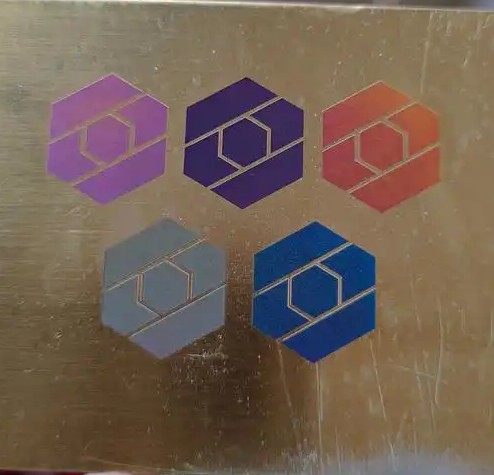
Color laser engraving on stainless steel
Can Laser Marking Create Gradient Colors?
Yes, but creating a visual gradient is more complicated than producing several separate colors.A gradient can be created by gradually changing the processing conditions across different areas of the design.
For example, one section may use parameters that produce blue, while adjacent sections use slightly different settings that shift the appearance toward purple and then another color.The design can therefore contain many small processing regions, each with slightly different parameters.When viewed together, these regions can create a visually smooth color transition.
This means complex color artwork requires not only a suitable MOPA laser but also good control of:
- Graphic segmentation
- Object parameters
- Scan strategy
- Filling method
- Processing sequence
For this reason, software control and parameter management can be just as important as laser power for advanced color applications.
Which Metals Are Suitable for Color Laser Engraving?
Stainless steel is one of the most common materials for laser color marking.Other metals can also be evaluated, but the results depend strongly on the material and surface condition.
Stainless Steel
One of the most established materials for laser color marking.Common applications include:
- Jewelry
- Watches
- Kitchenware
- Metal bottles
- Nameplates
- Tools
- Decorative components
- Consumer products
Titanium
Titanium is another important material for color laser processing.Applications include:
- Titanium jewelry
- Medical components
- Bicycle parts
- Premium consumer products
- Specialized industrial components
Aluminum
Color results depend strongly on the surface treatment. Anodized aluminum, for example, behaves differently from untreated aluminum.However, the final color is usually black or gray; it cannot be achieved with color.
What Laser Power Is Best for Color Laser Engraving?
Higher laser power does not automatically mean better color quality.For small decorative products, jewelry, and fine stainless steel marking, a 20W or 30W MOPA fiber laser may provide sufficient processing capability.For higher production volumes or applications that also require deeper engraving, a 50W MOPA fiber laser can provide additional processing capacity.
A simplified selection can be:
| Laser Power | Typical Positioning |
|---|---|
| 20W MOPA | Fine color marking and small products |
| 30W MOPA | Color marking with higher production efficiency |
| 50W MOPA | Color marking + stronger engraving capability |
The actual selection should consider the material, marking area, required color effect, production volume, and whether deep engraving is also required.
Why Parameter Development Matters More Than Power
A common mistake is to focus only on laser power when purchasing a color laser marking machine.For example, a 50W laser does not automatically produce better colors than a 20W laser.Color marking is highly dependent on the relationship between:
Pulse width + power + speed + frequency + hatch + focus + material
A machine with a highly adjustable MOPA laser and properly developed parameters may produce better and more repeatable results than a higher-power machine with limited parameter control.This is particularly important for businesses producing decorative products or products where color consistency is part of the finished-product quality.
Practical Example: Developing Color Parameters for Stainless Steel
For a customer who wants to produce multi-color stainless steel products, a practical development process could look like this:
Step 1 — Identify the material
Confirm the stainless steel grade and surface treatment.
Step 2 — Select the laser
Choose a suitable MOPA fiber laser according to the application.
Step 3 — Fix the optical configuration
Select the marking lens and establish the appropriate focus condition.
Step 4 — Build a parameter test
Test different combinations of pulse width, speed, power, and frequency.
Step 5 — Record the results
Create a color reference library based on actual samples.
Step 6 — Process the customer’s design
Assign different parameter sets to different design objects.
Step 7 — Verify repeatability
Run multiple samples to make sure the color can be reproduced consistently.
This process is much more reliable than simply downloading a parameter table and expecting the same result on another machine.
100W MOPA Fiber Laser Color Marking Stainless Steel
Applications of Color Laser Engraving on Metal
Color laser marking can be used where both permanent identification and visual appearance are important.Typical applications include:
Jewelry
Colorful logos, patterns, names, dates, and decorative designs on stainless steel or titanium jewelry.
Watches
Decorative markings and personalized designs on stainless steel watch components.
Metal Bottles and Kitchenware
Brand logos, decorative graphics, and personalized designs.
Nameplates and Tags
Color logos and identification information can be combined on the same metal tag.
Tools and Hardware
Branding, product identification, and decorative elements.
Medical and Titanium Products
Color marking can provide visual differentiation while maintaining a precise marking process.
Choosing a Color Laser Engraving Machine
If your main requirement is color laser engraving on metal, a MOPA fiber laser is usually a strong starting point because of its adjustable pulse characteristics and flexibility in parameter development.When evaluating a machine, do not look only at laser power. Consider:
- Laser source type
- MOPA pulse-width range
- Marking lens
- Spot size
- Galvo scanning system
- Software capabilities
- Parameter control
- Rotary axis compatibility
- Sample testing support
- After-sales technical support
For small products such as jewelry, a small marking field and rotary axis can also be valuable.For example, a rotary axis can allow cylindrical products to be rotated during processing, making it possible to apply color designs around rings, tubes, cups, and other round components.
Color Laser Engraving with ZS Machinery
At ZS Machinery, we have worked with customers on a wide range of metal laser marking applications, including stainless steel color marking, titanium marking, jewelry processing, decorative marking, and industrial identification.
Through these projects, we have found that successful color laser marking is rarely about simply selecting a higher-power laser. Material condition, optical configuration, laser parameters, and application requirements all need to be considered together.
For customers who require a specific color or multi-color design, we recommend sample testing before finalizing the machine configuration. Our team can evaluate the material and application requirements and help develop a suitable MOPA fiber laser solution based on the desired color effect, marking speed, engraving depth, and production volume.
The goal is not simply to make a laser mark.It is to develop a repeatable and practical laser process that can consistently produce the required result in production.Contact ZS Machinery today to get your own color laser engraving on metal solutions.
CNC Laser Marking Machine: When Do You Really Need One?